Experts split on global warming, highland malaria link

Nov 28, 2010 by Boris Bachorz
Women wash clothes in a river formed by the melting snow of the Rwenzori mountains near Bundibugyo in western Uganda on May 2009. Malaria cases in east African highland areas hitherto unaffected by the disease have caused worry that global warming is creating new mosquito breeding grounds but experts disagree on whether there is actually any link between the two.

Malaria cases in east African highland areas hitherto unaffected by the disease have caused worry that global warming is creating new mosquito breeding grounds but experts disagree on whether there is actually any link between the two.

"We have recently seen waves of epidemics in highland areas. ... They have actually killed people," said Dr. Amos Odiit, who was until October head of clinical paediatrics at Mulago hospital in the Ugandan capital Kampala.

The first cases of in Uganda's western Kabale region, which rises 2,000 metres above sea level, were reported in 2007, said Seraphine Adibaku, the head of the national programme against malaria.

"It is . Kabale is not as cold as before," she added.

Climatologists say Africa has become warmer by 0.7 degrees Celsius over a century, favouring the spread of malaria as mosquitoes that carry the parasite thrive in warmer climes and cannot survive in temperatures below 15 degrees.

However, linking and increase in malaria has remained one of the most contested debates of the effects of climate change.

For Kenyan doctor Andrew Githeko, who leads a research project into climate change and human health, the relationship between the two phenomena is clear.

"There is a very direct link between malaria and climate. As climate changes further, more areas will become suitable for transmission" of the malaria parasite, argued Githeko.
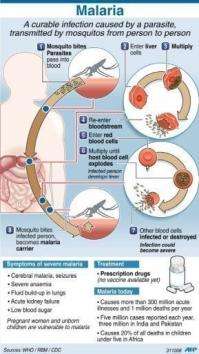
Graphic factfile on malaria. Malaria cases in east African highland areas hitherto unaffected by the disease have caused worry that global warming is creating new mosquito breeding grounds but experts disagree on whether there is actually any link between the two.

Citing his research at Tumutumu hospital in central Kenya, a region that stands 1,768 metres above the sea, Githeko says average temperatures there have risen and remained above 18 degrees and malaria infections have increased.

But the theory is just a juxtaposition according to other experts who explain that the spread of malaria is determined by the effectiveness of public health interventions and a country's state of economic development.

Contrary to the theory that malaria has increased due to rising global temparatures, the disease has not spread any further than it had in the past century, said Simon Hay of Oxford University.

"Our study shows clearly there has been no expansion of malaria in the last 100 years," he said, referring to a recent research entitled "Malaria Atlas Project."

"It has systematically retreated from the temperate regions to the tropics," he added.

"The success or failure of our efforts against the parasite in the coming century are likely to be determined by factors other than climate change."

Many researchers however seem to agree that while there is a theoretical relationship between climate change and rising malaria infections, this trend can be curbed by robust public health drives.

Ninety-one percent of the 881,000 malaria deaths every year occur in Africa, but Rwanda, Sao Tome and Eritrea have slashed deaths by 50 percent between 2000 and 2006 through distribution of medicines and bed nets, according to Roll Back Malaria, a global coalition against malaria.

Rory Nefdt, a UNICEF official in charge of malaria control in east and southern Africa, conceded that climate change creates favourable conditions for the spread of malaria, but says public health programmes can, if implemented properly, outweigh the effects of climate change.

"I do believe that the malaria control programmes that have been implemented are having a much greater beneficial effect against the parasite."

Explore further: Little evidence for prediction rules for low back pain

add to favorites email to friend print save as pdf

Related Stories

Study: Climate change one factor in malaria spread

Mar 02, 2010

(PhysOrg.com) -- Climate change is one reason malaria is on the rise in some parts of the world, new research finds, but other factors such as migration and land-use changes are likely also at play. The research, published ...

Malaria top killer in Congo

Apr 30, 2008

Health officials in the Democratic Republic of Congo say malaria is the primary cause of illness and death, despite prevention efforts.

New tool to map malaria developed

Oct 15, 2010

Malaria kills an estimated 1 million people each year, but humans aren't the only animals under attack. Birds also contract the disease through mosquito bites. SF State biologists have been studying malaria ...

'Airport malaria' -- cause for concern in the US

Nov 11, 2008

In a global world, significant factors affect the spread of infectious diseases, including international trade, air travel and globalized food production. "Airport malaria" is a term coined by researchers to explain the more ...

Recommended for you

Little evidence for prediction rules for low back pain

21 hours ago

(HealthDay)—Few randomized clinical trials have been done to assess clinical prediction rules for patients with lower back pain, and the trials that have been done are of low quality and do not provide ...

23 dead in initiation rites in South Africa

May 17, 2013

(AP)—Twenty-three youths have died in the past nine days at initiation ceremonies that include circumcisions and survival tests, South African police said Friday.

User comments : 1

Adjust slider to filter visible comments by rank

Display comments: newest first

geokstr
3 / 5 (2) Nov 28, 2010
Maybe we should de-legitimize the sainthood of Rachel Carson? Nah, it's only tens of millions of little brown people that have died since she published her fraudulent little book.

More news stories

New colonoscope provides ground-breaking view of colon

A ground-breaking advance in colonoscopy technology signals the future of colorectal care, according to research presented today at Digestive Disease Week(DDW). Additional research focuses on optimizing the minimal withdrawal ...

Temporal processing in the olfactory system

The neural machinery underlying our olfactory sense continues to be an enigma for neuroscience. A recent review in Neuron seeks to expand traditional ideas about how neurons in the olfactory bulb might encode information about ...

Galaxy's Ring of Fire

Johnny Cash may have preferred this galaxy's burning ring of fire to the one he sang about falling into in his popular song. The "starburst ring" seen at center in red and yellow hues is not the product of ...

Yahoo Japan suspects 22 million IDs stolen

Yahoo Japan Corp. has said it suspects up to 22 million user IDs may have been stolen during an unauthorised attempt to access the administrative system of its Yahoo! Japan portal.