EVALSO: A new high-speed data link to Chilean observatories
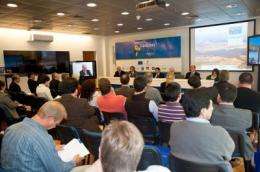
Stretching 100 kilometers through Chile's harsh Atacama Desert, a newly inaugurated data cable is creating new opportunities at ESO's Paranal Observatory and the Observatorio Cerro Armazones. Connecting these facilities to the main Latin American scientific data backbone completes the last gap in the high-speed link between the observatories and Europe.
This new cable is part of the EVALSO (Enabling Virtual Access to Latin American Southern Observatories) project, a European Commission FP7 co-funded programme co-ordinated by the University of Trieste that includes ESO, Observatorio Cerro Armazones (OCA, part of Ruhr-Universität Bochum), the Chilean academic network REUNA and other organisations. As well as the cable itself, the EVALSO project involves buying capacity on existing infrastructure to complete a high-bandwidth connection from the Paranal area to ESO's headquarters near Munich, Germany.
Project co-ordinator Fernando Liello said: "This project has been an excellent collaboration between the consortium members. As well as giving a fast connection to the two observatories, it brings wider benefits to the academic communities both in Europe and Latin America."
The sites of Paranal and Armazones are ideal for astronomical observation due to their high altitude, clear skies and remoteness from light pollution. But their location means they are far from any pre-existing communications infrastructure, which until now has left them dependent on a microwave link to send scientific data back to a base station near Antofagasta.
Telescopes at ESO's Paranal observatory produce well over 100 gigabytes of data per night, equivalent to more than 20 DVDs, even after compressing the files. While the existing link is sufficient to carry the data from the current generation of instruments at the Very Large Telescope (VLT), it does not have the bandwidth to handle data from the VISTA telescope (Visible and Infrared Survey Telescope for Astronomy, see eso0949), or for the new generation of VLT instruments coming online in the next few years.
This means that for much of the data coming from Paranal, the only practical way to send it to ESO Headquarters has been to save it onto hard drives and send these by airmail. This can mean a wait of days or even weeks before observations from VISTA are ready for analysis.
Even with this careful rationing of the connection and sophisticated data management to use the connection as efficiently as possible, the link can get saturated at peak times. While this causes no major problems at present, it indicates that the link is reaching capacity.
ESO Director General Tim de Zeeuw said: "ESO's observatory at Paranal is growing, with new telescopes and instruments coming online. Our world-class scientific observatories need state-of-the-art infrastructure."
In the place of the existing connection, which has a limit of 16 megabit/s (similar to home ADSL broadband), EVALSO will provide a much faster 10 gigabit/s link — a speed fast enough to transfer an entire DVD movie in a matter of seconds.
Mario Campolargo, Director, Emerging Technologies and Infrastructures at the European Commission, said: "It is strategically important that the community of astronomers of Europe gets the best access possible to the ESO observatories: this is one of the reasons why the European Union supports the deployment of regional e-infrastructures for science in Latin America and interlinks them with GÉANT and other EU e-infrastructures."
The dramatic increase in bandwidth will allow increased use of Paranal's data from a distance, in real-time. It will allow easier monitoring of the VISTA telescope's performance, and quicker access to VLT data, increasing the responsiveness of quality control. And with the expanded bandwidth, new opportunities will open up, such as astronomers and technicians taking part in meetings via high-definition videoconferencing without having to travel to Chile. Moreover, looking forward, the new link will provide enough bandwidth to keep up with the ever-growing volumes of information from Paranal and Armazones in future years, as new and bandwidth-intensive instruments come into use.
Immediate remote access to data at a distant location is not just about saving money and making the observatory's work more efficient. For unexpected and unpredictable events, such as gamma-ray bursts, there is often not enough time for astronomers to travel to observatories, and EVALSO will give experts a chance to work remotely on these events almost as if they were at the observatory.
Provided by ESO


