The ethical robot (w/ Video)
November 9, 2010 By Christine Buckley and Bret Eckhardt
Susan and Michael Anderson have programmed a robot to behave ethically. Image by Bret Eckhardt
(PhysOrg.com) -- Philosopher Susan Anderson is teaching machines how to behave ethically.
Professor emerita Susan Anderson and her research partner, husband Michael Anderson of the University of Hartford, a University of Connecticut alumnus, at first seem to have little in common when it comes to their academic lives: she's a philosopher, hes a computer scientist.
But these two seemingly opposite fields have come together in the Andersons collaborative work, in which the team works in a new field of research, called machine ethics, thats only about 10 years old.
This video is not supported by your browser at this time.
Using their expertise in different areas, the Andersons have recently accomplished something thats never been done before: Theyve programmed a robot to behave ethically.There are machines out there that are already doing things that have ethical import, such as automatic cash withdrawal machines, and many others in the development stages, such as cars that can drive themselves and eldercare robots, says Susan, professor emerita of philosophy in the College of Liberal Arts and Sciences, who taught at UConns Stamford campus. Dont we want to make sure they behave ethically?
The field of machine ethics combines artificial intelligence techniques with ethical theory, a branch of philosophy, to determine how to program machines to behave in an ethical manner. But there is currently no agreement, says Susan, as to which ethical principles should be programmed into machines.
In 1930, Scottish philosopher David Ross introduced a new approach to ethics, she says, called the prima facie duty approach, in which a person must balance many different obligations when deciding how to act in a moral way obligations like being just, doing good, not causing harm, keeping ones promises, and showing gratitude.
The robot the Andersons use in their research has been programmed with an ethical principle. Image by Bret Eckhardt
However, this approach was never developed far enough to instruct people how to weigh these different obligations with a satisfactory decision principle: one that would instruct them on how to behave when several of the prima facie duties pull in different directions.
There isnt a decision principle within this theory, so it wasnt widely adopted, says Susan.
Thats where the Andersons come in. By using information about specific ethical dilemmas supplied to them by ethicists, computers can effectively learn ethical principles in a process called machine learning.
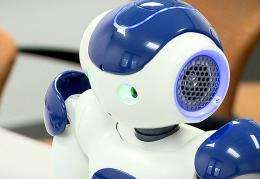
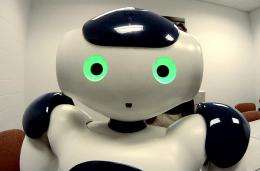
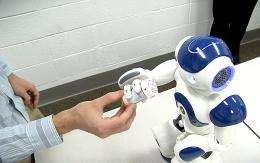
The toddler-sized robot they have been using in their research, called Nao, has been programmed with an ethical principle that was discovered by a computer. This learned principle allows their robot to determine how often to remind people to take their medicine and when to notify an overseer, such as a doctor, when they dont comply.
Reminding someone to take their medicine may seem relatively trivial, but the field of biomedical ethics has grown in relevance and importance since the 1960s. And robots are currently being designed to assist the elderly, so the Andersons research has very practical implications.
Susan points out that there are several prima facie duties the robot must weigh in their scenario: enabling the patient to receive potential benefits from taking the medicine, preventing harm to the patient that might result from not taking the medication, and respecting the persons right of autonomy. These prima facie duties must be correctly balanced to help the robot decide when to remind the patient to take medication and whether to leave the person alone or to inform a caregiver, such as a doctor, if the person has refused to take the medicine.
Philosopher Susan Anderson believes artificial intelligence has changed the field of ethics. Image by Bret Eckhardt
Michael says that although their research is in its early stages, its important to think about ethics alongside developing artificial intelligence. Above all, he and Susan want to refute the science fiction portrayal of robots harming human beings.We should think about the things that robots could do for us if they had ethics inside them, Michael says. Wed allow them to do more things for us, and wed trust them more.
The Andersons organized the first international conference on machine ethics in 2005, and they have a book on machine ethics being published by Cambridge University Press. In the future, they envision computers continuing to engage in machine learning of ethics through dialogues with ethicists concerning real ethical dilemmas that machines might face in particular environments.
Machines would effectively learn the ethically relevant features, prima facie duties, and ultimately the decision principles that should govern their behavior in those domains, says Susan.
Although this is a vision of the future of machine ethics research, Susan thinks that artificial intelligence has already changed her chosen field in major ways.
She thinks that working in machine ethics, which forces philosophers who are used to thinking abstractly to be more precise in applying ethics to specific, real-life cases, might actually advance the study of ethics.
And she believes that robots could be good for humanity: she believes that interacting with robots that have been programmed to behave ethically could even inspire humans to behave more ethically.
Provided by
University of Connecticut
-
From lemons to lemonade: Reaction uses carbon dioxide to make carbon-based semiconductor,
28 comments
-
Every black hole contains a new universe: A physicist presents a solution to present-day cosmic mysteries,
215 comments
-
New silicon memory chip developed,
16 comments
-
Thioridazine kills cancer stem cells in human while avoiding toxic side-effects of conventional cancer treatments,
3 comments
-
SpaceX private rocket blasts off for space station (Update),
41 comments
-
India Engineering Powerhouse
8 hours ago
-
electromagnet core dereference between hard and soft iron
9 hours ago
-
Measuring water pressure in an open tank
20 hours ago
-
Question from a non-engineer: Pulley Systems
May 24, 2012
-
Formula to calculate psi required to deliver gpm through nozzel
May 23, 2012
-
Introduction and general help regarding poers..
May 23, 2012
- More from Physics Forums - General Engineering
More news stories
MIT researchers devise new means to synchronize a group of robots (w/ Video)
(Phys.org) -- For several years, roboticists have been working out ways to get a group of robots to perform synchronized activities as demonstrated most often in dance routines. Its not just about trying ...
OmniVision tops up sensors for cameras, phones
(Phys.org) -- OmniVision has announced two high-resolution image sensors for the digital still and digital video camera market (DS/DVC) and higher end smartphones. In end-user language, it is a claim for superior ...
Nvidia says Kai platform will turn price tide for tablets
(Phys.org) -- In March, Nvidia gave some signs that they were working to lower the cost of their Tegra 3 processors and they suggested consumers might see prices for Android tablets as low as $199. Connect ...
Raspberry Pi to add camera later this year
(Phys.org) -- The Raspberry Pi, a uniquely priced, no casing computer that plugs into your TV and a keyboard., will be given a camera accessory later this year. That may be oh-so-what news if this ...
Several iOS developers welcome Apple's larger-screen iPhone
The sixth-generation iPhone is expected to have a larger screen, and several iOS developers say they would receive that change with a warm welcome.
Electronics / Consumer & Gadgets
May 24, 2012 |
1 / 5 (2) |
0
New device allows pacemaker patients to safely undergo MRIs
For many, it's a medical conundrum: The very pacemaker keeping their heart in rhythm prevents them from undergoing an MRI to diagnose other ailments, because interaction between the two devices could prove deadly.
Common therapies for basal cell carcinoma offer similar survival
(HealthDay) -- For patients with superficial basal cell carcinoma (sBCC), treatment with imiquimod or photodynamic therapy (PDT) results in similar long-term tumor-free survival, according to a review published ...
Pancreatectomy OK without downstaging from therapy
(HealthDay) -- Pancreatectomy improves median survival in pancreatic cancer patients even when presurgical neoadjuvant therapy does not lead to radiographic downstaging of tumors, according to a study published ...
One-fifth of healthy middle-aged men have low-grade murmur
(HealthDay) -- More than one-fifth of healthy middle-aged men have a low-grade systolic heart murmur that confers a nearly five-fold higher risk of future aortic valve replacement (AVR), according to a study ...
Of mice and mental models: Neuroscientific implications of risk-optimized behavior in the mouse
(Medical Xpress) -- Regardless of an organism’s biological complexity, every encephalized animal continuously makes under-informed behavioral choices that can have serious consequences. Despite its ubiquity, ...
Dragon arrives at space station in historic 1st (Update 2)
The privately bankrolled Dragon capsule arrived at the International Space Station for a historic docking Friday, captured by astronauts wielding a giant robot arm.


Nov 09, 2010
Rank: 5 / 5 (2)
You might want to delay 'programming' ethics until you can program general intelligence and self awareness.
Nov 09, 2010
Rank: 5 / 5 (1)
Nov 09, 2010
Rank: 4 / 5 (4)
Because you cannot build specific, isolated modules from the top-down and then somehow interconnect them to form a general intelligence. An AGI needs to be built from the ground up as an emergent property through learning and interacting with the physical environment. AGI has been stuck with the top-down approach since the field's inception. You need to raise an AGI much like you would raise a child, once the hardware and the software is up to scratch.
Nov 09, 2010
Rank: not rated yet
Nov 09, 2010
Rank: 4.3 / 5 (6)
Nov 09, 2010
Rank: not rated yet
if (they refuse)
Accept their response
else
Hand them the bottle
end
There was nothing special here. I saw ASIMO do something similar at a demonstration at Disneyland. The robot reminded the woman to order a pizza for dinner. What a little saint, isn't he? Or he was just programmed to restate the task at a later time.
Nov 10, 2010
Rank: not rated yet
Nov 10, 2010
Rank: not rated yet
Nov 14, 2010
Rank: not rated yet
Dec 08, 2010
Rank: not rated yet