Engineers test effects of fire on steel structures
November 16, 2010

Engineers test effects of fire on steel structures

Enlarge

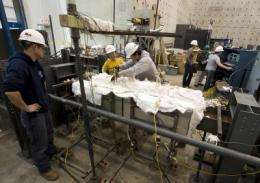
Purdue civil engineering doctoral student Lisa Choe works with graduate student Sungwoo Oh in using a one-of-a-kind heating system to study the effects of fire on steel structures. Research assistant Michael Bratt, far left, looks on. The work is led by Amit Varma, a Purdue associate professor of civil engineering (green hardhat), seen here with graduate students Erica Fischer and Kristi Selden. Credit: Purdue University photo/Mark Simons

Researchers at Purdue University are studying the effects of fire on steel structures, such as buildings and bridges, using a one-of-a-kind heating system and a specialized laboratory for testing large beams and other components.

Building fires may reach temperatures of 1,000 degrees Celsius, or more than 1,800 degrees Fahrenheit, said Amit Varma, a Purdue associate professor of civil engineering who is leading the work.g1

"At that temperature, exposed steel would take about 25 minutes to lose about 60 percent of its strength and stiffness," he said. "As you keep increasing the temperature of the steel, it becomes softer and weaker."

One project focuses on how a building's steel-and-concrete floor and its connections to the building behave in a fire. Another project concentrates on how fire affects steel columns and a building's frame.

Such testing is customarily conducted inside large furnaces.

"However, in a furnace it is very difficult to heat a specimen while simultaneously applying loads onto the structure to simulate the forces exerted during a building's everyday use," Varma said.

To overcome this limitation, Purdue researchers designed a system made up of heating panels to simulate fire. The panels have electrical coils, like giant toaster ovens, and are placed close to the surface of the specimens. As the system is used to simulate fire, test structures are subjected to forces with hydraulic equipment.

In practice, beams and other steel components in buildings are covered with fireproofing materials to resist the effects of extreme heating.

"Because the steel in buildings is coated with a fireproofing material, the air might be at 1,000 degrees but the steel will be at 300 or 400 degrees," Varma said. "We conduct tests with and without fire protection."

The work is funded by the National Science Foundation and the U.S. Department of Commerce's National Institute of Standards and Technology.

The heating system is being used to test full-scale steel columns at Purdue's Robert L. and Terry L. Bowen Laboratory for Large-Scale Civil Engineering Research. It is believed to be the only such in the world, Varma said.

Each panel is about 4 feet square, and the system contains 25 panels that cover 100 square feet. Having separate panels enables researchers to heat certain portions of specimens, recreating "the heating and cooling path of a fire event," Varma said.

The Bowen Lab is one of a handful of facilities where testing can be performed on full-scale structures to yield more accurate data. The 66,000-square-foot laboratory is equipped with special hydraulic testing equipment and powerful overhead cranes.

The research group also has tested 10-foot-by-10-foot "composite floor systems" - made of steel beams supporting a concrete slab - inside a furnace operated by Michigan State University. The composite design is the most common type of floor system used in .

Findings from that research will be compared with floor-system testing to be conducted at the Bowen Lab. Results from both experiments will be used to test and verify computational models used to design buildings.

"Most of these experiments are showing that we have good models, and we are using data to benchmark the models and make sure the theory and experiment agree with each other," Varma said.

Models are needed to design composite floor systems, which can be heavily damaged by fire.

"When you have a floor supporting weight, the floor starts sagging from the heat," Varma said. "It expands, but it's got nowhere to go so it starts bowing down, which produces pulling forces on the building's frame. It starts pulling on the columns and then it becomes longer and permanently deformed. After the , it starts cooling, and then it starts pulling on the columns even harder."

More information: Structures in Fire conference: http://www.egr.msu … ceedings.pdf

Provided by Purdue University search and more info website

Filter


Move the slider to adjust rank threshold, so that you can hide some of the comments.


Display comments: newest first

stealthc
Nov 16, 2010

Rank: 1 / 5 (1)
psst. 9/11 was an inside job. So did they use fireproofing on steel for the WTC?
COCO
Nov 18, 2010

Rank: 1 / 5 (1)
NIST trying post facto to do some repairs - they lost their credibility with WTC 7.
COCO
Nov 22, 2010

Rank: not rated yet
Surprised that Underwriters Laboratories (U.S.)and the Institute of Building Research at the NRC in Ottawa have not done the kind of testing that Purdue is doing. I trust that the researchers will contact the likes of Guy Gosselin who has written extensively on this subject. Furnace fire tests are not simply confined to structural members, but also to room enclosures and structural assemblies so as to limit the spread (through conduction/convection and prevent flashover. They also have tested for load resistance under fire loadings as well.
One area which these researchers may be missing is the consequence of thermal inertia, i.e. the effect of continuity of structural systems that tend to diminish localized heat build-ups. Such continuity inevitably occurs when a hi-rise steel building is designed, simply because rigid connections between columns and floor systems offer significant resistance to lateral loads due to wind or earthquake.
Rank 5 /5 (2 votes)
Relevant PhysicsForums posts

More news stories

Apple CEO Cook gives up $75M in stock dividends

(AP) -- Apple says CEO Tim Cook is giving up $75 million in dividends on restricted stock.

Technology / Business

created 1 hour ago | popularity not rated yet | comments 0

Beyond oil, can Alaska be tapped as a source for renewable energy?

Alaska has massive hydro, wind, geothermal and other renewable resources, but the state's rural villages are chained to diesel and suffer oppressive energy costs they say threaten their existence. Lawmakers, energy experts ...

Technology / Energy & Green Tech

created 2 hours ago | popularity not rated yet | comments 0

Computers excel at identifying smiles of frustration (w/ Video)

(Phys.org) -- Researchers at the Massachusetts Institute of Technology (MIT) in the US have trained computers to recognize smiles, and they have turned out to be more adept at recognizing smiles of frustration ...

Technology / Computer Sciences

created 9 hours ago | popularity 4 / 5 (2) | comments 1 | with audio podcast report

Researchers successfully test solar desalination system for arid land agriculture

Ben-Gurion University of the Negev (BGU) researchers have created a man-made oasis in the desert with the successful application of a solar-powered desalination system that provides water for irrigation in arid regions. The ...

Technology / Energy & Green Tech

created 4 hours ago | popularity not rated yet | comments 1

HyperSolar shows dirty water no barrier to power world

(Phys.org) -- The Santa Barbara, California, company, HyperSolar, is set to transparently share the ups and downs of its research experiences toward the company’s ultimate vision, successfully producing ...

Technology / Energy & Green Tech

created 21 hours ago | popularity 4.8 / 5 (14) | comments 16 | with audio podcast report


New device allows pacemaker patients to safely undergo MRIs

For many, it's a medical conundrum: The very pacemaker keeping their heart in rhythm prevents them from undergoing an MRI to diagnose other ailments, because interaction between the two devices could prove deadly.

Common therapies for basal cell carcinoma offer similar survival

(HealthDay) -- For patients with superficial basal cell carcinoma (sBCC), treatment with imiquimod or photodynamic therapy (PDT) results in similar long-term tumor-free survival, according to a review published ...

One-fifth of healthy middle-aged men have low-grade murmur

(HealthDay) -- More than one-fifth of healthy middle-aged men have a low-grade systolic heart murmur that confers a nearly five-fold higher risk of future aortic valve replacement (AVR), according to a study ...

Cancer patients share web info with docs for insight, advice

(HealthDay) -- Cancer patients' primary goal in talking with their doctors about information they've found on the Internet is to get more insight and advice on the online information, new research indicates.

Of mice and mental models: Neuroscientific implications of risk-optimized behavior in the mouse

(Medical Xpress) -- Regardless of an organism’s biological complexity, every encephalized animal continuously makes under-informed behavioral choices that can have serious consequences. Despite its ubiquity, ...

Dragon arrives at space station in historic 1st (Update 2)

The privately bankrolled Dragon capsule arrived at the International Space Station for a historic docking Friday, captured by astronauts wielding a giant robot arm.