Earth's dust tail points to alien planets
November 15, 2010 By Dauna Coulter

Earth's dust tail points to alien planets

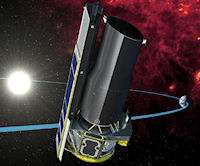
An artist's concept of Spitzer passing through Earth's dusty tail

Did you know that the Earth has a dust tail? The Spitzer Space Telescope sailed right through it a few months ago, giving researchers a clear idea of what it looks like. That could be a big help to planet hunters trying to track down alien worlds.

"Planets in distant solar systems probably have similar dust tails," says Spitzer project scientist Mike Werner. "And in some circumstances these dust features may be easier to see than the planets themselves. So we need to know how to recognize them."

It's extremely challenging – and usually impossible – to directly image exoplanets. They're relatively small and faint, hiding in the glare of the stars they orbit.
"A dust tail like Earth's could produce a bigger signal than a planet does. And it could alert researchers to a planet too small to see otherwise."

Earth has a dust tail not because the planet itself is particularly dusty, but rather because the whole is. Interplanetary space is littered with dusty fragments of comets and colliding asteroids. When Earth orbits through this dusty environment, a tail forms in the rear, akin to swaths of fallen leaves swirling up behind a streetsweeper.

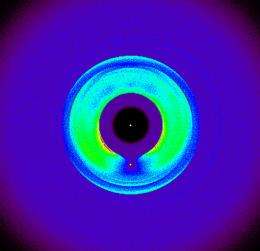
"As Earth orbits the sun, it creates a sort of shell or depression that dust particles fall into, creating a thickening of dust – the tail – that Earth pulls along via gravity," explains Werner. "In fact, the tail trails our planet all the way around the sun, forming a large dusty ring."
Earth's dust tail points to alien planets
Enlarge

A computer simulation of Earth's dust tail/ring seen from a vantage point outside our solar system. Colors indicate density; purple is lowest, red is highest. Credit: Christopher Stark, GSFC

Spitzer's recent observations have helped astronomers map the structure of Earth's dust tail and figure out what similar "tell-tale tails" attached to alien planets might look like.

Like our own solar system, other planetary systems are infused with dust that forms a dusty disk encircling the central star. And like Earth, exoplanets interact with their dust disk gravitationally, channeling and drawing strange features into it.

"In some stars' dust disks there are bumps, warps, rings, and offsets telling us that planets are interacting with the dust," explains Mark Clampin of NASA's Goddard Space Flight Center. "So we can 'follow the dust' to the . So far, we've seen about 20 dust disks in other solar systems. And in some of those cases, following the dust has already paid off."

Clampin, Paul Kalas, and colleagues were looking for a planet around the bright southern star Fomalhaut when they unexpectedly found a dust ring. The shape of that ring led them to their goal. "We suspected that the ring's sharp inner edge was formed by a planet gravitationally clearing out the surrounding debris," says Clampin. "We tracked the planet by this 'footprint' in the dust." (See the footprint here.)

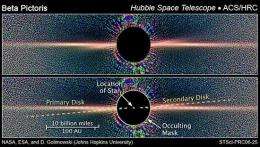
Another Hubble image shows a dusty disk around Beta Pictoris, a star in the constellation Pictor, or "Painter's Easel," pictured below:
Earth's dust tail points to alien planets
Enlarge

A Hubble image of dusty material circling the star Beta Pictoris

"Note the smaller dust ring that's tilted with respect to the larger dust disk," says Clampin. "Like , this planet is shepherding the dust into its orbital plane."

Clampin and Werner say Spitzer's observation of Earth's dust tail and these initial observations of dust structures in distant solar systems set the stage for the planet hunting debut of the James Webb Space Telescope. They fully expect the huge and powerful new telescope to spot many tell-tale tails ... of the alien variety.

Provided by Science@NASA search and more info website

4.8 /5 (15 votes)  

Rank 4.8 /5 (15 votes)
Relevant PhysicsForums posts

More news stories

Dragon arrives at space station in historic 1st (Update 2)

The privately bankrolled Dragon capsule arrived at the International Space Station for a historic docking Friday, captured by astronauts wielding a giant robot arm.

Space & Earth / Space Exploration

created 3 hours ago | popularity 5 / 5 (4) | comments 5

Astronauts capture SpaceX's Dragon for station dock

Astronauts aboard the International Space Station reached out and caught SpaceX's Dragon capsule for docking at the orbiting lab on Friday in a historic first for commercial spaceflight.

Space & Earth / Space Exploration

created 1 hour ago | popularity 5 / 5 (1) | comments 0

SAfrica stops short of being disappointed over SKA verdict

South Africa stopped short of expressing disappointment after it failed to win the bid to single-handily host the world's most powerful radio telescope.

Space & Earth / Space Exploration

created 1 hour ago | popularity 1 / 5 (1) | comments 0

SKA super telescope to be built in Australia, South Africa (Update 2)

A long-running joust to host a radio telescope that would give mankind its farthest peek into the Universe ended on Friday with a Solomon-like judgement to split the site between Australia and South Africa.

Space & Earth / Astronomy

created 4 hours ago | popularity 5 / 5 (1) | comments 2

Get ready for the transit of Venus

Scientists and amateur astronomers around the world are preparing to observe the rare occurrence of Venus crossing the face of the Sun on 5-6 June, an event that will not be seen again for over a hundred years.

Space & Earth / Space Exploration

created 5 hours ago | popularity 5 / 5 (1) | comments 0


New device allows pacemaker patients to safely undergo MRIs

For many, it's a medical conundrum: The very pacemaker keeping their heart in rhythm prevents them from undergoing an MRI to diagnose other ailments, because interaction between the two devices could prove deadly.

Common therapies for basal cell carcinoma offer similar survival

(HealthDay) -- For patients with superficial basal cell carcinoma (sBCC), treatment with imiquimod or photodynamic therapy (PDT) results in similar long-term tumor-free survival, according to a review published ...

One-fifth of healthy middle-aged men have low-grade murmur

(HealthDay) -- More than one-fifth of healthy middle-aged men have a low-grade systolic heart murmur that confers a nearly five-fold higher risk of future aortic valve replacement (AVR), according to a study ...

Cancer patients share web info with docs for insight, advice

(HealthDay) -- Cancer patients' primary goal in talking with their doctors about information they've found on the Internet is to get more insight and advice on the online information, new research indicates.

Of mice and mental models: Neuroscientific implications of risk-optimized behavior in the mouse

(Medical Xpress) -- Regardless of an organism’s biological complexity, every encephalized animal continuously makes under-informed behavioral choices that can have serious consequences. Despite its ubiquity, ...

MIT researchers devise new means to synchronize a group of robots (w/ Video)

(Phys.org) -- For several years, roboticists have been working out ways to get a group of robots to perform synchronized activities as demonstrated most often in dance routines. It’s not just about trying ...