How the dragon got its 'snap'
November 9, 2010

How the dragon got its 'snap'

Enlarge

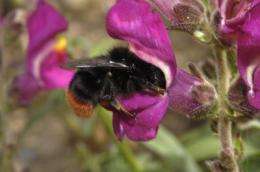
This is a bee on a snapdragon flower. Credit: John Innes Centre

Scientists at the John Innes Centre and the University of East Anglia are pioneering a powerful combination of computer modeling and experimental genetics to work out how the complex shapes of organs found in nature are produced by the interacting actions of genes. Their findings will influence our thinking about how these complex shapes have evolved.

"How do hearts, wings or flowers get their shape?" asks Professor Enrico Coen from the John Innes Centre. " Unlike man-made things like mobile phones or cars, there is no external hand or machine guiding the formation of these biological structures; they grow into particular shapes of their own accord."

"Looking at the complex, beautiful and finely tuned shapes produced by nature, people have often wondered how they came about. We are beginning to understand the basic genetic and chemical cues that nature uses to make them."

So, how does this happen? In a recent breakthrough, funded by the Biotechnology and Biological Sciences Research Council (BBSRC), scientists on Norwich Research Park have begun to answer this question, using the snapdragon flower as a convenient subject.

In the snapdragon flower, two upper petals and three lower petals form defined shapes, precisely coming together to form a tube with a hinge. When a bee lands on the lower petals the hinge opens up the flower, allowing access to and pollen. The shape of petals is known to be affected by four genes, but precisely how these genes work in combination to produce the specialised flower shape, and how this shape evolved, was unknown. The same is true for many organ shapes, but the snapdragon flower provides a good system to study this problem, as it is genetically well characterised and growth can be followed at the .

By changing when and how the genes involved in growth are turned on and off, and tracking how these changes affect the development of shape over time, the researchers got pointers as to how genes control the overall shape. They then used computer modelling to show how the flower could generate itself automatically through the application of some basic growth rules.

This video is not supported by your browser at this time.

This is a computer model of the growth of a snapdragon flower, produced by the groups of Professor Andrew Bangham of the University of East Anglia and Professor Enrico Coen of the John Innes Centre. Credit: John Innes Centre/UEA

A key finding was that genes control not only how quickly different regions of the petal grow, but also their orientations of growth. It is as if each cell has a chemical compass that allows it to get its bearings within the tissue, giving it the information needed to grow more in some directions than others. Genes also influence the cell's equivalent of magnetic poles; key regions of tissue that chemical compasses point to. Publishing in the journal PLoS Biology, the researchers show how these principles allow very complex biological shapes to generate themselves.

"We are now trying to get a better understanding of exactly how the chemical compasses work and determining the molecular nature of the poles that coordinate their orientations," said Professor Enrico Coen of the John Innes Centre.

The study also throws light on how different shapes may evolve. In the computational model, small changes to the that influence the growth rules produce a variety of different forms. The shape of the snapdragon flower, with the closely matched upper and lower petal shapes, could have arisen through similar 'genetic tinkering' during evolution. Evolutionary tinkering could also underlie the co-ordinated changes required for the development of many other biological structures, such as the matched upper and lower jaws of vertebrates.

Provided by Norwich BioScience Institutes

Filter


Move the slider to adjust rank threshold, so that you can hide some of the comments.


Display comments: newest first

kevinrtrs
Nov 10, 2010

Rank: 1 / 5 (6)
The shape of petals is known to be affected by four genes, but precisely how these genes work in combination to produce the specialised flower shape, and how this shape evolved, was unknown

The researchers need to keep things in perspective here.
Even if they understand to the finest detail how these structures currently operate, there's no way that they can conclusively and undisputedly assert how they came about. They can model all they want but they cannot go back into the past to document how things got their shapes. The best they can do is make assumptions and guesses.
As per usual all the maybes and might-have-beens will turn into fact over time - people will simply state those assumptions and guesses as if they were fact: guess-o-facts. This is the usual modus operandi of evolutionary thought.
An alternative and better explanation would be that those structures were designed. Ask yourself how that flower got fertilized while it was evolving it's hinged petal?
kevinrtrs
Nov 10, 2010

Rank: 1 / 5 (5)
The real issue here is not how the genes produces those shapes, rather it's the question of how the INFORMATION to produce those shapes got into the DNA.
Three things are required to get a functional flower:
1. The information to produce the material required for the shapes.
2. The information guiding the building of the petal - when to start, when to change material, when to stop.
3. The information of how to USE the functionality once it had been constructed.
Those petals and hinges are there for a purpose: to perpetuate the kind of plant. So everything needs to work together at once. You can't separate one particular function from the other, waiting for things to "evolve". The plant would simply go extinct. Pronto.

Skeptic_Heretic
Nov 10, 2010

Rank: 5 / 5 (1)
In response to kevin, I'd suggest anyone watching goes to youtube and views "Why do People Laugh at Creationists".
Ethelred
Nov 14, 2010

Rank: not rated yet
You can't separate one particular function from the other, waiting for things to "evolve". The plant would simply go extinct. Pronto.
Things CAN and DO evolve over time IN CONCERT. They only need to be able to function well enough to reproduce. There never was a target result. There is no target even now except to reproduce. And that only because if it does not reproduce then it goes away.

Kevin you aren't to make reality go away by remaining actively ignorant. It will still exist no matter how many idiotic posts you make.

Go learn something. Like how to think rationally. It can be done. Even Michael Schermer managed it and he STILL tends to mystical thinking if he isn't careful.

You can see it on the documentary about C. S. Lewis. Schermer never noticed that Lewis was NEVER the atheist he called himself. You can't be mad at a god you don't believe in. Which is what Lewis was. Mad at Jehovah.

Silly Bugger is what Lewis was. Not even close to being an Atheist.

Ethelred
Rank 5 /5 (2 votes)
Relevant PhysicsForums posts

More news stories

Copy of the genetic makeup travels in a protein suitcase

Scientists from the Institute for Physical and Theoretical Chemistry at the University of Bonn have succeeded for the first time in the real time filming of the transport of an important information carrier in biological ...

Biology / Cell & Microbiology

created 2 hours ago | popularity not rated yet | comments 0 | with audio podcast

A mating dance with Popeye arms

A research team at Bielefeld University headed by the evolutionary biologist Dr. Holger Schielzeth is now studying how far a comparable mechanism is involved in mate choice among locusts. The male Siberian ...

Biology / Plants & Animals

created 1 hour ago | popularity not rated yet | comments 0

'Transformer' protein makes different sized transport pods

These spheres may look almost identical, but subtle differences between them revealed a molecular version of the robots from Transformers. Each sphere is a vesicle, a pod that cells use to transport materials ...

Biology / Cell & Microbiology

created 2 hours ago | popularity not rated yet | comments 0

A new invading sea crab reaches the Ebro Delta

Originally endemic to the Atlantic Coast of North America, over the past 30 years Dyspanopeus sayi has been involuntarily introduced in the UK, France, the Netherlands, the Black Sea and the Adriatic Sea. A ...

Biology / Ecology

created 3 hours ago | popularity not rated yet | comments 0

Study uncovers secret to speedy burrowing by razor clams

(Phys.org) -- If you look at a razor burrowing clam sitting in a bucket, you’d never guess that it could burrow itself down into the soil, much less do it with any speed. Razor clams look like fat straws, ...

Biology / Plants & Animals

created 5 hours ago | popularity not rated yet | comments 2 | with audio podcast report


New device allows pacemaker patients to safely undergo MRIs

For many, it's a medical conundrum: The very pacemaker keeping their heart in rhythm prevents them from undergoing an MRI to diagnose other ailments, because interaction between the two devices could prove deadly.

Astronauts capture SpaceX's Dragon for station dock

Astronauts aboard the International Space Station reached out and caught SpaceX's Dragon capsule for docking at the orbiting lab on Friday in a historic first for commercial spaceflight.

More mental health care urged for kids who self-harm

(HealthDay) -- Doctors have long known that some kids suffering severe emotional turmoil find relief in physical pain -- cutting or burning or sticking themselves with pins to achieve a form of release.

Neck strength, cervical spine mobility don't predict pain

(HealthDay) -- Neither isometric neck muscle strength nor passive mobility of the cervical spine, two physical capacity parameters found to be associated with neck pain in other studies, predicts later neck ...

Cancer patients share web info with docs for insight, advice

(HealthDay) -- Cancer patients' primary goal in talking with their doctors about information they've found on the Internet is to get more insight and advice on the online information, new research indicates.

Dragon arrives at space station in historic 1st (Update 2)

The privately bankrolled Dragon capsule arrived at the International Space Station for a historic docking Friday, captured by astronauts wielding a giant robot arm.