DNA can act like Velcro for nanoparticles
November 18, 2010 By Jared Sagoff
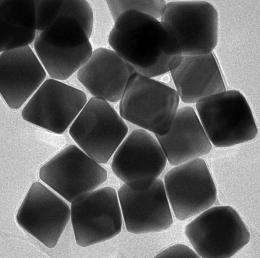
Argonne researcher Byeongdu Lee has determined that different shapes of gold nanoparticles, above and below, will self-assemble into different configurations when attached to single strands of DNA.
DNA can do more than direct how bodies our made -- it can also direct the composition of many kinds of materials, according to a new study from the U.S. Department of Energys Argonne National Laboratory.
Argonne researcher Byeongdu Lee and his colleagues at Northwestern University discovered that strands of DNA can act as a kind of nanoscopic "Velcro" that binds different nanoparticles together. "Its generally difficult to precisely control the assembly of these types of nanostructures," Lee said. "By using DNA, were borrowing nature's power."
The "Velcro" effect of the DNA is caused by the molecules "sticky ends," which are regions of unpaired nucleotides the building blocks of DNA that are apt to bond chemically to their base-pair partners, just like in our genes. When sufficiently similar regions contact each other, chemical bonds form a rigid lattice. Scientists and engineers believe these complex nanostructures have the potential to form the basis of new plastics, electronics and fuels.
In 2008, Lee and his colleagues attached DNA to spherical nanoparticles made of gold, hoping to control the way the particles arrange themselves into compact, ordered crystals. This process is called nanoparticle "packing," and Lee believed that by affixing DNA to the nanoparticles, he could control how they packed together. "Materials that are packed differently even if they are made from the same substance have been shown to exhibit dramatically different physical and chemical properties," Lee said.
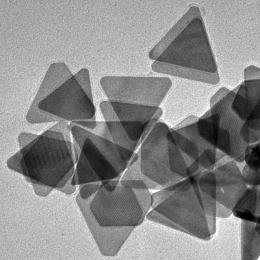
While the 2008 experiment showed that DNA appeared to control that instance of nanosphere packing, it was not known whether the effect would occur with different nanoparticle geometries. The more recent experiment looked at different shapes of nanoparticles to determine whether their contours affected how they packed.
According to Lee, the spherical nanoparticles in the earlier experiment tended to arrange themselves into one of two separate types of cubic crystals: a face-centered cube (a simple cube with nanospheres at each vertex and additional ones located in the middle of each face) or a body-centered cube (a simple cube with an additional nanosphere located in the middle of the cube itself). The type of lattice that the nanoparticles formed was determined by how the "sticky ends" attached to the nanoparticles paired together.
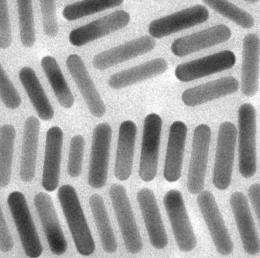
In the more recent experiment, the particles' shape did change the material's final structure, but only insofar as it altered how the DNA "sticky ends" attached to each other. In fact, the study showed that dodecahedral (12-sided) nanoparticles arranged into a face-centered cubic configuration while octahedral (8-sided) nanoparticles formed body-centered cubes even when the nanoparticles were attached to identical strands of DNA. "We may be able to make all different types of nanoparticle packing structures, but the structure that will result will always be the one that maximizes the amount of binding," he said.
"The face-centered cubic structure is the most compact way for the nanoparticles to arrange themselves, while the body-centered cubic is slightly less compact. The DNA binding is really the true force controlling the construction of the lattice," he added.
More information: A paper based on the research, "DNA-nanoparticle superlattices formed from anisotropic building blocks", appeared in the October 3 issue of Nature Materials.
Provided by
Argonne National Laboratory
-
From lemons to lemonade: Reaction uses carbon dioxide to make carbon-based semiconductor,
28 comments
-
Every black hole contains a new universe: A physicist presents a solution to present-day cosmic mysteries,
215 comments
-
New silicon memory chip developed,
16 comments
-
Thioridazine kills cancer stem cells in human while avoiding toxic side-effects of conventional cancer treatments,
3 comments
-
SpaceX private rocket blasts off for space station (Update),
41 comments
-
Density question
May 24, 2012
-
Mass transport originating from a point source at a solid gas interface
May 22, 2012
-
Ammonia dispersion in Air
May 22, 2012
-
Multi Choice Help
May 21, 2012
-
index of refraction and thickness of materials
May 18, 2012
-
Solar battery maintainer for car
May 17, 2012
- More from Physics Forums - Materials & Chemical Engineering
More news stories
Synthetic nano-waste does not disappear
(Phys.org) -- Tiny particles of cerium oxide do not burn or change in the heat of a waste incineration plant. They remain intact on combustion residues or in the incineration system, as a new study by Swiss ...
Nanotechnology / Bio & Medicine
4 hours ago |
not rated yet |
0
|
Nanotechnology for solar energy conversion systems
EU researchers extensively characterised the self-organisation of nanotubes and developed novel compositions particularly appropriate to solar energy conversion applications.
Nanotechnology / Nanomaterials
3 hours ago |
not rated yet |
0
Nano-structured polymer-based materials from scrap
EU researchers developed polymer blends and processing techniques facilitating recovery of scrap from industrial processes. Advances in this area have the potential to decrease costs and waste while protecting ...
Nanotechnology / Nanomaterials
4 hours ago |
not rated yet |
0
In nanorod crystal growth, nanoparticles seen as artificial atoms
In the growth of crystals, do nanoparticles act as "artificial atoms" forming molecular-type building blocks that can assemble into complex structures? This is the contention of a major but controversial theory ...
23 hours ago |
4.8 / 5 (5) |
0
|
First direct observation of oriented attachment in nanocrystal growth
Berkeley Lab researchers have reported the first direct observation of nanoparticles undergoing oriented attachment, the critical step in biomineralization and the growth of nanocrystals. A better understanding ...
23 hours ago |
4.7 / 5 (3) |
0
|
New device allows pacemaker patients to safely undergo MRIs
For many, it's a medical conundrum: The very pacemaker keeping their heart in rhythm prevents them from undergoing an MRI to diagnose other ailments, because interaction between the two devices could prove deadly.
Astronauts capture SpaceX's Dragon for station dock
Astronauts aboard the International Space Station reached out and caught SpaceX's Dragon capsule for docking at the orbiting lab on Friday in a historic first for commercial spaceflight.
More mental health care urged for kids who self-harm
(HealthDay) -- Doctors have long known that some kids suffering severe emotional turmoil find relief in physical pain -- cutting or burning or sticking themselves with pins to achieve a form of release.
Neck strength, cervical spine mobility don't predict pain
(HealthDay) -- Neither isometric neck muscle strength nor passive mobility of the cervical spine, two physical capacity parameters found to be associated with neck pain in other studies, predicts later neck ...
Cancer patients share web info with docs for insight, advice
(HealthDay) -- Cancer patients' primary goal in talking with their doctors about information they've found on the Internet is to get more insight and advice on the online information, new research indicates.
Dragon arrives at space station in historic 1st (Update 2)
The privately bankrolled Dragon capsule arrived at the International Space Station for a historic docking Friday, captured by astronauts wielding a giant robot arm.

