Cosmic Curiosity Reveals Ghostly Glow of Dead Quasar
November 3, 2010

Cosmic curiosity reveals ghostly glow of dead quasar

Enlarge

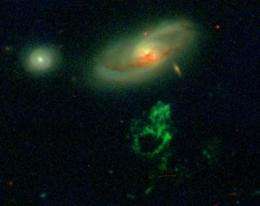
The green Voorwerp in the foreground remains illuminated by light emitted up to 70,000 years ago by a quasar in the center of the background galaxy, which has since died out. Credit: WIYN/William Keel/Anna Manning

(PhysOrg.com) -- While sorting through hundreds of galaxy images as part of the Galaxy Zoo citizen science project two years ago, Dutch schoolteacher and volunteer astronomer Hanny van Arkel stumbled upon a strange-looking object that baffled professional astronomers. Two years later, a team led by Yale University researchers has discovered that the unique object represents a snapshot in time that reveals surprising clues about the life cycle of black holes.

In a new study, the team has confirmed that the unusual object, known as Hanny’s Voorwerp (Hanny’s “object” in Dutch), is a large cloud of glowing gas illuminated by the light from a quasar—an extremely energetic galaxy with a supermassive black hole at its center. The twist, described online in the Astrophysical Journal Letters, is that the quasar lighting up the gas has since burned out almost entirely, even though the light it emitted in the past continues to travel through space, illuminating the gas cloud and producing a sort of “light echo” of the dead quasar.

“This system really is like the Rosetta Stone of quasars,” said Yale Kevin Schawinski, a co-founder of Galaxy Zoo and lead author of the study. “The amazing thing is that if it wasn’t for the Voorwerp being illuminated nearby, the galaxy never would have piqued anyone’s interest.”

The team calculated that the light from the dead quasar, which is the nearest known galaxy to have hosted a quasar, took up to 70,000 years to travel through space and illuminate the Voorwerp—meaning the quasar must have shut down sometime within the past 70,000 years.

Until now, it was assumed that supermassive black holes took millions of years to die down after reaching their peak energy output. However, the Voorwerp suggests that the supermassive black holes that fuel quasars shut down much more quickly than previously thought. “This has huge implications for our understanding of how and co-evolve,” Schawinski said.

“The time scale on which quasars shut down their prodigious energy output is almost entirely unknown,” said Meg Urry, director of the Yale Center for Astronomy & Astrophysics and a co-author of the paper. “That's why the Voorwerp is such an intriguing—and potentially critical—case study for understanding the end of black hole growth in .”

Although the galaxy no longer shines brightly in X-ray light as a quasar, it is still radiating at radio wavelengths. Whether this radio jet played a role in shutting down the central black hole is just one of several possibilities Schawinski and the team will investigate next.

“We’ve solved the mystery of the Voorwerp,” he said. “But this discovery has raised a whole bunch of new questions.”

More information: Kevin Schawinski et al 2010 ApJ 724 L30 DOI:10.1088/2041-8205/724/1/L30

Provided by Yale University search and more info website

4.8 /5 (20 votes)  

Filter


Move the slider to adjust rank threshold, so that you can hide some of the comments.


Display comments: newest first

Shino
Nov 03, 2010

Rank: not rated yet
object is "voorwerp" in dutch not voorVerp ;)
Slotin
Nov 03, 2010

Rank: 1.1 / 5 (25)
Such objects may be actually quite common - compare the Hoag's object, discussed here recently.

http://en.wikiped...s_Object
SteWe
Nov 04, 2010

Rank: 5 / 5 (2)
"Voorverp" ... it's typo. Both times. The scientific paper, as well as the original forum thread speak of a "Voorwerp".

There's no similarity between "Hoag's Object" and "The Voorwerp":

"Hoag's Object" is a ring galaxy, most likely formed by a small (satellite?) galaxy crashing perpendicular through the disk of a much larger spiral galaxy. (Galaxyzoo has found quite a bunch of those, too, so they're not as rare as once thought!)

"The Voorwerp" is a galaxy-sized gas cloud, in some 70.000 light year distance from the big spiral galaxy (IC 2497, the big dusty spiral just above the green Voorwerp) - and both are roughly at the same distance from us. Its not a "background" galaxy, as it is stated in the article, and the "light" from the Quasar has not gone through the gas cloud to reach us, but has been reflected ~90° to the side)

"The Hanny's Voorwerp." http://www.galaxy...c=3802.0
Tuxford
Dec 05, 2010

Rank: 1 / 5 (3)
This is evidence that active galactic cores can shut off in only thousands of years, rather than millions. And LaViolette maintains that they can turn on quickly too. This is his superwave theory, published in early eighties.

Our galactic core star could surprise us with a cosmic ray volley at any time. The Hopi indians legends reference a blue star visible during the daytime. And we are worried about asteroids? This could be as bad or worse.
Rank 4.8 /5 (20 votes)
Relevant PhysicsForums posts

More news stories

SAfrica stops short of being disappointed over SKA verdict

South Africa stopped short of expressing disappointment after it failed to win the bid to single-handily host the world's most powerful radio telescope.

Space & Earth / Space Exploration

created 1 minute ago | popularity not rated yet | comments 0

Dragon arrives at space station in historic 1st (Update 2)

The privately bankrolled Dragon capsule arrived at the International Space Station for a historic docking Friday, captured by astronauts wielding a giant robot arm.

Space & Earth / Space Exploration

created 2 hours ago | popularity 5 / 5 (3) | comments 4

SKA super telescope to be built in Australia, South Africa (Update 2)

A long-running joust to host a radio telescope that would give mankind its farthest peek into the Universe ended on Friday with a Solomon-like judgement to split the site between Australia and South Africa.

Space & Earth / Astronomy

created 3 hours ago | popularity 5 / 5 (1) | comments 1

Organic carbon from Mars, but not biological

(Phys.org) -- Molecules containing large chains of carbon and hydrogen--the building blocks of all life on Earth--have been the targets of missions to Mars from Viking to the present day. While these molecules ...

Space & Earth / Space Exploration

created 22 hours ago | popularity 4.4 / 5 (5) | comments 2 | with audio podcast

Aliens don't want to eat us, says former SETI director

Alien life probably isn’t interested in having us for dinner, enslaving us or laying eggs in our bellies, according to a recent statement by former SETI director Jill Tarter.

Space & Earth / Space Exploration

created 3 hours ago | popularity 5 / 5 (4) | comments 7


Copy of the genetic makeup travels in a protein suitcase

Scientists from the Institute for Physical and Theoretical Chemistry at the University of Bonn have succeeded for the first time in the real time filming of the transport of an important information carrier in biological ...

Cancer may require simpler genetic mutations than previously thought

Chromosomal deletions in DNA often involve just one of two gene copies inherited from either parent. But scientists haven't known how a deletion in one gene from one parent, called a "hemizygous" deletion, can contribute ...

Oldest Jewish archaeological evidence on the Iberian Peninsula

German archaeologists of the Friedrich Schiller University Jena found one of the oldest archaeological evidence so far of Jewish Culture on the Iberian Peninsula at an excavation site in the south of Portugal, ...

Apple CEO Cook gives up $75M in stock dividends

(AP) -- Apple says CEO Tim Cook is giving up $75 million in dividends on restricted stock.

In Spain, 70 percent of women use contraceptives during their first sexual encounter

Contraceptive use in Spain during the first sexual encounter is similar to other European countries. However, there are some geographical differences between Spanish regions: women in Murcia use contraceptives ...

World Health Assembly endorses new plan to increase global access to vaccines

Ministers of Health from 194 countries at the Sixty-fifth World Health Assembly today endorsed a landmark Global Vaccine Action Plan (GVAP), a roadmap to prevent millions of deaths by 2020 through more equitable access to ...