The time to prepare for climate change is now
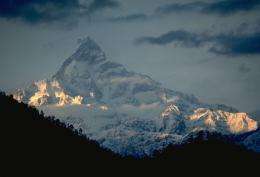
Though the massive glaciers of the greater Himalayan region are retreating slowly, development agencies can take steps now to help the region's communities prepare for the many ways glacier melt is expected to impact their lives, according to a new report. Programs that integrate health, education, the environment and social organizations are needed to adequately address these impacts, the report states.
"The extremely high altitudes and sheer mass of High Asian glaciers mean they couldn't possibly melt in the next few decades," said Elizabeth Malone, a Battelle sociologist and the report's technical lead. "But climate change is still happening and we do need to prepare for it. That's especially true in this part of the world, where poverty and other concerns make its residents very vulnerable to any change."
The report, Changing Glaciers and Hydrology in Asia: Addressing Vulnerability to Glacier Melt Impacts, was prepared in collaboration with Battelle and the U.S. Agency for International Development. Battelle operates the Department of Energy's Pacific Northwest National Laboratory in Richland, Wash. Malone works from the Joint Global Change Research Institute in College Park, Md., a collaboration between PNNL and the University of Maryland.
Malone will join Mary Melnyk, a USAID natural resource management senior advisor, and Kristina Yarrow, a USAID health advisor, to discuss the findings Tuesday at 10 a.m. Eastern time at the Woodrow Wilson International Center for Scholars in Washington, D.C. Geoff Dabelko, director of the Wilson Center's Environmental Change and Security Program, will moderate the discussion.
Vulnerable to change
High Asia is dominated by many steep, dramatic mountain ranges that run through parts of Nepal, Bhutan, Afghanistan, India, China, Tajikistan, Kyrgyzstan and other countries. The region is home to more than 50,000 glaciers that are vital water lifelines to Asia's largest rivers, including the Yellow, Yangtze, Mekong, Indus and Ganges. Roughly two billion people depend on these rivers for their water and food supply.
Unfortunately, many people who live in High Asia and along the river basins fed by the region's glaciers already experience malnutrition and food insecurity, insufficient access to clean water and sanitation, and other issues that will be exacerbated by climate change and population growth. The challenge for agencies like USAID is to incorporate climate change into their existing development efforts so that quality of life continues to improve in the developing world.
"This report lays out what are the potential impacts of glacier melt on sectors such as health and agriculture while exploring how USAID programs could respond to the challenges of changing water supplies," Melnyk said.
More information needed
Although the world's glaciers have slowly been retreating since 1850 — the end of what climate scientists refer to as the Little Ice Age — those in High Asia haven't melted as quickly, mostly due to the glaciers' location in elevations higher and colder than many other glacier systems, the report notes.
But there's little historical information about High Asian glaciers to predict their future. The data that does exist consists mostly of physical measurements taken at the glaciers' most accessible spots, their lowest ends. Glaciers are dynamic and routinely grow in some areas while shedding ice in others. The lower segments are more prone to change due to the higher temperatures associated with lower elevations, making the measurements taken there less reliable. Remote sensing technology has allowed researchers to measure glaciers over larger areas in recent years, but there isn't much historical data to provide a long-term picture.
The report states that many Himalayan glaciers are retreating, especially at lower elevations, but that no region-wide evidence supports the claim that they're retreating faster than any other location in the world. The report also recommends that scientists collaborate internationally to show the glaciers' overall ice balance on a regional scale.
Preparing for the future
One of the most pressing near-term impacts that scientists can study are glacier lake outburst floods. Unlike the widespread deluges that some inaccurately fear could follow sudden glacial melting, these floods are due to slow melting and occur on a smaller scale. They typically happen when an advancing glacier dams a river or water builds up behind soil and rocks deposited by a glacier.
Those most affected by the floods are residents of the rural villages close to glaciers. Although the number of people directly impacted can be small, the damage is often extensive. Glacier lake floods can be so destructive "that people who survive must move and begin to rebuild their lives in other places," the report notes. More than 25 glacier lake outburst floods have been recorded in Bhutan, Nepal and Tibet since the 1930s and more will likely occur as climate change progresses.
Retreating glaciers can also heighten existing water worries. In the Indus River Basin, for example, glacier melt accounts for about 30 percent of the river's water supply. Retreating glaciers would lessen the river's overall flow, but that impact would likely be more dramatic as the region's population growth increases the demand for water. The Indus River Basin is already home to more than 200 million people, and the region's high fertility rates mean its population will continue to grow rapidly. As a result, the region's per capita water availability will decline steeply. The issue is compounded by the large amount of irrigated land there. "The current vulnerabilities will likely worsen with increasing uncertainties related to water supply," the report notes.
Human health also stands to be affected by climate change in High Asia. Less available water could mean higher pollution levels and increased difficulty obtaining clean water and sanitation "for hundreds of millions in these watersheds," reads the report. Diarrhea and other diseases linked to biological and chemical contamination are likely, the report notes. Decreased water availability could also cause declining crop yields and food availability, which would worsen existing hunger issues in the region.
Other impacts discussed in the report include increased civil conflict across country borders due to unstable water supplies and declining ecosystem health that further endangers threatened animals and plants.
Many birds with a few stones
Such expected impacts make for a fairly daunting list. But the report makes several suggestions to address multiple issues at once with cross-sectoral development programs.
For example, programs that focus on agriculture, one of the largest water-use activities, could improve water efficiency and help address water scarcity. This approach could increase crop productivity to address hunger and malnutrition, and strengthen local water-user associations to improve governance capabilities.
Another threat to High Asia's glaciers, soot, can be reduced while also improving local health, the report suggests. The region's rural residents cook over traditional stoves that burn wood, agricultural waste, dung and other biomass. The stoves are inefficient and release soot, also known as black carbon, and other aerosols. The black carbon travels through the air and can land on glaciers, which then absorb more sunlight and melt faster. People - mostly women and children - living in the homes where the stoves are used are also harmed. They experience respiratory diseases, heart disease, stillbirth, cataracts and more from the indoor air pollution. More than 1.6 million people in the region die each year as a result.
To counteract this, development agencies could work with scientists, health specialists, technology experts and government officials to develop and make accessible cooking stoves that are more efficient and create fewer emissions. The collaborators could also work closely with women to address health issues by offering alternative cooking practices. And scientific organizations could improve observations and models of glacier melt in relation to soot. Such information could be used by local leaders to develop local methods to reduce soot emissions and improve glacier stability.
"Agencies like USAID already have assets and expertise that have advanced the developing world for years," Malone said. "This report offers a menu of options on how those assets can also be used to address the many issues that will arise from climate change."
More information: The event is open to the public, though RSVPs should be sent to ecsp@wilsoncenter.org. The Wilson Center is located inside the Ronald Reagan Building at 1300 Pennsylvania Ave. Directions are available online at www.wilsoncenter.org/directions. A live webcast will also be hosted at www.wilsoncenter.org. The report will be available at the event and posted online at www.usaid.gov
Provided by Pacific Northwest National Laboratory


