Man, climate combine to erode Cancun's beaches
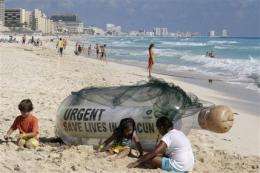
(AP) -- Cancun's eroding white sand beaches are providing a note of urgency to the climate talks being held just south of this seaside resort famed for its postcard-perfect vistas.
Rising sea levels and a series of unusually powerful hurricanes have aggravated the folly of building a tourist destination atop shifting sand dunes on a narrow peninsula. After the big storms hit, the bad ideas were laid bare: Much of Cancun's glittering hotel strip is now without a beach.
Hotels built too tall, too heavy and too close to the shore, as well as beaches stripped of native vegetation to make them more tourist-friendly, have contributed to the massive erosion.
"It was the chronicle of a disaster foretold," said Exequiel Ezcurra, the former head of Mexico's environmental agency. "Everybody knew this was going to happen. This had been predicted for 40 years."
Cancun's beaches largely disappeared after Category 4 Hurricane Wilma hit in 2005, leaving waves lapping against hotel foundations or against rocks.
Four category 4 and 5 hurricanes have hit Mexico in the past decade, the highest rate in 40 years and equal to all those in the preceding three decades, according to Mexico's National Meteorological Service. Many scientists blame such extreme weather patterns on climate change.
The coastline erosion was worsened by a rise in sea level, which has grown at a rate of about 2.2 millimeters a year.
"It doesn't sound like much, but ... in an area as low as that sandbar, it doesn't help, especially when the sandbar doesn't have the properties to compensate for sea level," Ezcurra said.
In a major restoration project last year, millions of cubic yards (meters) of sand were dredged from the sandy bottom of the Caribbean and pumped ashore in Cancun. The project created a seven-mile stretch of beach some 40 to 70 yards (meters) wide, at a cost of about $70 million.
It is already washing away. Waves have carved a waist-high shelf into the beach and Assistant Tourism Secretary Hector de la Cruz acknowledges that 6 percent to 8 percent of the new sand has been swept away - even without any major storms.
It was the second time such an undertaking had been tried; a $19 million beach restoration effort in 2006 also washed away, finished off by a Category 5 hurricane, Dean, that hit further down the coast in 2007.
Officials hope each disaster will be the last and the sand will somehow stick.
"The erosion was really caused by Hurricane Wilma stalling over the area, and we just have to hope we don't get another one like that," De la Cruz said.
Tourists and local residents are skeptical.
Fernando Garcia, a 47-year-old opal dealer from Bilbao, Spain, strode up the steep Delfines beach after a swim in the turquoise waters and gazed back to the shelf the waves have carved in the sand.
"In a year or two, another hurricane will come and the same thing will happen all over again," he said. "This is an absurd waste of money."
In a financial sense, however, it still works. Cancun remains the biggest money-earner of all of Mexico's tourist destinations, bringing in about $3 billion per year - about a quarter of Mexico's tourism income.
"I wouldn't talk about Cancun as an error," said De la Cruz. "I think Cancun is one of the most successful tourist developments not just in Mexico, but in the entire Caribbean."
And those with enough money to stay here continue to enjoy it - perhaps even more, as the climate undergoes increasingly large swings.
Margaret Young, a retired teacher from Winnipeg, Canada, came to Cancun as unusually heavy storms lashed her hometown.
"We feel climate change," Young said. "We get storms in the summer that we never used to get."
And the foot of snow that fell in the Winnipeg area in late November was also unusual. "We used to get some snow, but not that severe," she said.
Told that the beach she and her friends were enjoying was largely artificial, Young said: "How would you know from looking at it? It's fabulous, one of the nicest beaches ever."
All the debate might be academic if it weren't for the fact that pumping huge amounts of sand affects both the ocean floor ecosystems where the sand was removed, and the coral reefs that lie offshore.
That's because sand from the sea bottom contains fine sediments that wash away with the tide from the newly restored beaches and onto the reefs, blocking out sunlight and causing them to secrete mucuous-like substances, said Roberto Iglesias, a biologist with the Ocean Sciences Institute of Mexico's National Autonomous University.
Experiments are still under way to judge the exact effects, but there is evidence that sea grasses have suffered higher die-offs from previous beach restoration efforts, said Iglesias, who works on coral reefs and coastal environments in Puerto Morelos, just outside Cancun, where the two-week U.N. climate change conference is being held.
Experts note that dredging sandy sea bottoms affects the populations that live there, such as conches, octopus and sea cucumbers.
Iglesias recalled one local official saying the resort had to choose restoring the beaches over protecting coral reefs "because the majority of Cancun's inhabitants make their living off the beaches, not the reefs."
De la Cruz, whose agency oversaw the sand-dredging project, blames more frequent, violent storms for the erosion and maintains "all the beaches in the Caribbean are vulnerable to these natural events."
But the former head of Mexico's environmental agency, Exequiel Ezcurra, says Cancun was built with fatal flaws.
Tall hotels force winds downward onto the beach, creating eddies that encourage erosion. Waves that once might have rolled harmlessly right over the dunes now smack into solid hotel foundations, and rebound - filled with sand - back out to sea. And the very weight of big hotels might be pressing the unstable sand peninsula downward.
Fittingly for the scene of what some see as an environmental crime, the coastal resort has increasingly been marked by police tape. In July 2009, marines cordoned off the beach in front of a Cancun hotel that had built an illegal breakwater to hoard sand.
The armed guards treated the stretch of beach as a stolen property case: While such cement jetties often benefit the builder, they rob properties down-current of their natural flow of sand.
Garcia says the powder sand beaches - unblemished by the shrubs, vines and dune grasses that might hold it together - are "something made up, intended as a promotional picture."
But he concedes their effectiveness. "This is something to be used to sell the idea of the resort to people who live in cold climates," he said.
©2010 The Associated Press. All rights reserved. This material may not be published, broadcast, rewritten or redistributed.


