Chemists design molecule that responds to stimuli
Nov 23, 2010
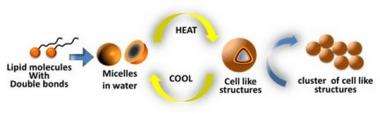
A cartoon representation of reversible organization from synthetic lipid-like molecules to form cell-like structures (called vesicles) upon change in temperature. The cell like structures cluster together similar to toad eggs or Caviar-like morphologies upon maintaining a particular temperature.

(PhysOrg.com) -- The venus flytrap plant captures its prey when it senses the presence of an insect on the tips of its leaves. An amphiphilic molecule designed by chemists at The City College of New York acts in a similar manner by changing its structure when heated slightly and, then, reverting to its original form when cooled.

The finding, reported in the journal , points toward the possibility of designing adaptive soft materials in the lab that take their cues from how nature responds to , said Dr. George John, associate professor and corresponding author.

Professor John and colleagues designed the molecule, which has both water-adhering and water-repelling ends, from cardanol, a naturally available material found in cashew nut shell liquid. When mixed with water, the molecules formed a self-assembled called a micelle with a water-adhering exterior and water-repelling interior.

Warming the micelles to 50 degrees Celsius caused them to take on a three-dimensional structure known as a vesicle that was larger – 200 – 300 nm in diameter – and viscous, much like oil. "The molecules would stick together, similar to caviar," Professor John said. "When we touched the material with a glass rod, we could draw it out in a thin strand, much like glue."

Allowing the material to cool resulted in the reverting to their original micellar structure. When they were reheated, they would again take on the viscous form.

The change in structure resulted because, while heating caused the micelles to rearrange, they began to interlock in a bi-layer arrangement and eventually undergo curvature. Directional hydrogen bonding of the amide linkages and stacking of the aromatic ring groups, further stabilized the assembly.

The objective of the research is to study responsive systems, Professor John said. "If we can understand the influence of saturation at the bi-layer stage, we can regulate the adaptive response to stimuli." This will require investigating the number of micelles needed in a mixture and where they need to be positioned.

Explore further: Scientists determine activation barrier in ammonia-sulfuric acid clusters that could lead to cloud formation

Provided by City College of New York

4.3 /5 (4 votes)

Related Stories

Sugar battles oil spills

Aug 12, 2010

The environment has often suffered from the catastrophic effects of an oil spill, the most recent example being the oil spill in the Gulf of Mexico. The search for ways to remove oil from polluted water is ...

A Venus flytrap for nuclear waste

Jan 26, 2010

Not every object is food to a Venus flytrap. Like the carnivorous plant, a new material developed at Northwestern University permanently traps only its desired prey, the radioactive ion cesium, and not other harmless ions ...

Scientists make water-free liquid from blood protein

Jun 07, 2010

(PhysOrg.com) -- Scientists at the University of Bristol have discovered a way to make a highly concentrated water-free liquid of a key blood protein, myoglobin, opening up the possibility of new types of ...

Recommended for you

Unique method creates correct mirror image of molecule

May 22, 2013

Many molecules have a right and a left form, just like shoes. In pharmaceuticals, it is important that the correct form of the molecule is used. Researchers at the University of Gothenburg, Sweden, have been ...

New method for producing clean hydrogen

May 21, 2013

Duke University engineers have developed a novel method for producing clean hydrogen, which could prove essential to weaning society off of fossil fuels and their environmental implications.

Non-wetting fabric drains sweat

May 20, 2013

(Phys.org) —Waterproof fabrics that whisk away sweat could be the latest application of microfluidic technology developed by bioengineers at the University of California, Davis.

User comments : 0

More news stories

Scientists develop advanced biological computer

(Phys.org) —Using only biomolecules (such as DNA and enzymes), scientists at the Technion-Israel Institute of Technology have developed and constructed an advanced biological transducer, a computing machine capable of manipulating ...

Explainer: What are chemical weapons?

There was chaos on the streets of Halajba in March 1988. In this corner of Iraq, at the time Iraqi Kurdistan, people had suddenly started experiencing cold-like symptoms – tight chest and nasal congestion. ...

Strong earthquake at exceptional depth

This morning at 05:45 CEST, the earth trembled beneath the Okhotsk Sea in the Pacific Northwest. The quake, with a magnitude of 8.2, took place at an exceptional depth of 605 kilometers. Because of the great ...