Catastrophic drought looms for capital city of Bolivia
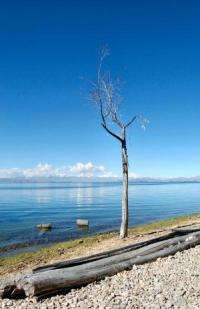
Drought is on the horizon for the region surrounding Lake Titicaca; it may arrive by 2040. Credit: laketiticaca.org
Catastrophic drought is on the near-term horizon for the capital city of Bolivia, according to new research into the historical ecology of the Andes.
If temperatures rise more than 1.5 to 2 degrees Celsius (3 to 5 degrees Fahrenheit) above those of modern times, parts of Peru and Bolivia will become a desert-like setting.
The change would be disastrous for the water supply and agricultural capacity of the two million inhabitants of La Paz, Bolivia's capital city, scientists say.
The results, derived from research funded by the National Science Foundation (NSF) and conducted by scientists affiliated with the Florida Institute of Technology (FIT), appear in the November issue of the journal Global Change Biology.
Climatologist Mark Bush of FIT led a research team investigating a 370,000-year record of climate and vegetation change in Andean ecosystems.
The scientists used fossilized pollen trapped in the sediments of Lake Titicaca, which sits on the border of Peru and Bolivia.
They found that during two of the last three interglacial periods, which occurred between 130,000-115,0000 years ago and 330,000-320,000 years ago, Lake Titicaca shrank by as much as 85 percent.
Adjacent shrubby grasslands were replaced by desert.
In each case, a steady warming occurred that caused trees to migrate upslope, just as they are doing today.
However, as the climate kept warming, the system suddenly flipped from woodland to desert.
"The evidence is clear that there was a sudden change to a much drier state," said Bush.
Scientist Sherilyn Fritz at the University of Nebraska-Lincoln showed that during these warm episodes the algae living in Lake Titicaca shifted from freshwater species to ones tolerant of salty water. Paul Baker of Duke University identified peaks of carbonate deposition.
Both point to a sudden shallowing of the lake due to evaporative loss.
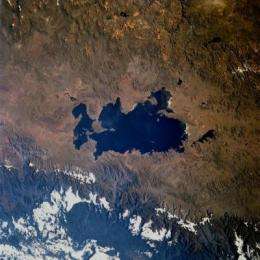
This is Lake Titicaca viewed from space. Its outline may look very different in the future. Credit: NASA
An environmental reconstruction demonstrates that with moderate warming, forests moved upslope. But as that warming continued, a climate tipping point was reached.
The system was thrown into a new, drier state that halted forest expansion.
The tipping point is caused by increased evaporative loss from Lake Titicaca.
As the lake contracts, the local climate effects attributable to a large lake--doubling of rainfall, among the most important--would be lost, says Bush.
Such tipping points have been postulated by other studies, but this work allowed the researchers to state when the system will change.
Based on the growth limits of Andean forests, they defined a tipping point that was exceeded within a 1.5 to 2 degrees Celsius warming above modern conditions.
Given a rate of warming in the Peruvian Andes of about 0.3-0.5 degrees Celsius per decade, the tipping point ahead would be reached between 2040 and 2050.
"The implications would be profound for some two million people," says Paul Filmer, program director in NSF's Division of Earth Sciences. Severe drought, and a loss of stored water in lakes in the region, would reduce yields from important agricultural regions and threaten drinking water supplies.
The research suggests that limiting wildfires would help delay the worst effects of the drought.
Provided by
National Science Foundation
-
From lemons to lemonade: Reaction uses carbon dioxide to make carbon-based semiconductor,
28 comments
-
Every black hole contains a new universe: A physicist presents a solution to present-day cosmic mysteries,
215 comments
-
New silicon memory chip developed,
16 comments
-
Thioridazine kills cancer stem cells in human while avoiding toxic side-effects of conventional cancer treatments,
2 comments
-
SpaceX private rocket blasts off for space station (Update),
41 comments
-
Conversion from aircraft bearing to normal degrees
May 23, 2012
-
Interpretation/Analysis of the Lab results(HEPA filter)
May 22, 2012
-
Has anyone here attended the The Urbino Summer School in Paleoclimatology?
May 22, 2012
-
Earthquakes: Mag 6 N. Italy and Mag 5.6 W. Bulgaria
May 21, 2012
-
determining time frame for most recent geological layers
May 17, 2012
-
solar radiation - conversion to calculate radiation impacting vertical surface
May 16, 2012
- More from Physics Forums - Earth
More news stories
SKA super telescope to be built in Australia, South Africa (Update 2)
A long-running joust to host a radio telescope that would give mankind its farthest peek into the Universe ended on Friday with a Solomon-like judgement to split the site between Australia and South Africa.
2 hours ago |
not rated yet |
0
Dragon arrives at space station in historic 1st (Update 2)
The privately bankrolled Dragon capsule arrived at the International Space Station for a historic docking Friday, captured by astronauts wielding a giant robot arm.
Space & Earth / Space Exploration
1 hour ago |
5 / 5 (3) |
3
Organic carbon from Mars, but not biological
(Phys.org) -- Molecules containing large chains of carbon and hydrogen--the building blocks of all life on Earth--have been the targets of missions to Mars from Viking to the present day. While these molecules ...
Space & Earth / Space Exploration
21 hours ago |
4.4 / 5 (5) |
2
|
Aliens don't want to eat us, says former SETI director
Alien life probably isnt interested in having us for dinner, enslaving us or laying eggs in our bellies, according to a recent statement by former SETI director Jill Tarter.
Space & Earth / Space Exploration
2 hours ago |
5 / 5 (4) |
5
Sea sponges could act as early warning system
(Phys.org) -- Sea sponges may hold clues to climate change and other impending environmental risks, researchers from Flinders University believe.
2 hours ago |
not rated yet |
0
First study to suggest that the immune system may protect against Alzheimer's changes in humans
Recent work in mice suggested that the immune system is involved in removing beta-amyloid, the main Alzheimer's-causing substance in the brain. Researchers have now shown for the first time that this may apply in humans.
Inherited DNA change explains overactive leukemia gene
A small inherited change in DNA is largely responsible for overactivating a gene linked to poor treatment response in people with acute leukemia.
A new invading sea crab reaches the Ebro Delta
Originally endemic to the Atlantic Coast of North America, over the past 30 years Dyspanopeus sayi has been involuntarily introduced in the UK, France, the Netherlands, the Black Sea and the Adriatic Sea. A ...
Phone contact with nurses linked with better outcomes for women with gestational diabetes
Among women with gestational diabetes mellitus, referral to a telephone-based nurse management program was associated with lower risk of high baby birth weight and increased postpartum glucose testing, according to Kaiser ...
Physicians definitively links irritable bowel syndrome and bacteria in gut
An overgrowth of bacteria in the gut has been definitively linked to Irritable Bowel Syndrome in the results of a new Cedars-Sinai study which used cultures from the small intestine. This is the first study to use this "gold ...
Beyond oil, can Alaska be tapped as a source for renewable energy?
Alaska has massive hydro, wind, geothermal and other renewable resources, but the state's rural villages are chained to diesel and suffer oppressive energy costs they say threaten their existence. Lawmakers, energy experts ...

Nov 15, 2010
Rank: 1 / 5 (1)
Propaganda?
This new, short video explains how government science really works.
Real Science vs Federal Science Elitism
http://www.youtub...ld5PR4ts
Questions and comments would be appreciated.
With kind regards
Oliver K. Manuel
Emeritus Professor
Nuclear & Space Sciences
Former NASA Principal
Investigator for Apollo