Cancer drug linked to quantum dots increases drug uptake, reduces inflammation
November 1, 2010

Cancer drug linked to quantum dots increases drug uptake, reduces inflammation

Enlarge

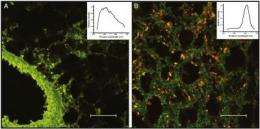
The left image shows lung tissue injected with doxorubicin alone, while the image on the right (yellow dots)indicates the increased uptake of the quantum-dot delivered drug. Credit: University at Buffalo

Researchers at the University at Buffalo have developed a novel technology using quantum dots that is expected to have major implications for research and treatment of tuberculosis, as well as other inflammatory lung diseases.

A paper appearing online in Nanomedicine: Nanotechnology, Biology and Medicine as an article-in-press describes specific delivery of a to specific cells in the lung, particularly the alveolar white cell, without causing acute inflammation.
are tiny generally no larger than 10 nanometers that can be made to fluoresce in different colors depending on their size. Scientists are interested in quantum dots because they are a superb carrier and last much longer than conventional dyes used to tag molecules, which usually stop emitting light in seconds.

"The ability to target specific cells in the lung without exposing surrounding cells and tissue or distant organs to the detrimental effects of drugs is an exciting avenue to explore," says Krishnan V. Chakravarthy, PhD, a research fellow in the UB School of Medicine and Biomedical Sciences joint MD/PhD program and lead author on the paper.

"We have been able to prove this in both and in animals," he continues. "The technology is still in its infancy, but being able to conduct these experiments in the whole animal makes it more promising as a clinical application. The long-term goal would be to do targeted drug delivery through aerosolized techniques, making it suitable for clinical use."

Researchers in UB's Institute of Lasers, Photonics and have made major advancements in the use of quantum dots, sometimes called , to build new devices for biological and environmental sensing.

In this research, quantum dots were linked with doxorubicin, an anti-cancer chemotherapy drug, to target specific , known as (aMØ) which play a critical role in the pathogenesis of various inflammatory lung injuries.

"The aMØ is the sentinel cell involved in directing the host innate and adaptive immune responses involved in infectious and non-infectious lung diseases such as COPD," notes Chakravarthy. "The aMØ's central role in response to environmental influences makes these cells an ideal candidate for targeted drug delivery to modulate the immune/inflammatory response."

To test the ability of linked quantum dot-doxorubicin (QD-DOX) to decrease lung inflammation, the researchers delivered QD-DOX or doxorubicin alone to rats and mice and assessed the damage to the lung. Doxorubicin, a frequently used cancer drug, is known to cause a variety of damaging immune responses in cancer patients.

Results showed that QD-DOX increased uptake of the drug compared with doxorubicin alone, and did not cause as significant a pro-inflammatory response as doxorubicin alone. The researchers also demonstrated that the drug is released from the QD-DOX formulation once it is delivered into the targeted cell and still retains its bioactivity.

"Based on these results, we believe that linking quantum dots with therapeutic drugs may have tremendous potential for diagnosis and treatment of lung injury compared to other nanoparticle formulations, and should be further developed for lung pharmacotherapy applications," says Chakravarthy.

Provided by University at Buffalo search and more info website


Rank 5 /5 (2 votes)
Relevant PhysicsForums posts

More news stories

Nanotechnology for solar energy conversion systems

EU researchers extensively characterised the self-organisation of nanotubes and developed novel compositions particularly appropriate to solar energy conversion applications.

Nanotechnology / Nanomaterials

created 41 minutes ago | popularity not rated yet | comments 0

Synthetic nano-waste does not disappear

(Phys.org) -- Tiny particles of cerium oxide do not burn or change in the heat of a waste incineration plant. They remain intact on combustion residues or in the incineration system, as a new study by Swiss ...

Nanotechnology / Bio & Medicine

created 2 hours ago | popularity not rated yet | comments 0 | with audio podcast

Nano-structured polymer-based materials from scrap

EU researchers developed polymer blends and processing techniques facilitating recovery of scrap from industrial processes. Advances in this area have the potential to decrease costs and waste while protecting ...

Nanotechnology / Nanomaterials

created 1 hour ago | popularity not rated yet | comments 0

In nanorod crystal growth, nanoparticles seen as artificial atoms

In the growth of crystals, do nanoparticles act as "artificial atoms" forming molecular-type building blocks that can assemble into complex structures? This is the contention of a major but controversial theory ...

Nanotechnology / Nanophysics

created 20 hours ago | popularity 4.8 / 5 (5) | comments 0 | with audio podcast

First direct observation of oriented attachment in nanocrystal growth

Berkeley Lab researchers have reported the first direct observation of nanoparticles undergoing oriented attachment, the critical step in biomineralization and the growth of nanocrystals. A better understanding ...

Nanotechnology / Nanophysics

created 20 hours ago | popularity 4.7 / 5 (3) | comments 0 | with audio podcast


MIT researchers devise new means to synchronize a group of robots (w/ Video)

(Phys.org) -- For several years, roboticists have been working out ways to get a group of robots to perform synchronized activities as demonstrated most often in dance routines. It’s not just about trying ...

First study to suggest that the immune system may protect against Alzheimer's changes in humans

Recent work in mice suggested that the immune system is involved in removing beta-amyloid, the main Alzheimer's-causing substance in the brain. Researchers have now shown for the first time that this may apply in humans.

A new invading sea crab reaches the Ebro Delta

Originally endemic to the Atlantic Coast of North America, over the past 30 years Dyspanopeus sayi has been involuntarily introduced in the UK, France, the Netherlands, the Black Sea and the Adriatic Sea. A ...

Phone contact with nurses linked with better outcomes for women with gestational diabetes

Among women with gestational diabetes mellitus, referral to a telephone-based nurse management program was associated with lower risk of high baby birth weight and increased postpartum glucose testing, according to Kaiser ...

Physicians definitively links irritable bowel syndrome and bacteria in gut

An overgrowth of bacteria in the gut has been definitively linked to Irritable Bowel Syndrome in the results of a new Cedars-Sinai study which used cultures from the small intestine. This is the first study to use this "gold ...

WHO target to cut early chronic illness deaths

The World Health Organization announced on Friday it was set to approve a new target to reduce premature deaths from chronic illnesses such as heart disease by a quarter by 2025.