Broadband usage growing even as gaps persist
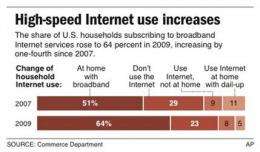
(AP) -- The U.S. still faces a significant gap in residential broadband use that breaks down along incomes, education levels and other socio-economic factors, even as subscriptions among American households overall grew sevenfold between 2001 and 2009.
What's more, even when controlling for key socio-economic characteristics, the U.S. continues to confront a racial gap in residential broadband use, with non-Hispanic white Americans and Asian-Americans more likely to go online using a high-speed connection than African-Americans and Hispanics.
Those are some of the key conclusions of a new analysis of Census data being released Monday by the Commerce Department. It found that the percentage of households that connect to the Internet using broadband grew to 63.5 percent in 2009 from 9.2 percent in 2001, reflecting increases across nearly all demographics.
The report - prepared by the Commerce Department's National Telecommunications and Information Administration and the Economics and Statistics Administration - is based on a Census survey of about 54,000 households conducted in October 2009.
The new report provides some of the deepest analysis yet of broadband usage trends in the United States. And it is likely to help guide Congress and the Federal Communications Commission as they develop policies to ensure that all Americans have access to affordable high-speed Internet service.
The analysis, said Lawrence Strickling, head of the NTIA, shows that "there is no single solution" to make this happen.
Among the major findings:
- 94.1 percent of households with income exceeding $100,000 subscribed to broadband in 2009, compared with 35.8 percent of households with income of less than $25,000.
- 84.5 percent of households with at least one college degree subscribed to broadband last year, compared with 28.8 percent of households without a high school degree.
- 77.3 percent of Asian-American households and 68 percent of non-Hispanic white households subscribed to broadband last year, compared with 49.4 percent of African-American households and 47.9 percent of Hispanic households.
- 65.9 percent of urban households subscribed to broadband in 2009, compared with 51 percent of rural households.
Closing such gaps is a top priority for the FCC, which released a sweeping national broadband plan filled with policy proposals in March. The agency's top recommendations include tapping the federal program that subsidizes telephone service for poor and rural Americans to pay for broadband, and unleashing more airwaves for wireless connections. Wireless broadband is seen as a particularly attractive option for bringing high-speed connections to rural areas that may be too sparsely populated to justify costly landline networks.
At the same time, the NTIA and the Rural Utilities Service, part of the Agriculture Department, have been handing out roughly $7 billion in stimulus money to pay for new broadband networks and programs to get more Americans online.
Strickling stressed that one key challenge for policymakers lies in convincing Americans who are not online of the benefits of broadband.
The Census data found that 38 percent of Americans who don't have broadband at home say they don't subscribe because they don't need it, while 26 percent say it's too expensive and only 4 percent say it's not available where they live.
A survey conducted by the FCC last year reached many of the same conclusions. It found that 35 percent of Americans do not use broadband at home, including 22 percent of adults who do not use the Internet at all. Of that 35 percent, 36 percent say it is too expensive, while 19 percent do not see the Internet as relevant to their lives. Another 22 percent lack what the FCC calls "digital literacy" skills.
To try to change such attitudes, the stimulus program includes $250 million for projects to teach digital literacy skills and encourage broadband adoption, plus another $200 million for public computer centers.
One surprising finding of the new Commerce Department report is that African-Americans and Hispanics lag behind in broadband adoption even when controlling for factors such as income and education. The data show a gap of 10 percentage points in broadband use between whites and blacks and a gap of 14 percentage points between whites and Hispanics even after controlling for socio-economic factors.
Although the data do not provide an explanation for these numbers, Rebecca Blank, under secretary for Economic Affairs, believes it could reflect limited exposure to the Internet among certain racial groups.
"Internet usage relies on networks," she said. "If the people around you don't use the Internet, you will be less likely to use the Internet, too."
©2010 The Associated Press. All rights reserved. This material may not be published, broadcast, rewritten or redistributed.


