Trained bacteria convert bio-wastes into plastic
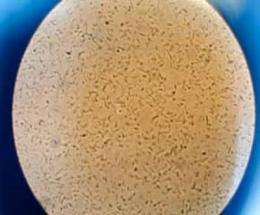
Dutch researcher Jean-Paul Meijnen has 'trained' bacteria to convert all the main sugars in vegetable, fruit and garden waste efficiently into high-quality environmentally friendly products such as bioplastics.
He will be defending his doctoral thesis on this topic, which was carried out in the context of the NWO B-Basic programme, at TU Delft in the Netherlands on Monday 22 November 2010.
There is considerable interest in bioplastics nowadays. The technical problems associated with turning potato peel into sunglasses, or cane sugar into car bumpers, have already been solved. The current methods, however, are not very efficient: only a small percentage of the sugars can be converted into valuable products. By adapting the eating pattern of bacteria and subsequently training them, Meijnen has succeeded in converting sugars in processable materials, so that no bio-waste is wasted.
The favoured raw materials for such processes are biological wastes left over from food production. Lignocellulose, the complex combination of lignin and cellulose present in the stalks and leaves of plants that gives them their rigidity, is such a material. Hydrolysis of lignocellulose breaks down the long sugar chains that form the backbone of this material, releasing the individual sugar molecules. These sugar molecules can be further processed by bacteria and other micro-organisms to form chemicals that can be used as the basis for bioplastics. The fruit of the plant, such as maize, can be consumed as food, while the unused waste such as lignocellulose forms the raw material for bioplastics.
Cutting the price of the process
'Unfortunately, the production of plastics from bio-wastes is still quite an expensive process, because the waste material is not fully utilized,' explains Jean-Paul Meijnen. (It should be noted here that we are talking about agricultural bio-wastes in this context, not the garden waste recycled by households.) The pre-treatment of these bio-wastes leads to the production of various types of sugars such as glucose, xylose and arabinose. These three together make up about eighty per cent of the sugars in bio-waste.
The problem is that the bacteria Meijnen was working with, Pseudomonas putida S12, can only digest glucose but not xylose or arabinose. As a result, a quarter of the eighty per cent remains unused. 'A logical way of reducing the cost price of bioplastics is thus to 'teach' the bacteria to digest xylose and arabinose too.'
Enzymes
The xylose has to be 'prepared' before Pseudomonas putida S12 can digest it. This is done with the aid of certain enzymes. The bacteria are genetically modified by inserting specific DNA fragments in the cell; this enables them to produce enzymes that assist in the conversion of xylose into a molecule that the bacteria can deal with.
Meijnen achieved this by introducing two genes from another bacterium (E. coli) which code for two enzymes that enable xylose to be converted in a two-stage process into a molecule that P. putida S12 can digest.
Evolution
This method did work, but not very efficiently: only twenty per cent of the xylose present was digested. The modified bacteria were therefore 'trained' to digest more xylose. Meijnen did this by subjecting the bacteria to an evolutionary process, successively selecting the bacteria that showed the best performance.
'After three months of this improvement process, the bacteria could quickly digest all the xylose present in the medium. And surprisingly enough, these trained bacteria could also digest arabinose, and were thus capable of dealing with the three principal sugars in bio-wastes.'
Meijnen also incorporated other genes, from the bacterium Caulobacter crescentus. This procedure also proved effective and efficient from the start.
Blend
Finally, in a separate project Meijnen succeeded in modifying a strain of Pseudomonas putida S12 that had previously been modified to produce para-hydroxybenzoate (pHB), a member of the class of chemicals known as parabens that are widely used as preservatives in the cosmetics and pharmaceutical industries.
Meijnen tested the ability of these bacteria to produce pHB, a biochemical substance, from xylose and from other sources such as glucose and glycerol. He summarized his results as follows: 'This strategy also proved successful, allowing us to make biochemical substances such as pHB from glucose, glycerol and xylose. In fact, the use of mixtures of glucose and xylose, or glycerol and xylose, gives better pHB production than the use of unmixed starting materials. This means that giving the bacteria pretreated bio-wastes as starting material stimulates them to make even more pHB.'
Provided by Delft University of Technology


