'BacillaFilla' for concrete cracks
November 12, 2010

'BacillaFilla' for concrete cracks

Enlarge

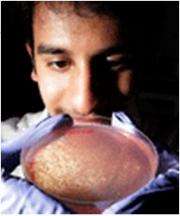
A bacteria that can knit together cracks in concrete structures by producing a special 'glue' has been developed by a team of students at Newcastle University.

The genetically-modified microbe has been programmed to swim down fine in the concrete. Once at the bottom it produces a mixture of calcium carbonate and a bacterial which combine with the filamentous bacterial to ‘knit’ the building back together.

Ultimately hardening to the same strength as the surrounding concrete, the ‘BacillaFilla’ – as it has been aptly named – has been developed to prolong the life of structures which are environmentally costly to build.

Designed as part of a major international science competition in the US, the students have scooped Gold for their research.

Joint project instructor Dr. Jennifer Hallinan explains: “Around five per cent of all man-made carbon dioxide emissions are from the production of concrete, making it a significant contributor to global warming.

“Finding a way of prolonging the lifespan of existing structures means we could reduce this environmental impact and work towards a more sustainable solution.

“This could be particularly useful in earthquake zones where hundreds of buildings have to be flattened because there is currently no easy way of repairing the cracks and making them structurally sound.”

As part of the research, the students have not only considered the advantages of their engineered , but also the potential risks to the environment.

The BacillaFilla spores only start germinating when they make contact with concrete – triggered by the very specific pH of the material – and they have an in-built self-destruct gene which means they would be unable to survive in the environment.

Once the cells have germinated, they swarm down the fine cracks in the concrete and are able to sense when they reach the bottom because of the clumping of the bacteria.

This clumping activates repair, with the cells differentiating into three types: cells which produce crystals, cells which become filamentous acting as reinforcing fibres and cells which produce a Levans glue which acts as a binding agent and fills the gap.

The nine students, whose backgrounds range from computer science, civil engineering and bioinformatics to microbiology and biochemistry, took part in the International Genetically Engineered Machines contest (iGEM), is run out of the Massachusetts Institute of Technology (MIT) in Cambridge, Boston.

The aim is to get together a team of students from a variety of backgrounds to design and genetically engineer a bacterium to do something novel and useful.

Over 130 teams took part in this year’s event and it is now the third time Newcastle University has won Gold. The team instructors were Professor Neil Wipat and Dr. Jennifer Hallinan, and the advisors were Dr. Wendy Smith, Dr. Matthew Pocock, Dr. Colin Davies, Dr. Jem Stach and Professor Colin Harwood.

Professor Neil Wipat added: “The students have done extremely well – this is a great achievement.  Their work will now be used as a basis for research which is being carried out here at the University.”

Provided by Newcastle University

Filter


Move the slider to adjust rank threshold, so that you can hide some of the comments.


Display comments: newest first

JamesThomas
Nov 12, 2010

Rank: 5 / 5 (2)
'BacillaFilla'....LOL

That the bacteria produces the three required ingredients is fascinating.
Bob_B
Nov 12, 2010

Rank: not rated yet
The BacillaFilla hits the bottom then it repairs the concrete from the bottom, up?
krundoloss
Nov 12, 2010

Rank: 4.5 / 5 (2)
This is awesome. Atleast until they start filling the cracks in Humans! AAHHHHHH! They will kill us all. But our dead bodies will be structurally sound. LOL!
Mandan
Nov 12, 2010

Rank: 4 / 5 (2)
This is very exciting. I have long felt that a future for humans on this planet will not be possible if we continue our current wasteful ways, or keep inventing new, energy intensive methods for extracting food/resources from the environment.

The microbial world is a vast laboratory/energy source/manufacturing sector/food producing asset which has been in business for over 2 billion years.

Microbes, in conjunction with chemistry and physics, have built this world. They have already invented everything for us. We just need to learn how to let them do it for us.

There are no toxic substances in the microcosmos. For everything we have made from the things we dug up/pumped out, heated up/cooled down there is a microbe that has been eating it somewhere on-or-in the earth, and turning it into something useful to other life forms or locking it up in inert structures in conjunction with the forces of geology-- forever.

Microbial tech is our next revolution. The time is now.
Decimatus
Nov 12, 2010

Rank: not rated yet
This is awesome. Atleast until they start filling the cracks in Humans! AAHHHHHH! They will kill us all. But our dead bodies will be structurally sound. LOL!


This made me lol.

Give me concrete bones oh great bacteria!
DamienS
Nov 12, 2010

Rank: 5 / 5 (1)
I would have liked to have known at what rate this works. How long would it take to repair a meter long hairline crack?
trekgeek1
Nov 12, 2010

Rank: 4.7 / 5 (3)
This is a great breakthrough. I'm very happy to see we are finally reprogramming nature for our purposes.
However,

and they have an in-built self-destruct gene which means they would be unable to survive in the environment.


If they are grown in a culture, they reproduce with each other. If they reproduce with each other, or at least divide themselves, couldn't a gene mutation evolve within them and possibly shut down this auto destruct sequence? This seems possible unless you painstakingly grow each bacteria so that the possibility of passing on a genetic mutation is reduced significantly. I'm no biologist, so could somebody elaborate on the possibility of these evolving?
tarheelchief
Nov 13, 2010

Rank: not rated yet
This new product should be placed in the hands of all the California, New England,Midwestern, Atlantic states,and Rocky Mountain states which use salt on which injures their roads and destroys their bridges.
andeee
Nov 13, 2010

Rank: 4 / 5 (1)
Issues:- How does this bacteria tell the difference between concrete and for example natural lime stone and other Alkaline rocks? If it is released into the environment its effect could be catastrophic. Although novel and an interesting concept how will it be controlled?
douglas2
Nov 13, 2010

Rank: not rated yet
ice IX . Will it cement everything when it goes free?
andeee
Nov 13, 2010

Rank: not rated yet
some how I think this is a hoax.....need more info
SkiSci
Nov 13, 2010

Rank: not rated yet
Issues:- How does this bacteria tell the difference between concrete and for example natural lime stone and other Alkaline rocks? If it is released into the environment its effect could be catastrophic. Although novel and an interesting concept how will it be controlled?


It is probably fine-tuned to excel in concrete specific environments. Even so, it would most certainly be weeded out in a different environment, one full of competitors. But I still wouldn't want to stick BacillaFilla up my ass.
genastropsychicallst
Nov 15, 2010

Rank: 1 / 5 (1)
Bacils lensing the lost life of viruses known as a gravitation founded dead on bacteriums, Albert.
Rank 5 /5 (23 votes)
Relevant PhysicsForums posts

More news stories

Alibaba.com $2.5B privatization bid approved

(AP) -- Chinese e-commerce firm Alibaba Group's $2.5 billion bid to take its Hong Kong-listed unit private was cleared Friday by minority shareholders, easing the way for CEO Jack Ma to gain more control over his company's ...

Technology / Business

created 1 hour ago | popularity not rated yet | comments 0

Researchers successfully test solar desalination system for arid land agriculture

Ben-Gurion University of the Negev (BGU) researchers have created a man-made oasis in the desert with the successful application of a solar-powered desalination system that provides water for irrigation in arid regions. The ...

Technology / Energy & Green Tech

created 6 minutes ago | popularity not rated yet | comments 0

Computers excel at identifying smiles of frustration (w/ Video)

(Phys.org) -- Researchers at the Massachusetts Institute of Technology (MIT) in the US have trained computers to recognize smiles, and they have turned out to be more adept at recognizing smiles of frustration ...

Technology / Computer Sciences

created 5 hours ago | popularity not rated yet | comments 1 | with audio podcast report

Everyone knows it's windy . . .

... And now they have the data to prove it.  The middle of Lake Michigan is a vast, untapped reservoir of wind energy. The next step will be to find out if it can be harvested economically without harming ...

Technology / Energy & Green Tech

created 1 hour ago | popularity not rated yet | comments 0

Solar plane ends first leg of intercontinental bid

The Swiss sun-powered aircraft Solar Impulse landed safely in Madrid early Friday at the end of the first leg of its attempt at an intercontinental flight without using a drop of fuel.

Technology / Energy & Green Tech

created 6 hours ago | popularity 5 / 5 (1) | comments 1


Of mice and mental models: Neuroscientific implications of risk-optimized behavior in the mouse

(Medical Xpress) -- Regardless of an organism’s biological complexity, every encephalized animal continuously makes under-informed behavioral choices that can have serious consequences. Despite its ubiquity, ...

Researchers demonstrate possible primitive mechanism of chemical info self-replication

(Phys.org) -- When scientists think about the replication of information in chemistry, they usually have in mind something akin to what happens in living organisms when DNA gets copied: a double-stranded molecule ...

Researchers identify key brain cell in antidepressant action

(Medical Xpress) -- Antidepressant medications such as Prozac have helped improve mood and lessen anxiety in millions of people with major depression. But scientists know surprisingly little about how these drugs work.

Looking out for the Myanmar snub-nosed monkey

A new genetic study has shed light on how the newly discovered Myanmar snub-nosed monkey evolved.

New prostate cancer screening guidelines face a tough sell, study suggests

(Medical Xpress) -- Recent recommendations from the U.S. Preventive Services Task Force (USPSTF) advising elimination of routine prostate-specific antigen (PSA) screening for prostate cancer in healthy men are likely to encounter ...

Questionable research practices surprisingly common

(Medical Xpress) -- Not all scientific misconduct is flat-out fraud. Much falls into the murkier realm of “questionable research practices.” A new study finds that in one field, psychology, these practices are surprisingly ...