Babies and robots learn from each other
A few years ago, AnthroTronix, Inc., an engineering research and development firm in College Park, Md., introduced Cosmobot, a type of social robot for therapists and educators who work with developmentally and learning disabled children.
By imitating human joint movement in its shoulders, arms, hands and head, Cosmobot motivates children to develop new skills more quickly than is typical with traditional therapy. Supported in part by the National Science Foundation's (NSF) Small Business Innovation Research Program, scientists developed the assistive social robot primarily to work with children ages 5-12, including those with autism and cerebral palsy.
But why does this work? Why do children respond so favorably to educational programs taught by technology? And when the technology is a robot made from inanimate materials, how do children learn to distinguish between the robot and a living thing?
The answer, it turns out, may have far-reaching implications for interaction with "social" robots for both children and adults.
Working with a group of 18-month-old toddlers and a metallic robot, a team of scientists from the University of Washington (UW) recently determined that it is not only what something looks like, but how it moves and interacts with others that give even inanimate objects social significance. In fact, they say these characteristics give lifeless objects meaning to all humans regardless of age.
Their interdisciplinary experiment was funded in part by the LIFE Center at the University of Washington, which is part of NSF's Science of Learning Center program.
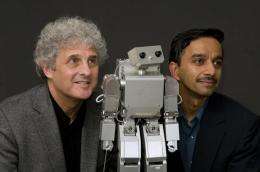
"Over the past 10 years, research in developmental science has taught us that social interaction is important for children's learning," said project co-director psychologist Andrew Meltzoff of UW's Institute for Learning & Brain Sciences.
But what makes something "social?" Meltzoff's group has a particular interest in this question not only because it is relevant to children with autism, but also because of its importance for typical child development and the design of new learning technologies. "It is not so much what an entity looks like--its physical features--or even how it moves, but how it interacts and reacts that is important to a child," he said.
UW computer scientist and co-director of the project Rajesh Rao agreed. "From a robotics point of view, the results shift the emphasis from designing robots that look like humans to robots that can interact credibly with humans," he said applying the findings to his particular area of building adaptive robotic systems.
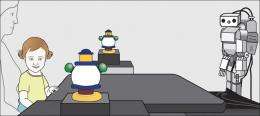
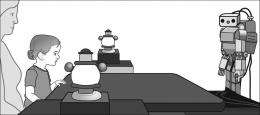
The research team programmed a metal robot named Morphy to copy some basic human social skills and designed an experiment to see if 18-month-olds would interact with it. During the experiment, 64 babies individually sat on their parents' lap facing Rechele Brooks, a co-author of the UW study. The babies played with toys for a few minutes to get used to the environment and then Brooks revealed Morphy, who was hidden behind a barrier.
Following a script, Brooks said, "Oh, hi! That's our robot!" and asked Morphy if it wanted to play a game. Controlled by a researcher hidden from the baby, Morphy responded by waving its arms and shaking its head. Brooks then asked, "Where is your tummy?" and "Where is your head?" and the robot pointed to its torso and head. Then Brooks demonstrated arm movements and Morphy imitated them. All the while, the babies watched, looking back and forth as if at a ping pong match.
Then when Brooks excused herself from the room, researchers measured whether the baby would interact with and take cues from the robot as if it was a sentient being. When the robot looked at a toy in the room, 13 out of 16 babies, who had watched the robot play with Brooks, followed the robot's gaze as compared to a control group in which babies did not see Morphy engage in games. Only 3 of 16 of these babies turned to where the robot was looking.
"Remember, the robot did not directly interact with the child. The child simply observed as the adult and the robot communicated," said Meltzoff. "Yet, they were deeply influenced by what they saw."
Traditional theories picture infants learning about space, objects, causality, and time by playing alone. But newer theories suggest that when they're born, young children are prepared to learn from so-called social agents, who are other members in a group or society who pass on skills, values, beliefs, knowledge and modes of behavior through social interaction. Findings and theories also suggest this type of social interaction is also important over a person's lifetime.
Computer scientists are using this knowledge to fashion acceptable robots that can assist people from childhood well into adulthood.
"The research places important constraints on the design of companion robots and provides clues as to what aspects of human behavior robotics researchers will need to focus on," said Rao.
So-called "companion robots" have a number of potential applications, ranging from helping and caring for the elderly and disabled to doing household chores and acting as playmates or personalized tutors for children. But robotics researchers have long wondered how human-like in appearance they need to be for adults to accept them.
The study indicates that more than appearance, robots will need to possess sophisticated cognitive abilities such as being able to understand speech and imitate human actions in order to pass the test of human social acceptance. The specific set of movements or gestures a robot should have will depend on a number of factors such as the domain in which it operates--whether the robot is an emergency responder or a child's tutor, for example. Programming for local culture also is important for determining whether humans will interact with it.
"Some skills such as being able to interact through speech and understand a human's intentions are universally applicable to all robots that interact with humans," said Rao. "Other skills will need to be learned on-the-fly, which is one of the reasons why we have focused our robotics research on learning by imitating humans."
The relationship between Meltzoff's work and Rao's work appears to be quite symbiotic with children learning from robots and robots learning from children.
Robots were a crucial help to Meltzoff. "We were able to 'manipulate the stimulus' to investigate the key features of sociality," he said. "In short, if you want a child to learn from a robot, and possibly other types of technology, designers are best advised to infuse it with social characteristics.
"We are making headway into specifying those parameters in some useful detail. For a variety of technical reasons we could not do this with dolls, puppets, or trained human actors. The robots were the key."
Meanwhile, during the last five years, Rao's group has been developing methods by which humanoid robots can learn new skills by observing humans directly. "Our approach to building robots that learn is inspired by how children learn from watching and imitating adults or other children," he said. "Such an approach provides a flexible and powerful way of programming robots through demonstration."
"When we know ‘what makes a social agent' for a child, we may be able to embody the key features in technology to help children learn," Meltzoff said. "We may be able to make technology more social for children, especially for elementary school children, who are quite curious about all kinds of technology and can profit from it."
The researchers say they're not suggesting robot nannies, but the basic principles of learning they're uncovering from infant-robot interaction has implications for future robot use. As the project moves forward, the Seattle infant-robotics team will conduct a range of studies using social robots to investigate social cognition in typical children and children with autism.
"We hope to illuminate the basic mechanisms of social-cognitive development, and with our colleagues in clinical psychology, may be able to contribute to more effective diagnoses and treatment interventions for children with autism," said Meltzoff.
Provided by National Science Foundation


