Autonomous vehicle to demonstrate portable battery charging for dismounted soldiers
Nov 02, 2010
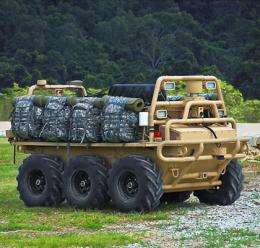
The SMSS Block 1 is the newest variant, featuring a lighter frame, upgraded sensors and better accessibility.

Lockheed Martin’s Squad Mission Support System (SMSS) autonomous vehicle will demonstrate its rugged maneuverability while meeting Soldiers’ needs to recharge batteries in Portable Power Excursion (PPE) tests next month at Fort Riley, KS.

The Portable Power Excursion test is part of the larger Nett Warrior program, which will use the PPE tests to collect data and form a strategy to help alleviate a Soldier’s weight burden, while still providing long-lasting, reliable power critical to today’s missions.

“Soldiers deserve the best possible situational awareness, communications, optics, sensors and protection, and the SMSS will help power it all and relieve their burden,” said Jim Gribschaw, director of Combat Maneuver Systems at Lockheed Martin Missiles and Fire Control. “SMSS represents much more than a portable charging station; it can carry more than half a ton of the Warfighters’ supplies and can autonomously follow the squad, allowing the Soldier to put down the remote control and focus on the fight.”

Lockheed Martin’s SMSS vehicle will cycle through three test Companies from the 1st BDE, 1 Infantry Division during the Nett Warrior excursion demonstration scheduled in November. During that time, SMSS will maneuver with Soldiers and provide two kilowatts to four kilowatts of power. With the requisite number of chargers, the SMSS is capable of charging 146 batteries within 10 hours.

In addition to six Soldier battery chargers and a complement of batteries, the SMSS will carry and power a Mobile Network Integration Kit to improve communications from the network to the platoon, as well as transport up to 600 pounds of other Soldier gear.

Nett Warrior, managed by the U.S. Army’s Product Manager Ground Soldier, is a set of Soldier-worn, battle tracking technologies that provide dismounted with increased situational awareness, better reaction time and reduced risk of fratricide. Nett Warrior is designed for Infantry Brigade Combat Teams. A Nett Warrior-equipped Rifle platoon, along with all of its organic radio power consumers, will consume the power of 140 batteries per day. The collection of batteries required for one 24 hour mission weighs 155 pounds.

Explore further: Sensitive bomb detector to rove in search of danger

add to favorites email to friend print save as pdf

Related Stories

New power sources needed for soldier of the future

Sep 11, 2004

The U.S. Army should investigate alternative power sources, such as fuel cells and small engines, to create longer-lasting, lighter, cheaper, and more reliable sources of energy for the equipment soldiers will use in the ...

Army looks to hydrogen to lighten soldiers' load

Mar 27, 2008

Researchers at Missouri University of Science and Technology are developing a portable, hydrogen-generating power system to power everything from laptops to communications gear for soldiers in the battlefield.

Afghan warfare gets wired in quest to spare lives

Aug 19, 2009

(AP) -- Sgt. 1st Class Gregory Henson goes out on patrol with a computer on his back and a joystick in his holster. He also carries a rifle, but the military is hoping he'll soon have less need for it.

New Technology Aims to Lighten the Load for Soldiers

Feb 08, 2007

The high-tech American soldier, equipped with computers, radios and night-vision goggles, has become a familiar image. However, less well known are the physical and logistical burdens associated with carrying all of that ...

Soldiers turn a march into a charge

Jul 27, 2009

Engineers at the University of Leeds (UK) are developing a way to capture the kinetic energy produced when soldiers march and use it to power their equipment.

Recommended for you

Sensitive bomb detector to rove in search of danger

20 hours ago

European researchers have developed and tested a light-weight device capable of detecting extremely minute quantities of explosives from up to 20 metres away, providing an invaluable law-enforcement tool ...

How soon could car seats enter the 3-D comfort zone?

May 23, 2013

New 3D textiles made of recyclable polyester fibres could contribute help cars be easier to recycle. But recycling technology has yet to progress in separating seat material from other car components.

NASA: Austin, calling Austin. 3-D pizzas to go

May 22, 2013

(Phys.org) —The idea of living with 3-D printed food is neither unthinkable nor new; designers and futurists have been looking to 3-D printing as food's next frontier. In 2012, there was news that the Thiel ...

User comments : 0

More news stories

Google eyes emerging markets networks

Google has become deeply involved in a series of projects to build and operate wireless networks in emerging markets including sub-Saharan Africa and Southeast Asia, a report said Friday.

Facial-recognition technology proves its mettle

(Phys.org) —In a study that evaluated some of the latest in automatic facial recognition technology, researchers at Michigan State University were able to quickly identify one of the Boston Marathon bombing ...

Drones may violate international law

(Phys.org) —As President Obama gives a speech on national security—including defending U.S. use of drones to combat terrorism—Leila Sadat, JD, international law expert and professor of law at Washington University in ...

The long road to the 2000-watt society

The vision of a society in which each inhabitant of the earth manages to consume only 2000 watts has already been around for 15 years. During this time, there has been a steady increase in environmental awareness ...

Galaxies fed by funnels of fuel

(Phys.org) —Computer simulations of galaxies growing over billions of years have revealed a likely scenario for how they feed: a cosmic version of swirly straws.