Anti-mirror optical illusion could increase LED luminosity and laser power
November 15, 2010 By Lisa Zyga
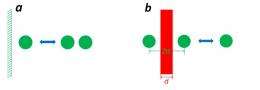
(a) In the mirror effect, an object placed in front of a mirror is equivalent to two identical objects. (b) In the anti-mirror effect, two identical perfect electrical conductors (PECs) on both sides of a perfect lens are equivalent to one object. Image credit: Yadong Xu, et al.
(PhysOrg.com) -- By making multiple objects appear to look like only one using a "perfect lens," scientists have demonstrated a new optical illusion that could have practical applications in lighting systems. Normally, a mirror makes one object appear to look like two objects (the original object and its reflection). Since the new set-up does the opposite, the scientists have called the concept the "anti-mirror effect."
Huanyang Chen, a researcher in metamaterials and transformation optics from Soochow University in Jiangsu, China, and his colleagues have discovered and modeled the anti-mirror effect. The ability to make multiple objects look like one using overlapped illusion optics has not been found in nature before now.
To demonstrate the basic idea, the researchers explained that two identical cylindrical perfect electric conductors (PECs) are placed on opposite sides of a perfect lens made of a negative refractive index material. When viewed from the far field (beyond a certain distance) on either side of the lens, the two PECs look like one. Further, when the scientists replaced one of the circular PECs with an illusion device with an elliptic cylindrical PEC, both PECs look like only one circular cylindrical PEC.
Further elaborating on this effect, the researchers showed that illusion devices with elliptic cylindrical PECs can be used in place of both real cylindrical PECs. Once again, the two illusion devices look like one PEC. As the scientists explained, this effect occurs because the two illusion devices are close enough together so that their virtual illusion spaces overlap. Inside this shared region, both illusion devices form a single PEC image.
The two PECs on both sides of the perfect lens follow the image-forming principle so that each of them is overlapped with the virtual image of another, Chen explained to PhysOrg.com. The anti-mirror effect stems from the evanescent wave amplification of the perfect lens.
The anti-mirror effect could have applications in both solid-state lighting, such as LEDs, and in coherent light sources, such as lasers. Currently, one of the biggest challenges in LED development is achieving a high enough luminosity for general lighting purposes. One method of increasing LED illuminance is to package many LEDs inside a single bulb; however, the problem is that the lamp's spatial illumination is not uniform. Using the new overlapped illusion optics, the researchers show that the images from multiple LEDs in different places can be overlapped to make the bulb look like a single-LED source with high, uniform illumination.
The proposed overlapped illusion optics method could also increase the power and preserve the spatial uniformity of lasers. Usually, spatial uniformity degrades when two coherent sources are aligned due to interference. Using the same configuration as the LEDs, multiple coherent sources can be operated at the same frequency and phase to double the light amplitude and quadruple the total power of the coherent system. These improvements cannot be achieved using traditional beam-combining techniques.
Our current work is just a conceptual model, Chen said. We have recently realized the first illusion optical device an invisible gateway by using a transmission-line medium. See http://arxiv.org/abs/1005.3425 .
More information: Yadong Xu, et al. Anti-mirror effect: A perfect lens brings a brighter future. arXiv:1011.0542v1 [physics.optics] http://arxiv.org/abs/1011.0542
Copyright 2010 PhysOrg.com.
All rights reserved. This material may not be published, broadcast, rewritten or redistributed in whole or part without the express written permission of PhysOrg.com.
-
From lemons to lemonade: Reaction uses carbon dioxide to make carbon-based semiconductor,
28 comments
-
Every black hole contains a new universe: A physicist presents a solution to present-day cosmic mysteries,
215 comments
-
New silicon memory chip developed,
16 comments
-
Thioridazine kills cancer stem cells in human while avoiding toxic side-effects of conventional cancer treatments,
2 comments
-
SpaceX private rocket blasts off for space station (Update),
41 comments
-
Can sound fall?
55 minutes ago
-
AC Electric field in the conducting media
2 hours ago
-
The physics of the greenhouse effect.
2 hours ago
-
Electric Dipole Moment
9 hours ago
-
Paradox of motion implies discrete space?
13 hours ago
-
acceleration decceleration
14 hours ago
- More from Physics Forums - General Physics
More news stories
Landmark calculation clears the way to answering how matter is formed
(Phys.org) -- An international collaboration of scientists, including Thomas Blum, associate professor of physics, is reporting in landmark detail the decay process of a subatomic particle called a kaon ...
55 minutes ago |
3 / 5 (1) |
0
|
Is a classical electrodynamics law incompatible with special relativity?
(Phys.org) -- The laws of classical electromagnetism that were developed in the 19th century are the same laws that scientists use today. They include Maxwell’s four equations along with the Lorentz la ...
Thousands of invisibility cloaks trap a rainbow
Many people anticipating the creation of an invisibility cloak might be surprised to learn that a group of American researchers has created 25 000 individual cloaks.
14 hours ago |
4.8 / 5 (6) |
0
|
Excitons: Exotic particles, chilled and trapped, form giant matter wave
Physicists have trapped and cooled exotic particles called excitons so effectively that they condensed and cohered to form a giant matter wave.
21 hours ago |
4.9 / 5 (9) |
1
|
Slip-and-slide power generators
Researchers from Vestfold University College in Norway have created a simple, efficient energy harvesting device that uses the motion of a single droplet to generate electrical power.
15 hours ago |
4 / 5 (1) |
0
Of mice and mental models: Neuroscientific implications of risk-optimized behavior in the mouse
(Medical Xpress) -- Regardless of an organism’s biological complexity, every encephalized animal continuously makes under-informed behavioral choices that can have serious consequences. Despite its ubiquity, ...
Researchers demonstrate possible primitive mechanism of chemical info self-replication
(Phys.org) -- When scientists think about the replication of information in chemistry, they usually have in mind something akin to what happens in living organisms when DNA gets copied: a double-stranded molecule ...
Synthetic nano-waste does not disappear
(Phys.org) -- Tiny particles of cerium oxide do not burn or change in the heat of a waste incineration plant. They remain intact on combustion residues or in the incineration system, as a new study by Swiss ...
Building a better solar panel -- one molecule at a time
(Phys.org) -- One of the fundamental building blocks in modern chemistry, an organometallic chemical compound called ferrocene, has never been structurally defined - until now.
Researchers identify key brain cell in antidepressant action
(Medical Xpress) -- Antidepressant medications such as Prozac have helped improve mood and lessen anxiety in millions of people with major depression. But scientists know surprisingly little about how these drugs work.
Get ready for the transit of Venus
Scientists and amateur astronomers around the world are preparing to observe the rare occurrence of Venus crossing the face of the Sun on 5-6 June, an event that will not be seen again for over a hundred years.
Nov 15, 2010
Rank: 5 / 5 (2)
Nov 15, 2010
Rank: not rated yet
Nov 18, 2010
Rank: not rated yet
Nov 18, 2010
Rank: not rated yet
The illusion effects described are created by independently manipulating the electric and magnetic aspects of light. These aspects are wavelength dependent and structures that can affect these aspects must currently be sized accordingly. Multi-wavelength metamaterials are one of the holy grails of transformation optics.
Dec 05, 2010
Rank: not rated yet
Anything like tapeturn lucidum?
Dec 06, 2010
Rank: not rated yet
Think even more simply: supercheap lighting. Using anti-mirror, LED bulbs can use larger or more varied LEDs and put out a single light sounce as opposed to that spotty garbage you typically get.
Jan 01, 2011
Rank: not rated yet
Sorry, its nothing like that. tapeturn lucidum is a reflective mechanism, and although the effect mentioned is called the anti-mirror effect, its not achieved through reflection, but through the use of materials that exhibit a negative index of refraction, which to my knowledge no species has come close to manufacturing.
Eyes are hugely complicated to begin with, being the product of an evolutionary arms war for millions of years with the end result being those that don't see well, don't hunt well, and therefor die. Considering our eyes have been under the stress of survival for nearly the entire existence of our species, and all other large species, its reasonable to assume that our eyes are already the product of hyper evolution, and that negative index refraction may in fact be so complicated, that it becomes unlikely for a simple process like evolution to stumble upon.