Researchers aim to harvest solar energy from pavement to melt ice, power streetlights
November 9, 2010

Researchers aim to harvest solar energy from pavement to melt ice, power streetlights

Enlarge

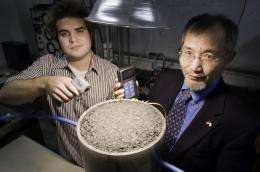
URI student Andrew Correia and Professor K. Wayne Lee conduct a laboratory experiment to measure the solar energy generated by a patch of asphalt. URI Department of Communications & Marketing photo by Michael Salerno Photography.

The heat radiating off roadways has long been a factor in explaining why city temperatures are often considerably warmer than nearby suburban or rural areas. Now a team of engineering researchers from the University of Rhode Island is examining methods of harvesting that solar energy to melt ice, power streetlights, illuminate signs, heat buildings and potentially use it for many other purposes.

"We have mile after mile of asphalt pavement around the country, and in the summer it absorbs a great deal of heat, warming the roads up to 140 degrees or more," said K. Wayne Lee, URI professor of civil and environmental engineering and the leader of the joint project. "If we can harvest that heat, we can use it for our daily use, save on , and reduce global warming."

The URI team has identified four potential approaches, from simple to complex, and they are pursuing research projects designed to make each of them a reality.

One of the simplest ideas is to wrap flexible around the top of Jersey barriers dividing highways to provide electricity to power streetlights and illuminate road signs. The photovoltaic cells could also be embedded in the roadway between the Jersey barrier and the adjacent rumble strip.

"This is a project that could be implemented today because the technology already exists," said Lee. "Since the new generation of are so flexible, they can be installed so that regardless of the angle of the sun, it will be shining on the cells and . A pilot program is progressing for the lamps outside Bliss Hall on campus."

Another practical approach to harvesting from pavement is to embed water filled pipes beneath the asphalt and allow the sun to warm the water. The heated water could then be piped beneath bridge decks to melt accumulated ice on the surface and reduce the need for road salt. The water could also be piped to nearby buildings to satisfy heating or hot water needs, similar to geothermal heat pumps. It could even be converted to steam to turn a turbine in a small, traditional power plant.

Graduate student Andrew Correia has built a prototype of such a system in a URI laboratory to evaluate its effectiveness, thanks to funding from the Korea Institute for Construction Technology. By testing different asphalt mixes and various pipe systems, he hopes to demonstrate that the technology can work in a real world setting.

"One property of asphalt is that it retains heat really well," he said, "so even after the sun goes down the asphalt and the water in the pipes stays warm. My tests showed that during some circumstances, the water even gets hotter than the asphalt."

A third alternative uses a thermo-electric effect to generate a small but usable amount of electricity. When two types of semiconductors are connected to form a circuit linking a hot and a cold spot, there is a small amount of electricity generated in the circuit.

URI Chemistry Professor Sze Yang believes that thermo-electric materials could be embedded in the roadway at different depths – or some could be in sunny areas and others in shade – and the difference in temperature between the materials would generate an electric current. With many of these systems installed in parallel, enough electricity could be generated to defrost or be used for other purposes. Instead of the traditional semiconductors, he proposes to use a family of organic polymeric semiconductors developed at his laboratory that can be fabricated inexpensively as plastic sheets or painted on a flexible plastic sheet.

"This is a somewhat futuristic idea, since there isn't any practical device on the market for doing this, but it has been demonstrated to work in a laboratory," said Yang. "With enough additional research, I think it can be implemented in the field."

Perhaps the most futuristic idea the URI team has considered is to completely replace asphalt roadways with roadways made of large, durable electronic blocks that contain photovoltaic cells, LED lights and sensors. The blocks can generate electricity, illuminate the roadway lanes in interchangeable configurations, and provide early warning of the need for maintenance.

According to Lee, the technology for this concept exists, but it is extremely expensive. He said that one group in Idaho made a driveway from prototypes of these blocks, and it cost about $100,000. Lee envisions that corporate parking lots may become the first users of this technology before they become practical and economical for roadway use.

"This kind of advanced technology will take time to be accepted by the transportation industries," Lee said. "But we've been using asphalt for our highways for more than 100 years, and pretty soon it will be time for a change."

Provided by University of Rhode Island search and more info website

4.1 /5 (8 votes)  

Filter


Move the slider to adjust rank threshold, so that you can hide some of the comments.


Display comments: newest first

A_Paradox
Nov 09, 2010

Rank: not rated yet
I listened to a discussion of these very concepts on ABC Radio National [Australian BC, OK!]the other day and the rationale appears sound. The key concept is that glass can be made to virtually any required specification of strength and clarity. I suspect that it is not necessary to be confined to photovoltaic either. It might in fact be cheaper to build small but durable Stirling engines, one per brick, with piped water providing the necessary heat sink.
The glass bricks could be made in sets with different optimal light concentrating orientations. This just means that the upper part of each brick incorporates a Fresnel lens/reflector. Having a quasi random spread of preferred directions for light gathering should mean that any given length of roadway should have its power output spread over most of the daylight hours.
El_Nose
Nov 09, 2010

Rank: 5 / 5 (2)
I have only one dissent - and the article does not state the work through --

In detroit when it gets cold enough to snow and put ice on bridges, normally the entire city is a cold and snowy place... what is going to heat this water that is in the cold ground/ asphalt to melt ice on a bridge??? where is the heat coming from that is going to warm the pavement in the middle of winter?? and while that top inch of pvaement gets warmer -- what source of energy is going to unfreeze the many water pipes now stored close to the surface. In detroit water lines are buried many feet below ground where it take large surface temperature changes to effect that environment. If you think about it all cold water lines are underground and even on the hottest day of summer the water coming out of the faucet is cool. well in the winter this keeps the line from freezing... are they going to add an antifreeze compound to the water -- and if so how will this effect a steam turbine?
PinkElephant
Nov 09, 2010

Rank: not rated yet
@El_Nose, all excellent points. Though instead of water, one could use something like ethanol (the freezing point of which is -114 C...)

But I agree, in places where snow falls during winter, the sky tends to be heavily overcast during those same months.
Guntharian
Nov 10, 2010

Rank: not rated yet
You can find more info at SolarRoadways. This is the Idaho firm already doing this work.
Husky
Nov 10, 2010

Rank: not rated yet
Geothermal is a good source for roadheating, even lower energy lukewarm water pumped up is sufficient for keeping roads unfreezed, in Iceland there are geothermal sidewalks in Reykyavik. Naturally they have the vulcanic advantage, but geothermal is getting increasingly more aeconomically viable to other sites thanks to rock fracturing with supercritical co2 for example
A_Paradox
Nov 10, 2010

Rank: not rated yet
EL_Nose, PinkElephant,
No need to get hung up on de-icing of the roads, that is just one application, besides which bulk storage of heat in ground water reservoirs may be feasible. Ie heat from the long days of summer can be transferred to aquifers for winter retrieval.

Also solar roadways might be most serviceable for providing 12V or 24V DC domestic electricity supply which is all we need for much of our electronic equipment. Combined with similar structures on house roofs and on the side of buildings facing to the equator, domestic electricity supply will be assured for much of the year.
Rank 4.1 /5 (8 votes)
Relevant PhysicsForums posts

More news stories

Alibaba.com $2.5B privatization bid approved

(AP) -- Chinese e-commerce firm Alibaba Group's $2.5 billion bid to take its Hong Kong-listed unit private was cleared Friday by minority shareholders, easing the way for CEO Jack Ma to gain more control over his company's ...

Technology / Business

created just added | popularity not rated yet | comments 0

Everyone knows it's windy . . .

... And now they have the data to prove it.  The middle of Lake Michigan is a vast, untapped reservoir of wind energy. The next step will be to find out if it can be harvested economically without harming ...

Technology / Energy & Green Tech

created 19 minutes ago | popularity not rated yet | comments 0

China fund may help Alibaba in Yahoo! bid: report

China Investment Corporation is in advanced talks to add up to $2 billion to the Alibaba Internet Group's efforts to buy back a stake from struggling Internet pioneer Yahoo!, the New York Times reported.

Technology / Business

created 46 minutes ago | popularity not rated yet | comments 0

Computers excel at identifying smiles of frustration (w/ Video)

(Phys.org) -- Researchers at the Massachusetts Institute of Technology (MIT) in the US have trained computers to recognize smiles, and they have turned out to be more adept at recognizing smiles of frustration ...

Technology / Computer Sciences

created 4 hours ago | popularity not rated yet | comments 1 | with audio podcast report

Solar plane ends first leg of intercontinental bid

The Swiss sun-powered aircraft Solar Impulse landed safely in Madrid early Friday at the end of the first leg of its attempt at an intercontinental flight without using a drop of fuel.

Technology / Energy & Green Tech

created 5 hours ago | popularity 5 / 5 (1) | comments 1


Landmark calculation clears the way to answering how matter is formed

(Phys.org) -- An international collaboration of scientists, including Thomas Blum, associate professor of physics, is reporting in landmark detail the decay process of a subatomic particle called a kaon – ...

Study uncovers secret to speedy burrowing by razor clams

(Phys.org) -- If you look at a razor burrowing clam sitting in a bucket, you’d never guess that it could burrow itself down into the soil, much less do it with any speed. Razor clams look like fat straws, ...

Dragon capsule on course for space station arrival

The privately bankrolled Dragon capsule approached the International Space Station for a historic docking Friday after sailing through a practice rendezvous the day before.

Rockefeller scientists pioneer new method to determine mechanisms of drug action

(Medical Xpress) -- Knowing that a drug works is great. Knowing how it works is a luxury. And until now, determining a drug’s mechanism of action has been a tedious and difficult process for scientists.

Synthetic nano-waste does not disappear

(Phys.org) -- Tiny particles of cerium oxide do not burn or change in the heat of a waste incineration plant. They remain intact on combustion residues or in the incineration system, as a new study by Swiss ...

Building a better solar panel -- one molecule at a time

(Phys.org) -- One of the fundamental building blocks in modern chemistry, an organometallic chemical compound called ferrocene, has never been structurally defined - until now.