Aerosol particles at global view
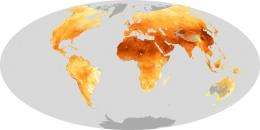
Of all the pollution that fills our lungs on any given day, the most dangerous is the small stuff. Aerosol particle pollutionairborne solid particles and liquid droplets--comes in a range of sizes. Particles smaller than 2.5 micrometers pose the greatest risk to human health because they are small enough to be breathed deep into the lungs and, in some cases, enter the blood stream. These fine particles, about 30 times smaller than the width of a human hair, are also a major cause of poor visibility.
This map provides an estimate of the average distribution of fine particles near ground-level throughout the world. The highest concentrations of fine particles, called PM (particulate matter) 2.5, hover over highly industrialized areas in eastern Asia. The high concentrations over northern Africa and the Middle East are likely fine dust from the deserts. The World Health Organizations Air Quality Guidelines recommend that concentrations of particulate pollution should not exceed 10 micrograms per cubic meter. When compared with global population, the map reveals that 80 percent of the worlds people live in areas that exceed that value.
The map was compiled from satellite measurements (acquired between 2001 and 2006) and from model data. Both the Multi-angle Imaging SpectroRadiometer (MISR) and the Moderate Resolution Imaging Spectroradiometer (MODIS) on NASAs Terra satellite measure particle pollution (aerosols). The GEOS-Chem model was used to help researchers determine how much of the satellite-measured pollution was at ground level, where it poses a threat to human health.
Particle pollution comes from a variety of sources, as detailed in the Earth Observatorys new fact sheet, Aerosols: Tiny Particle, Big Impact. The following is an excerpt.
The bulk of aerosolsabout 90 percent by masshave natural origins. Volcanoes, for example, eject huge columns of ash into the air, as well as sulfur dioxide and other gases, yielding sulfates. Forest fires send partially burned organic carbon aloft. Certain plants produce gases that react with other substances in the air to yield aerosols, such as the smoke in the Great Smoky Mountains of the United States.
Sea salt and dust are two of the most abundant aerosols, as sandstorms whip small pieces of mineral dust from deserts into the atmosphere and wind-driven spray from ocean waves flings sea salt aloft. Both tend to be larger particles than their human-made counterparts.
The remaining 10 percent of aerosols are considered anthropogenic, or human-made, and they come from a variety of sources. Though less abundant than natural forms, anthropogenic aerosols can dominate the air downwind of urban and industrial areas.
Automobiles, incinerators, smelters, and power plants are prolific producers of sulfates, nitrates, black carbon, and other particles. Deforestation, overgrazing, drought, and excessive irrigation can alter the land surface, increasing the rate at which dust aerosols enter the atmosphere. Even indoors, cigarettes, cooking stoves, fireplaces, and candles are sources of aerosols.
More information: Donkelaar, A., et al. (2010, June). Global estimates of ambient fine particulate matter concentrations from satellite-based aerosol optical depth: development and application. Environmental Health Perspectives, 118 (6). Accessed November 4, 2010.
Provided by
JPL/NASA
-
From lemons to lemonade: Reaction uses carbon dioxide to make carbon-based semiconductor,
28 comments
-
Every black hole contains a new universe: A physicist presents a solution to present-day cosmic mysteries,
215 comments
-
New silicon memory chip developed,
16 comments
-
Thioridazine kills cancer stem cells in human while avoiding toxic side-effects of conventional cancer treatments,
2 comments
-
SpaceX private rocket blasts off for space station (Update),
41 comments
-
Conversion from aircraft bearing to normal degrees
May 23, 2012
-
Interpretation/Analysis of the Lab results(HEPA filter)
May 22, 2012
-
Has anyone here attended the The Urbino Summer School in Paleoclimatology?
May 22, 2012
-
Earthquakes: Mag 6 N. Italy and Mag 5.6 W. Bulgaria
May 21, 2012
-
determining time frame for most recent geological layers
May 17, 2012
-
solar radiation - conversion to calculate radiation impacting vertical surface
May 16, 2012
- More from Physics Forums - Earth
More news stories
Dragon capsule on course for space station arrival
The privately bankrolled Dragon capsule approached the International Space Station for a historic docking Friday after sailing through a practice rendezvous the day before.
Space & Earth / Space Exploration
46 minutes ago |
5 / 5 (2) |
1
Get ready for the transit of Venus
Scientists and amateur astronomers around the world are preparing to observe the rare occurrence of Venus crossing the face of the Sun on 5-6 June, an event that will not be seen again for over a hundred years.
Space & Earth / Space Exploration
12 minutes ago |
not rated yet |
0
A pinwheel in many colors
(Phys.org) -- This image of the Pinwheel Galaxy, or also known as M101, combines data in the infrared, visible, ultraviolet and X-rays from four of NASA's space-based telescopes. This multi-spectral view shows ...
12 minutes ago |
not rated yet |
0
Sea sponges could act as early warning system
(Phys.org) -- Sea sponges may hold clues to climate change and other impending environmental risks, researchers from Flinders University believe.
10 minutes ago |
not rated yet |
0
Climate pact process stumbles as countries bicker
Less than six months after the world agreed to craft a new climate pact by 2015, negotiations stumbled at a crucial preparatory phase on Friday as rich and poor countries butted heads.
45 minutes ago |
not rated yet |
0
Landmark calculation clears the way to answering how matter is formed
(Phys.org) -- An international collaboration of scientists, including Thomas Blum, associate professor of physics, is reporting in landmark detail the decay process of a subatomic particle called a kaon ...
Study uncovers secret to speedy burrowing by razor clams
(Phys.org) -- If you look at a razor burrowing clam sitting in a bucket, youd never guess that it could burrow itself down into the soil, much less do it with any speed. Razor clams look like fat straws, ...
Rockefeller scientists pioneer new method to determine mechanisms of drug action
(Medical Xpress) -- Knowing that a drug works is great. Knowing how it works is a luxury. And until now, determining a drugs mechanism of action has been a tedious and difficult process for scientists.
Synthetic nano-waste does not disappear
(Phys.org) -- Tiny particles of cerium oxide do not burn or change in the heat of a waste incineration plant. They remain intact on combustion residues or in the incineration system, as a new study by Swiss ...
Building a better solar panel -- one molecule at a time
(Phys.org) -- One of the fundamental building blocks in modern chemistry, an organometallic chemical compound called ferrocene, has never been structurally defined - until now.
Earliest musical instruments in Europe 40,000 years ago
The first modern humans in Europe were playing musical instruments and showing artistic creativity as early as 40,000 years ago, according to new research from Oxford and Tübingen universities.
Nov 10, 2010
Rank: not rated yet
Nov 13, 2010
Rank: not rated yet
I imagine it's a matter of location and degree. Some areas in China have horrifically polluted air. For a good example of the health effects of air pollution, just look at London Fog. Any population living in such highly air faces immediate and severe consequences.
Humanity as a whole, however, is almost certainly more challenged by potentially game-changing GHGs and other problems. We can afford to lose slightly more of the vulnerable (old, young, poor) every year, but we can't afford to relocate major population centers or severely impact industry.
Nov 14, 2010
Rank: not rated yet
I will challenge your statement only in so far as to say that your opinions are not fully supported by the facts. There are too many factors that you have not taken into account, and far too many unanswered questions to say what our greatest threat is right now. If you are talking about sea level rise, when you talk about relocating cities, then I think you are a little crazy, no offense.
Nov 14, 2010
Rank: not rated yet
There are plenty of issues I refrain from judging on, but on this issue there is enough evidence to make an informed, tentative conclusion. Particulate matter has a powerful local effect, and has a well-documented impact on health. Assuming the IPCC's conclusions have even a slim 10% chance of being true, I think it's pretty darned safe to say that climate change poses a larger global threat.
As I said, we can absorb the current human losses and health effects/healthcare costs brought about by particulate matter. I'm not saying we shouldn't do anything about the problem, just that it's a manageable and localized one. The less-localized causes are largely out of our control.
Nov 15, 2010
Rank: not rated yet
That is not true. Aerosols from the central US drift a thousand miles to cause acid rain in Quebec. Aerosols from the Saharah desert drift all the way across the Atlantic and affect cloud formation in the Amazon. Ash from Mt St Hellen fell like snow in Ohio. I have two vials of it in my keepsake chest. I would not be so quick to say that aerosols are the least harmful of the two when compared to ghg's. The space agencies have only just begun to study aerosols, after all. They are not well understood and it still remains to be discovered what the magnitude of their effect is on global climate change. I'm not saying you are wrong, or that ghg's aren't harmful. I'm not saying that ghg's shouldn't be contained. I am just suggesting that aerosols could be even worse, because we really don't know how bad they are yet.
Ghg's could even have a positive net effect according to some. Warmer climate in tundra leads to biodiversity increase.