Taming wild grapes for better wine
When you think about "wine country," Illinois may not be the first state that comes to mind. But it's actually big business on the prairie. There are 90 wineries licensed in Illinois and 1,500 acres of wine grapes. One acre of wine grapes can bring as much as $8,000 in sales, though more commonly it's $3,000 to $5,000. The largest wineries in Illinois produce 90,000 gallons per year, while many produce 3,000 to 10,000 per year.
"In many cases, growing wine grapes is supplementary to the producer's entire farming operation. The break-even point for wineries is about 10,000 gallons to make it a full-time business," said Bill Shoemaker, superintendent at the St. Charles Horticulture Research Center.
Shoemaker works with other University of Illinois researchers to conduct grape research at the Center. For one of his latest projects, he is crossing wild grapes with proven wine grape varieties to develop a good wine grape that can withstand the cooler northern Illinois weather.
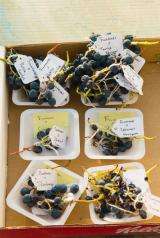
"There are wild grapes growing along the roadside on I-57," Shoemaker said. "The interstate grapes root easily with no further help. Their native genetics means that they have already adapted to this climate but they aren't good for eating or wine-making. We're crossing them with European grapes that have high quality to create new varieties that will grow in our climate and be a good wine grape."
Unfortunately, the wild grapes have poor flavor and low yield. But Shoemaker is looking at three wild grape species that have excellent disease resistance to create breeding lines that will require less use of pesticides. Right now growers sometimes have to spray in order to grow a good wine grape, so this would be a great step forward for the industry.
"There isn't much grape breeding being done to create improved varieties globally. We're working to improve the fruit quality and develop new flavor profiles in wine," he said.
The northern and southern hilly parts of the state have more potential for vineyards, with Galena in Jo Davies County part of a new American viticulture region, said Shoemaker.
Since 1998 grapes, particularly cold-hardy wine grapes, have been a subject of research at the University of Illinois St. Charles Horticulture Research Center. The research was initiated by U of I scientists Robert Skirvin and Alan Otterbacher with a trial of 26 grape varieties planted on a southwest-facing slope – Shoemaker noted that it was the only southwest-facing slope available in the area.
Today Shoemaker conducts research at the St. Charles Center on cultivar evaluation, cultural research, including Integrated Pest Management, and breeding new varieties of grapes.
"Cultural practices are all the methods growers use to manage the grape crop such as pest management" Shoemaker said. "Grapes are popular with many pests. There are insect challenges at every point in the growing season, especially during harvest. There are also several fungal diseases that can infect current varieties, and weeds, particularly perennial weeds such as Canada thistle, are constantly challenging growers and their grape crops."
Perhaps worst of all are the animals that love to eat grapes, Shoemaker said. Birds can decimate vineyards.
At the St. Charles Center, Shoemaker manages a 1-acre vineyard of Frontenac grape which was established as a research platform in 2006. "We knew we needed a vineyard dedicated to studying the cultural practices growers use, or need to use, to successfully grow grapes for high-quality wine," he said.
On one of the research projects in the Frontenac vineyard Shoemaker is working with U of I researcher Rick Weinzierl on methods to control Japanese beetles. "We are evaluating three pesticide regimens and two cultural controls for the pest. We are also looking at spun-bonded polypropylene row covers over the top of the vines as an exclusion barrier to the beetle. This could be attractive to organic grape growers if there are no negative effects on the vines or fruit development," Shoemaker said.
Weinzierl said they hope to identify reduced-risk insecticides and nonchemical methods, such as the spun-bound polyester covers, that will allow conventional and organic growers to prevent losses to Japanese beetles without too frequent sprays of insecticides that might result in greater residues or toxicity to beneficial insects. "This would result in greater profits for the Illinois wine industry," he said.
Evaluating new grape varieties for their potential use in the grape wine industry is time consuming, Shoemaker said. "The Europeans, especially the French, created thousands of varieties of interspecific hybrids, many of which have never been grown in the Midwest. Most never will, as they were not exported to North America. But many were and some are planted here at St. Charles. We are also evaluating new varieties and breeding lines from other breeding programs at St. Charles so we can identify which have the greatest potential for our industry," Shoemaker said.
Provided by University of Illinois at Urbana-Champaign


