Unsung hero: Researchers produce high-res model of Ndc80 in action
October 14, 2010 by Lynn Yarris
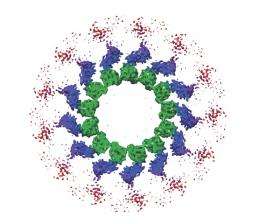
Overhead view of a subnanometer resolution reconstruction showing the microtubule-binding region of the Ndc80 complex (blue) attached to a microtubule(green). The part of the Ndc80 complex away from the microtubule is flexible and appears as scattered density in the reconstruction (red). (Image courtesy of Nogales group)
(PhysOrg.com) -- Unless you are in a field of study related to cell biology, you most likely have never heard of Ndc80. Yet this protein complex is essential to mitosis, the process by which a living cell separates its chromosomes and distributes them equally between its two daughter cells. Now, through a combination of cryo-electron microscopy and three-dimensional image reconstruction, a team of researchers with the Lawrence Berkeley National Laboratory and the University of California Berkeley have produced a subnanometer resolution model of human Ndc80 that reveals how this unsung hero carries out its essential tasks.
"Our model suggests that Ndc80 oligomerizes on the surface of the microtubule via a segment of the protein that is regulated so that correct attachments are maintained and incorrect attachments are discarded," says biophysicist Eva Nogales who led this study.
"What we propose is that this oligomerization is an important part of the mechanism by which Ndc80 is able to
utilize the energy of microtubule disassembly to move chromosomes towards the spindle poles during mitosis. This oligomerization will only happen for correctly attached microtubules"
Nogales holds joint appointments with Berkeley Lab's Life Sciences Divisions, UC Berkeley's Molecular and Cell Biology Department, and the Howard Hughes Medical Institute. An expert on electron microscopy and image analysis and an authority on the structure and dynamics of microtubules, she is the corresponding author of a paper published in the journal Nature titled, "The Ndc80 kinetochore complex forms oligomeric arrays along microtubules."
Co-authoring the paper with Nogales were Gregory Alushin, Vincent Ramey, Sebastiano Pasqualato, David Ball, Nikolaus Grigorieff and Andrea Musacchio.
Biological cells have a cytoskeleton that gives shape to membrane walls and other cellular structures and also
controls the transportation of substances in and out of the cell. This cytoskeleton is spun from tiny fibers of tubulin protein called microtubles. During mitosis, microtubules disassemble and reform into spindles across which duplicate sets of chromosomes line up and migrate to opposite poles. After chromosome migration is complete, the microtubules disassemble and reform back into skeletal systems for the two new daughter cells.
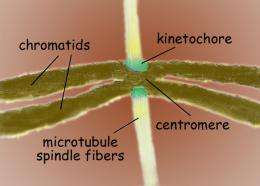
A kinetochore is the multi-protein structure in which microtubule spindle fibers engage chromosomes to align and separate them equally between daughter cells during cell division.(Image courtesy of Nogales group)
Mistakes in the distribution of chromosomes from a parent cell to its daughter cells can lead to birth defects, cancer and other disorders. To ensure that each daughter cell receives a single copy of each chromosome, microtubule spindles dock with each chromosome's centromere - the central region where its two chromatids connect. The microtubule spindles connect with the centromere through a network of proteins called the kinetochore. Ndc80 is a key member of the kinetochore network and serves as a sort of "landing pad" for the microtubule-centromere connection. Although Ndc80's genetics and biochemistry have been extensively characterized, the mechanisms behind its activities have until now remained a mystery.
"Our first ever subnanometer model of Ndc80 shows that the protein complex binds the microtubule with a tubulin monomer repeat that is sensitive to tubulin conformation," Nogales says. "Furthermore, Ndc80 complexes self-associate along microtubule protofilaments via interactions that are mediated by the amino-terminal tail of the Ndc80 protein, which is the site of phospho-regulation by the Aurora B kinase."
The Aurora B kinase is an enzyme that ensures the correction of any improper microtubule-kinetochore attachments faulty attachments will result in unequal segregation of the genetic material, such as both chromatides going to the same daughter cell. In their paper, Nogales and her co-authors contend that Ndc80's mode of interaction with the microtubule and its oligomerization provide a means by which the Aurora B kinase can regulate the stability of the load-bearing Ndc80-microtubule attachments.
"The Aurora B kinase corrects wrong microtubule-kinetochore attachments by phosphorylating proteins in the kinetochore," Nogales says. "Ndc80 is a major substrate of this regulation. Our work shows that if phosphorylated by Aurora B, attachments are not robust because there is no oligomerization of Ndc80s."
Provided by
Lawrence Berkeley National Laboratory
-
From lemons to lemonade: Reaction uses carbon dioxide to make carbon-based semiconductor,
28 comments
-
Every black hole contains a new universe: A physicist presents a solution to present-day cosmic mysteries,
215 comments
-
New silicon memory chip developed,
16 comments
-
Thioridazine kills cancer stem cells in human while avoiding toxic side-effects of conventional cancer treatments,
2 comments
-
SpaceX private rocket blasts off for space station (Update),
41 comments
-
What does exophillic and endophillic mean in terms of mosquito and their control?
19 hours ago
-
Semen stains glows under black lights (uv light)?
May 23, 2012
-
Question on Human Chromosome 2
May 23, 2012
-
How important is composition of TBST in diluting antibodies and Western Blotting?
May 22, 2012
-
Does the medulla monitor blood pH
May 20, 2012
-
What physically constitutes memory?
May 17, 2012
- More from Physics Forums - Biology
More news stories
Diagnostic labs analyze from bugs to toenails
Found an odd bug in your closet? Rhododendrons inexplicably wilting? Need a toenail analyzed? There's a lab for that.
1 hour ago |
not rated yet |
0
Global warming winner: Once rare butterfly thrives
(AP) -- Global warming is rescuing the once-rare brown Argus butterfly, scientists say.
15 hours ago |
4 / 5 (3) |
3
Gourmet butterflies speed north: study
A new study led by scientists in the Department of Biology at the University of York has shown how a butterfly has changed its diet, and consequently has sped northwards in response to climate change. Their study is published ...
17 hours ago |
5 / 5 (3) |
1
|
Researchers find a way to delay aging of stem cells
Stem cells are essential building blocks for all organisms, from plants to humans. They can divide and renew themselves throughout life, differentiating into the specialized tissues needed during development, ...
21 hours ago |
5 / 5 (5) |
0
|
Fungi shifted plant balance of power
Cooperating with fungi didn't just help the earliest plants spread across a barren, rocky landscape; it also played a decisive role in the rise of more complex plants with roots and leaves that make up most ...
22 hours ago |
5 / 5 (2) |
0
|
New study should end debate over magnesium treatment for preventing poor outcome after haemorrhagic stroke
An international randomised trial and meta-analysis published Online First in The Lancet should put an end to the debate about the use of intravenous magnesium sulphate to prevent poor outcomes after haemorrhagic stroke. The in ...
Research: Negative leakage could be key to reducing carbon emissions
(Phys.org) -- The unilateral efforts of a single country or region to reduce the emissions of greenhouse gases could reduce exports, increase imports and lead to higher emissions elsewhere what economists call leakage. ...
Computers excel at identifying smiles of frustration (w/ Video)
(Phys.org) -- Researchers at the Massachusetts Institute of Technology (MIT) in the US have trained computers to recognize smiles, and they have turned out to be more adept at recognizing smiles of frustration ...
OmniVision tops up sensors for cameras, phones
(Phys.org) -- OmniVision has announced two high-resolution image sensors for the digital still and digital video camera market (DS/DVC) and higher end smartphones. In end-user language, it is a claim for superior ...
Progestin treatment for polycystic ovarian syndrome may reduce pregnancy chances
(Medical Xpress) -- The hormone progestin, often given as a first step in infertility treatment for polycystic ovary syndrome (PCOS), appears to decrease the odds of conception and of giving birth, according to a study by ...
Talking works: UB professor develops method to analyze creative problem solving
(Phys.org) -- Talk -- if it's the right kind -- can increase creativity, leading students to create useful, new ideas that solve problems, a University at Buffalo professor has found by using a statistical tool that he invented.

Oct 14, 2010
Rank: 5 / 5 (2)
Oct 14, 2010
Rank: 5 / 5 (1)
@ article author: this is gold!