Researchers find a stable way to store the sun's heat (w/ Video)
October 25, 2010 by David L. Chandler

Researchers find a stable way to store the sun's heat

Enlarge

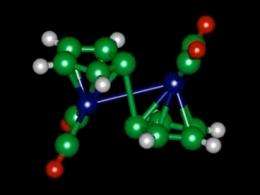
A molecule of fulvalene diruthenium, seen in diagram, changes its configuration when it absorbs heat, and later releases heat when it snaps back to its original shape. Image: Jeffrey Grossman

(PhysOrg.com) -- Researchers at MIT have revealed exactly how a molecule called fulvalene diruthenium, which was discovered in 1996, works to store and release heat on demand. This understanding, reported in a paper published on Oct. 20 in the journal Angewandte Chemie, should make it possible to find similar chemicals based on more abundant, less expensive materials than ruthenium, and this could form the basis of a rechargeable battery to store heat rather than electricity.

The molecule undergoes a structural transformation when it absorbs sunlight, putting it into a higher-energy state where it can remain stable indefinitely. Then, triggered by a small addition of or a catalyst, it snaps back to its original shape, releasing heat in the process. But the team found that the process is a bit more complicated than that.

"It turns out there's an intermediate step that plays a major role," said Jeffrey Grossman, the Carl Richard Soderberg Associate Professor of Power Engineering in the Department of Materials Science and Engineering. In this intermediate step, the molecule forms a semi-stable configuration partway between the two previously known states. "That was unexpected," he said. The two-step process helps explain why the molecule is so stable, why the process is easily reversible and also why substituting other elements for has not worked so far.

In effect, explained Grossman, this process makes it possible to produce a "rechargeable heat battery" that can repeatedly store and release heat gathered from or other sources. In principle, Grossman said, a fuel made from fulvalene diruthenium, when its stored heat is released, "can get as hot as 200 degrees C, plenty hot enough to heat your home, or even to run an engine to produce ."

This video is not supported by your browser at this time.

Jeffrey Grossman explains how this material can be used to store and release energy in the form of heat. Video: Jeffrey C. Grossman; additional editing: Melanie Gonick

Compared to other approaches to solar energy, he said, "it takes many of the advantages of solar-thermal energy, but stores the heat in the form of a fuel. It's reversible, and it's stable over a long term. You can use it where you want, on demand. You could put the fuel in the sun, charge it up, then use the heat, and place the same fuel back in the sun to recharge."

In addition to Grossman, the work was carried out by Yosuke Kanai of Lawrence Livermore National Laboratory, Varadharajan Srinivasan of MIT's Department of Materials Science and Engineering, and Steven Meier and Peter Vollhardt of the University of California, Berkeley.

The problem of ruthenium's rarity and cost still remains as "a dealbreaker," Grossman said, but now that the fundamental mechanism of how the molecule works is understood, it should be easier to find other materials that exhibit the same behavior. This molecule "is the wrong material, but it shows it can be done," he said.

The next step, he said, is to use a combination of simulation, chemical intuition, and databases of tens of millions of known to look for other candidates that have structural similarities and might exhibit the same behavior. "It's my firm belief that as we understand what makes this material tick, we'll find that there will be other materials" that will work the same way, Grossman said.

Grossman plans to collaborate with Daniel Nocera, the Henry Dreyfus Professor of Energy and Professor of Chemistry, to tackle such questions, applying the principles learned from this analysis in order to design new, inexpensive materials that exhibit this same reversible process. The tight coupling between computational materials design and experimental synthesis and validation, he said, should further accelerate the discovery of promising new candidate solar thermal fuels.

More information: "Mechanism of Thermal Reversal of the (Fulvalene) tetracarbonyldiruthenium Photoisomerization: Toward Molecular Solar–Thermal Energy Storage," by Yosuke Kanai, Varadharajan Srinivasan, Steven K. Meier, K. Peter C. Vollhardt, Jeffrey C. Grossman. Angewandte Chemie, 20 October, 2010.

Provided by Massachusetts Institute of Technology search and more info website

4.8 /5 (38 votes)  

Filter


Move the slider to adjust rank threshold, so that you can hide some of the comments.


Display comments: newest first

Shootist
Oct 25, 2010

Rank: 1 / 5 (1)
How much ruthenium is necessary? Is ruthenium plentiful in the grand scheme of things?

Is this method more efficient than pumping water into a reservoir, then releasing the water to power hydroelectric turbines?

It is obvious to all that large virtual sunfarm/windfarm generating stations will have a large generating potential, but will also suffer from a small guaranteed capacity.

Better yet, build 100 1GW fission reactors. Combining large potential generating capacity with a large, guaranteed, generating capacity.
Eric_B
Oct 25, 2010

Rank: 4 / 5 (4)
"Better yet, build 100 1GW fission reactors. Combining large potential generating capacity with a large, guaranteed, generating capacity."

That's fine if you don't mind your tax dollars paying to decommission the plants and dispose of the waste...
ormondotvos
Oct 25, 2010

Rank: 3.6 / 5 (7)
Always the BS about decommissioning nuclear plants, but never a word about comparable toxic sites from oil, coal, fracking, clear cuts, food acreage displacement.

Anti-nukes is a sure sign of fearful rigidity. One can never get them to compare apples with apples.
xamien
Oct 25, 2010

Rank: 4.3 / 5 (3)
If they get a cheaper material to do it and it be cheap enough to do it on a per-person basis, one could set it up with a high-capacity stirling engine for generation during the evening and for during the day use solar panels with heatsinks straight to the stirling engine. also, use the materials that increase the efficiency of absorption of heat/photons from the sun to the sterling and from the sterling to the heat battery.
Sanescience
Oct 25, 2010

Rank: 4 / 5 (1)
Sterling engines may be efficient in the world of mechanical devices, but ultimately a solid state photon to electron direct transfer technology will far surpass it.
bliskater
Oct 25, 2010

Rank: not rated yet
Might be interesting with a little more info.
Might as well have just said. "Some researchers at
a well known research center have determined how a
certain molecule stores energy from heat..."
How many calories worth of heat will a gram of this store?
If not much, what are the indications that it might be a profitable field of study?
Going
Oct 26, 2010

Rank: not rated yet
Heat stores are not new. Heat in a click pads are available now . See this ad
http://www.youtub...=related

No idea how they work but I have one and they do.

jalmy
Oct 26, 2010

Rank: not rated yet
You could have a heat exchanger. Have it act as a radiator in your car absorbing excess heat. Pull it out and stick it in your furnace and heat your house.
Sanescience
Oct 26, 2010

Rank: 5 / 5 (2)
Heat in a click pads are probably Sodium Acetate. The metal disk you click provides a nucleus point for a super saturated solution to crystallize.
danman5000
Oct 27, 2010

Rank: 5 / 5 (2)
Heat stores are not new. Heat in a click pads are available now . See this ad
http://www.youtub...=related

No idea how they work but I have one and they do.


Yes that video is definitely sodium acetate. It's a super saturated solution that crystallizes when you click the disk, as Sanescience said. This process releases heat. Its mechanism is much different than this new heat-storing molecule. It sounds amazing, and if they can replace the ruthenium and make it affordable I bet this will lead to some very interesting stuff.
Olivia
Nov 02, 2010

Rank: not rated yet
It is the start of my dream to make a fully self-contained cup noodle that needs such a heat source to boil the water inside.
Rank 4.8 /5 (38 votes)
Relevant PhysicsForums posts
  • Electrons And Radiation
    created4 hours ago
  • Acid Base Theories
    createdMay 24, 2012
  • Stability of phenyl cation
    createdMay 23, 2012
  • Carbon dioxide density & distribution in the atmosphere
    createdMay 23, 2012
  • Question regarding classification of halogen derivatives of alkanes
    createdMay 23, 2012
  • the concept of mole
    createdMay 23, 2012
  • More from Physics Forums - Chemistry

More news stories

Discarded data may hold the key to a sharper view of molecules

(Phys.org) -- There's nothing like a new pair of eyeglasses to bring fine details into sharp relief. For scientists who study the large molecules of life from proteins to DNA, the equivalent of new lenses have come in the ...

Chemistry / Biochemistry

created 16 hours ago | popularity 4.7 / 5 (3) | comments 0 | with audio podcast

Pivotal role for proteins -- from helping turn carbs into energy to causing devastating disease

Research into how carbohydrates are converted into energy has led to a surprising discovery with implications for the treatment of a perplexing and potentially fatal neuromuscular disorder and possibly even cancer and heart ...

Chemistry / Biochemistry

created 16 hours ago | popularity 5 / 5 (1) | comments 0 | with audio podcast

Nuisance seaweed found to produce compounds with biomedical potential

A seaweed considered a threat to the healthy growth of coral reefs in Hawaii may possess the ability to produce substances that could one day treat human diseases, a new study led by scientists at Scripps ...

Chemistry / Biochemistry

created 18 hours ago | popularity 5 / 5 (2) | comments 1 | with audio podcast

New CO2-removing catalyst can take the heat

(Phys.org) -- The current method of removing the greenhouse gas carbon dioxide (CO2) from the flues of coal-fired power plants uses so much energy that no one bothers to use it. So says Roger Aines, principal ...

Chemistry / Materials Science

created 23 hours ago | popularity 5 / 5 (7) | comments 6 | with audio podcast

Study cracks a secret of methanol production

(Phys.org) -- What’s the best way to make methanol? The question is more pressing than it sounds. Not only is methanol an important industrial chemical – some 50 million tons are used each year to ...

Chemistry / Materials Science

created 23 hours ago | popularity 5 / 5 (1) | comments 0 | with audio podcast


Research: Negative leakage could be key to reducing carbon emissions

(Phys.org) -- The unilateral efforts of a single country or region to reduce the emissions of greenhouse gases could reduce exports, increase imports and lead to higher emissions elsewhere – what economists call “leakage.” ...

Progestin treatment for polycystic ovarian syndrome may reduce pregnancy chances

(Medical Xpress) -- The hormone progestin, often given as a first step in infertility treatment for polycystic ovary syndrome (PCOS), appears to decrease the odds of conception and of giving birth, according to a study by ...

World 'no tobacco day' puts spotlight on dangers of smoking

It’s not just smokers who are at-risk when it comes to tobacco smoke exposure—and the health concerns of smoking cigarettes are not limited to the most known consequence: lung cancer. 

Talking works: UB professor develops method to analyze creative problem solving

(Phys.org) -- Talk -- if it's the right kind -- can increase creativity, leading students to create useful, new ideas that solve problems, a University at Buffalo professor has found by using a statistical tool that he invented.

Nonsmoking lung cancer survivor encourages others to consider risk

Carol Seibert had an upper respiratory infection she just couldn’t seem to shake. The timing of her illness was awful, as she had just returned from a trip to Florida for her youngest son’s surgery and was preparing ...

OmniVision tops up sensors for cameras, phones

(Phys.org) -- OmniVision has announced two high-resolution image sensors for the digital still and digital video camera market (DS/DVC) and higher end smartphones. In end-user language, it is a claim for superior ...