New space research settles years of scientific debate
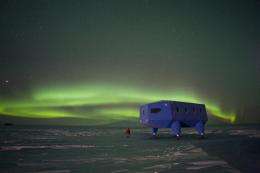
The 'aurora australis' (known as the southern lights) seen in Antarctica. The 'aurora australis' look like fiery, moving curtains of colourful light and can be seen by the naked eye whereas the diffuse aurora is much fainter (viewed via satellite), but is more extensive.
(PhysOrg.com) -- New space research published this week (Thursday 21 October) in the journal Nature, has settled decades of scientific debate. Researchers from the University of California (UCLA) and British Antarctic Survey (BAS) have found the final link between electrons trapped in space and the glow of light from the upper atmosphere known as the diffuse aurora. The research will help us understand 'space weather', with benefits for the satellite, power grid and aviation industries, and how space storms affect the Earth's atmosphere from the top down.
Scientists have long understood that the 'diffuse aurora' is caused by electrons striking the upper atmosphere. However, the electrons are normally trapped much higher up in the Earth's magnetic field through a long chain of events starting with the Sun. The problem is to understand how these electrons reach the atmosphere.
Since the 1970s scientists have debated whether very low frequency (VLF) radio waves could scatter the trapped electrons into the atmosphere. Two types of VLF waves were identified in space as the possible cause of the 'diffuse aurora', but despite years of argument and research no conclusive result had been possible. The new research shows, without doubt, that VLF waves known as 'chorus' are responsible; so-called since the signals detected by ground-based recording equipment sound like the bird's dawn chorus when played back through a loud speaker.
Through detailed analysis of satellite data the authors were able to calculate the effects on the trapped electrons and identify which radio waves were causing the scattering.
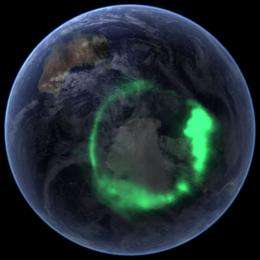
Satellite image of 'diffuse aurora' seen over Antarctica in the southern hemisphere. Image Credit: NASA
Lead author Professor Richard Thorne from UCLA says,"The breakthrough came when we realised that the electrons being lost from space to the Earth's atmosphere were leaving a signature, effectively telling a story about how they were being scattered. We could then analyse our satellite data on the two types of VLF waves and by running calculations on them including the rate at which the electrons were being lost to the Earth's atmosphere we could clearly see that chorus waves were the cause of the scattering."
Professor Richard Horne from British Antarctic Survey says,
"Our finding is an important one because it will help scientists to understand how the diffuse aurora leads to changes in the chemistry of the Earth's upper atmosphere, including effects on ozone at high altitude, which may affect temperature right through the atmosphere.
"We are also including the VLF waves into computer models to help predict 'space weather' which not only affects satellites and power grids, but also the accuracy of GPS navigation and high frequency radio communications with aircraft on polar routes."
The 'diffuse aurora', is not the same as the 'discrete aurora' known as the northern and southern lights. 'Discrete aurora' look like fiery moving curtains of colourful light and can be seen by the naked eye, whereas the diffuse aurora is much fainter but more extensive. The 'diffuse aurora', which typically accounts for three-quarters of the energy input into the upper atmosphere at night, varies according to the season and the 11 year solar cycle.
More information: Thorne, R. M., Ni, B., Tao, X., Horne, R. B., & Meredith N. P., Scattering by chorus waves as the dominant cause of diffuse auroral precipitation, Nature, doi:10.1038/nature09467 (2010).
Provided by
British Antarctic Survey
-
From lemons to lemonade: Reaction uses carbon dioxide to make carbon-based semiconductor,
28 comments
-
Every black hole contains a new universe: A physicist presents a solution to present-day cosmic mysteries,
215 comments
-
New silicon memory chip developed,
16 comments
-
Thioridazine kills cancer stem cells in human while avoiding toxic side-effects of conventional cancer treatments,
2 comments
-
SpaceX private rocket blasts off for space station (Update),
41 comments
-
Transiting Exoplanet Light Curve
2 hours ago
-
Math behind Theoretical Physics
May 24, 2012
-
Do we know whats at the center of galaxies yet?
May 23, 2012
-
Structure of the Milky Way?
May 20, 2012
-
What would it take to terraform Pluto and Charon?
May 19, 2012
-
Whats is volume of mass at the centre of the sun
May 19, 2012
- More from Physics Forums - General Astronomy
More news stories
Nasa receives widespread concepts for future Mars missions
NASA's call to scientists and engineers to help plan a new strategy to explore Mars has resulted in almost double the amount of expected submissions with unique and bold ideas.
Space & Earth / Space Exploration
16 minutes ago |
not rated yet |
0
Image: Carpenter's Flight
50 years ago today, Scott Carpenter flew the second American manned orbital flight on May 24, 1962.
Space & Earth / Space Exploration
17 minutes ago |
not rated yet |
0
Organic carbon from Mars, but not biological
(Phys.org) -- Molecules containing large chains of carbon and hydrogen--the building blocks of all life on Earth--have been the targets of missions to Mars from Viking to the present day. While these molecules ...
Space & Earth / Space Exploration
16 hours ago |
4 / 5 (3) |
2
|
Asteroid nudged by sunlight: Most precise measurement of Yarkovsky effect
Scientists on NASA's asteroid sample return mission, Origins, Spectral Interpretation, Resource Identification, Security, Regolith Explorer (OSIRIS-REx), have measured the orbit of their destination asteroid, ...
Space & Earth / Space Exploration
12 hours ago |
4.9 / 5 (7) |
0
|
New mapping of Mars shows western Medusae Fossae formation older than once thought
(Phys.org) -- Recent geologic mapping of the Medusae Fossae Formation on Marsan intensely eroded deposit near the northern edge of the cratered highlandshas revealed a wider distribution of its ...
Space & Earth / Space Exploration
12 hours ago |
not rated yet |
0
|
Progestin treatment for polycystic ovarian syndrome may reduce pregnancy chances
(Medical Xpress) -- The hormone progestin, often given as a first step in infertility treatment for polycystic ovary syndrome (PCOS), appears to decrease the odds of conception and of giving birth, according to a study by ...
World 'no tobacco day' puts spotlight on dangers of smoking
Its not just smokers who are at-risk when it comes to tobacco smoke exposureand the health concerns of smoking cigarettes are not limited to the most known consequence: lung cancer.
Talking works: UB professor develops method to analyze creative problem solving
(Phys.org) -- Talk -- if it's the right kind -- can increase creativity, leading students to create useful, new ideas that solve problems, a University at Buffalo professor has found by using a statistical tool that he invented.
Nonsmoking lung cancer survivor encourages others to consider risk
Carol Seibert had an upper respiratory infection she just couldnt seem to shake. The timing of her illness was awful, as she had just returned from a trip to Florida for her youngest sons surgery and was preparing ...
OmniVision tops up sensors for cameras, phones
(Phys.org) -- OmniVision has announced two high-resolution image sensors for the digital still and digital video camera market (DS/DVC) and higher end smartphones. In end-user language, it is a claim for superior ...
Diagnostic labs analyze from bugs to toenails
Found an odd bug in your closet? Rhododendrons inexplicably wilting? Need a toenail analyzed? There's a lab for that.
