Russia marks 50 years since horrific space launch disaster
October 24, 2010 by Anna Smolchenko

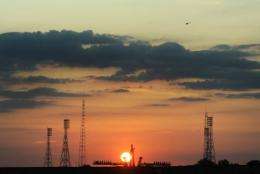
The sun rises over the launch pad at Kazakhstan's Russian-leased Baikonur cosmodrome in 2009

Enlarge

The sun rises over the launch pad at Kazakhstan's Russian-leased Baikonur cosmodrome in September 2009. Russia on Sunday marked the 50th anniversary of the world's most horrific but long-classified space catastrophe when 126 people were burned alive during a launch pad accident at the Baikonur cosmodrome.

Russia on Sunday marked the 50th anniversary of the world's most horrific but long-classified space catastrophe when 126 people were burned alive during a launch pad accident.

During the accident, which the Russian space agency says was a veritable "inferno", people were burned alive or vaporised altogether, while others died of noxious fumes or succumbed to burns later.

Authorities and relatives of those who died in this accident and others held a memorial service at the Baikonur cosmodrome and also laid flowers at their mass graves.

In 1960 the Soviet Union, locked in a space race with the United States, was developing an intercontinental ballistic missile known as the R-16, and on October 24 that year was scheduled to launch a prototype rocket when it exploded on the launch pad.

"People died in horrific pain, essentially burning alive, but the country and the rest of the world practically never learnt anything about that terrible catastrophe and its heroes-victims," Russian space agency Roscosmos said.

"To this day it is considered the most horrific (tragedy) in the history of space exploration," the agency said in a statement.

The Russian space agency, citing Soviet scientist Boris Chertok, says 126 people died, but also notes that the exact number of casualties is hard to pin down and may range between 60 and 150.

The testing crew accidentally initiated the second stage of the rocket, which ignited the first stage causing the disaster.

Those closest to the rocket were "more or less vaporised, and many of the victims only later succumbed to their burns," the space agency said in a separate statement in English.

Known as the "devil's venom", the rocket fuel was so noxious that those who jumped into blast wells to escape the "inferno" were found asphyxiated, the space agency said.

In the West, the tragedy is referred to as the Nedelin disaster, after the commander of the Russian Strategic Missile Forces, Mitrofan Nedelin, who oversaw the rocket programme and died along with designers and testers.

During the test, Konstantin Gerchik, head of the Baikonur cosmodrome at the time, asked Nedelin to step aside for safety reasons.

Nedelin refused. "Am I not the officer just like the rest?" Gerchik remembered Nedelin telling him, according to excerpts of his memoirs carried by the state news agency RIA Novosti.
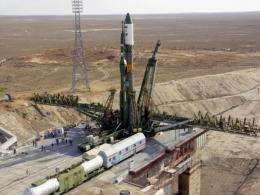
Picture taken in September 2005 shows Russian spacecraft Soyuz-U on the launchpad at the Baikonur cosmodrome
Enlarge

Picture taken in September 2005 shows Russian spacecraft Soyuz-U with the Progress M-54 cargo capsule in the launch pad at the Baikonur cosmodrome in Kazakhstan. Russia on Sunday marked the 50th anniversary of the world's most horrific but long-classified space catastrophe when 126 people were burned alive during a launch pad accident at the Baikonur cosmodrome.

The only thing that was left of the marshal was a pin by which he was later identified, according to Gerchik's previously classified memoirs.

Soviet authorities led by Nikita Khrushchev imposed total secrecy over the accident.

The Pravda newspaper, the official mouthpiece of the Communist Party, said Nedelin had perished in a plane crash, NTV channel said, which estimated 74 people burned alive and more than 50 received injuries.

The files on the launch failure were only declassified in the 1990s.

By coincidence, on the same day three years later a fire at a launch pad killed another seven testers.

In the wake of the two accidents, October 24 is known as "a black day" for space exploration on which Russian officials commemorate the memory of all those who dedicated their lives to the space programme.

Space officials do not schedule any launches on this day.

Sending the first man into space in 1961 and launching the first sputnik satellite four years earlier are among key accomplishments of the Soviet space programme and remain a major source of national pride in Russia.

(c) 2010 AFP

4.4 /5 (11 votes)  

Filter


Move the slider to adjust rank threshold, so that you can hide some of the comments.


Display comments: newest first

ubavontuba
Oct 24, 2010

Rank: 3.8 / 5 (4)
Not just Russian heroes, but heroes for humanity.
zevkirsh
Oct 24, 2010

Rank: not rated yet
well, october 24 is almost over, phew!
CarolinaScotsman
Oct 25, 2010

Rank: 2 / 5 (4)
Testing an intercontinental ballistic missile was not part of the space program. That was a military missle, designed for the delivery of nuclear warheads. It had nothing to do with the space program; it was a military weapons test that failed. Big difference.
ubavontuba
Oct 26, 2010

Rank: 4 / 5 (4)
Testing an intercontinental ballistic missile was not part of the space program. That was a military missle, designed for the delivery of nuclear warheads. It had nothing to do with the space program; it was a military weapons test that failed. Big difference.
Incorrect. Early space vehicles were little more than long-range ballistic missiles with alternate payloads. Missile technology transferred directly into space technology. In the early days, you couldn't really separate the two programs. It was an early R-7 ICBM which launched Sputnik into orbit. Atlas, Redstone, Titan, R-7, and Proton, all started as ICBM designs.

Of course, the cold war must be remembered as a difficult time in history, but it's noteworthy that not one ballistic missile was fired in anger (from either side) during this time.

See? Whether they knew it or not, what they were really making were the first building blocks of the Soviet (now Russian) space program. That's a cool legacy.
CarolinaScotsman
Oct 27, 2010

Rank: 3 / 5 (2)
Incorrect. Early space vehicles were little more than long-range ballistic missiles with alternate payloads.

Wrong. The missle referred to became the SS7, the Soviet Union's front line ICBM, in 1961. It continued to be deployed until the mid 1970s. It was never used in the space program and was always a delivery system for nuclear warheads and nothing else. This rocket was never part of the space program in any form. Read your history a little more closely.
CarolinaScotsman
Oct 27, 2010

Rank: 3 / 5 (2)
Let me rephrase that. In the case of the SS7, there was no connection to the space program. I do realize that early space program vehicles derived from military missles, but this is not one of those and it should not be remembered as part of the space program. To do so does a disservice to those who did work converting military hardware to civilian use. This was a weapons program only and should not be commeorated with the space program.
ubavontuba
Oct 27, 2010

Rank: 5 / 5 (1)
Wrong. The missle referred to became the SS7, the Soviet Union's front line ICBM, in 1961. It continued to be deployed until the mid 1970s. It was never used in the space program and was always a delivery system for nuclear warheads and nothing else. This rocket was never part of the space program in any form. Read your history a little more closely.
It's not about the rocket, it's about the people. These people, though working on a military launch vehicle at the time of their deaths, were largely also associated with the Soviet space program.

And, if you knew your missile technology history, you'd know the SS-7 wasn't exactly the Cadillac of missiles. The Allies had technologically superior and more numerous launch vehicles.

See: http://en.wikiped...missile)
ubavontuba
Oct 27, 2010

Rank: 5 / 5 (1)
Let me rephrase that. In the case of the SS7, there was no connection to the space program. I do realize that early space program vehicles derived from military missles, but this is not one of those and it should not be remembered as part of the space program. To do so does a disservice to those who did work converting military hardware to civilian use. This was a weapons program only and should not be commeorated with the space program.
Again, it's not about the rocket, it's about the people. The Soviet space program and the missile program were essentially one and the same. And, without the weapons program there never would have been a space program to begin with.

Here's a brief history (notice that at the bottom they also commemorate the Nedelin disaster as a failure of the Soviet space program):

http://en.wikiped..._program
frajo
Oct 28, 2010

Rank: 5 / 5 (2)
Seems that both aspects, space and military, are valid ones. Reminds one of Wernher von Braun.
Skeptic_Heretic
Oct 28, 2010

Rank: 5 / 5 (2)
Let me rephrase that. In the case of the SS7, there was no connection to the space program. I do realize that early space program vehicles derived from military missles, but this is not one of those and it should not be remembered as part of the space program. To do so does a disservice to those who did work converting military hardware to civilian use. This was a weapons program only and should not be commeorated with the space program.

Russia's space program and missle program were one in the same, as were the similar US programs. Effectively, both sides used their space programs to cover up long range weapons delivery system testing.
ubavontuba
Oct 30, 2010

Rank: not rated yet
Russia's space program and missle program were one in the same, as were the similar US programs. Effectively, both sides used their space programs to cover up long range weapons delivery system testing.
That's not exactly true. Unlike the Soviets, the Americans separated their civilian and military programs rather early. In fact, NASA was created as a separate, civilian entity in 1958 - in response to Sputnik.

However, it's true that elements of the Army's Ballistic Missile Agency (including Werhner von Braun's team) were incorporated into NASA. And NASA has, and continues to support advanced research which has both civilian and military applications.

See: http://en.wikiped...#History
ubavontuba
Oct 30, 2010

Rank: not rated yet
Oops, shame on me. I misspelled an important name. His full name was actually; Wernher Magnus Maximilian Freiherr von Braun.
frajo
Oct 30, 2010

Rank: 3 / 5 (2)
Oops, shame on me. I misspelled an important name. His full name was actually; Wernher Magnus Maximilian Freiherr von Braun.
More important than his name is his responsibility for the death of more than 10000 slave workers from German concentration camps some of which he personally selected in KZ Buchenwald. The production of the A4 rocket killed more humans than its wartime use.
ubavontuba
Oct 31, 2010

Rank: not rated yet
More important than his name is his responsibility for the death of more than 10000 slave workers from German concentration camps some of which he personally selected in KZ Buchenwald. The production of the A4 rocket killed more humans than its wartime use.
Without minimizing the horrific nature of the circumstances, and while agreeing he must bear some responsibility, it's difficult to say how much personal responsibility he had. He was himself arrested for a period of a couple of weeks and apparently feared for his safety on numerous occasions.

See: http://en.wikiped...ve_labor
frajo
Oct 31, 2010

Rank: 3.7 / 5 (3)
it's difficult to say how much personal responsibility he had. He was himself arrested for a period of a couple of weeks and apparently feared for his safety on numerous occasions.
The nazis were not a homogeneous bunch. The SS killed more than 100 leading people of the SA (Roehm etc.) in 1934 but that doesn't imply that SA members were a better kind of nazis. Wernher von Braun was NSDAP and SS member. The rest is PR.
Skeptic_Heretic
Oct 31, 2010

Rank: 5 / 5 (1)
That's not exactly true. Unlike the Soviets, the Americans separated their civilian and military programs rather early. In fact, NASA was created as a separate, civilian entity in 1958 - in response to Sputnik.

Then can you explain why the designs for the MX-774 (the first US ICBM) and the Redstone (NASA's first LiOx rocket) are identical? Can you explain why they were both codenamed "Atlas"?

The answer is simple, they were one in the same.
The two grouops worked as one for a long time, where NASA would outwardly speak about some of their developments, (simultaneously leading Russian engineers down faulty paths) and keeping their successes silent.

It was an excellent method of counter intelligence.
Pete83
Oct 31, 2010

Rank: 5 / 5 (1)
Despite numerous posts regarding historical accuracy and von Braun, nobody has mentioned Sergei Korolev. His name is synonymous with the Soviet space program, despite his name not being known even by the people he worked with at the time! A true genius of his time, and a man that pushed tirelessly to get into space. The whole time he was building rockets for war, he was thinking of using them to get into space. Wernher von Braun has always been a hero to me, however my hero of the space race has to be Sergei Korolev.

http://en.wikiped..._Korolev
ubavontuba
Nov 01, 2010

Rank: not rated yet
Can you explain why they were both codenamed "Atlas"?
As I explained, NASA was separate, but NASA was derived from and used military resources. It's no secret that NASA and the military still share common resources and technology.

NASA isn't, however (strictly speaking), a military entity.
ubavontuba
Nov 01, 2010

Rank: not rated yet
Despite numerous posts regarding historical accuracy and von Braun, nobody has mentioned Sergei Korolev. His name is synonymous with the Soviet space program, despite his name not being known even by the people he worked with at the time! A true genius of his time, and a man that pushed tirelessly to get into space. The whole time he was building rockets for war, he was thinking of using them to get into space. Wernher von Braun has always been a hero to me, however my hero of the space race has to be Sergei Korolev.

http://en.wikiped..._Korolev


Excellent reference.

His death in 1966 (from medical complications) certainly slowed their progress, as his replacement (Vasili Mishin) wasn't nearly as effective a leader.
Skeptic_Heretic
Nov 01, 2010

Rank: not rated yet
NASA isn't, however (strictly speaking), a military entity.

And that isn't what was said, so I'm not sure what point you're backing away from here.
otto1932
Nov 01, 2010

Rank: not rated yet
The production of the A4 rocket killed more humans than its wartime use.
Strange about that... The damage caused by V1 and V2 rocket programs was far outweighed by their continued reminder to brits of just who the 'enemy' was and what they were capable of.

This was important because many in western europe saw germany as their only protection from russian communism. Around 60% of Waffen-SS members were non-German volunteers.

Nazis were slated to be blamed for the war so that communism could complete its own postwar Tasks of destroying obsolete cultures within its realm.

After ww2, both sides of the cold war benefited from nazi ballistic and cruise missile tech, gained in the Only viable Manner- during actual wartime field experience. This meshed perfectly with nuclear weapons, leading one to suspect that this was a Planned division of effort by Parties best able to develop each segment, leaving postwar 'opponents' in undeniable control of the entire world. Again.
otto1932
Nov 01, 2010

Rank: not rated yet
@frajo
I preemptively negate your Inevitable 1/5... Angriff ist die beste Verteidigung. Actually, since you will 1/5 this post too, otto must attack yet again. War is hell. 'God help me, I love it so.' -Patton
Rank 4.4 /5 (11 votes)
Relevant PhysicsForums posts

More news stories

Organic carbon from Mars, but not biological

(Phys.org) -- Molecules containing large chains of carbon and hydrogen--the building blocks of all life on Earth--have been the targets of missions to Mars from Viking to the present day. While these molecules ...

Space & Earth / Space Exploration

created 15 hours ago | popularity 4 / 5 (3) | comments 1 | with audio podcast

Asteroid nudged by sunlight: Most precise measurement of Yarkovsky effect

Scientists on NASA's asteroid sample return mission, Origins, Spectral Interpretation, Resource Identification, Security, Regolith Explorer (OSIRIS-REx), have measured the orbit of their destination asteroid, ...

Space & Earth / Space Exploration

created 11 hours ago | popularity 4.8 / 5 (6) | comments 0 | with audio podcast

New mapping of Mars shows western Medusae Fossae formation older than once thought

(Phys.org) -- Recent geologic mapping of the Medusae Fossae Formation on Mars—an intensely eroded deposit near the northern edge of the cratered highlands—has revealed a wider distribution of its ...

Space & Earth / Space Exploration

created 11 hours ago | popularity not rated yet | comments 0 | with audio podcast

Private supply ship flies by space station in test (Update)

The world's first private supply ship flew tantalizingly close to the International Space Station on Thursday but did not stop, completing a critical test in advance of the actual docking.

Space & Earth / Space Exploration

created 19 hours ago | popularity 4.8 / 5 (9) | comments 5

Rapid coral death by a deadly chain reaction

(Phys.org) -- Most people are fascinated by the colorful and exotic coral reefs, which form habitats with probably the largest biodiversity. But human civilisation is the top danger to these fragile ecosystems ...

Space & Earth / Environment

created 20 hours ago | popularity 3.7 / 5 (3) | comments 5 | with audio podcast


Computers excel at identifying smiles of frustration (w/ Video)

(Phys.org) -- Researchers at the Massachusetts Institute of Technology (MIT) in the US have trained computers to recognize smiles, and they have turned out to be more adept at recognizing smiles of frustration ...

Is a classical electrodynamics law incompatible with special relativity?

(Phys.org) -- The laws of classical electromagnetism that were developed in the 19th century are the same laws that scientists use today. They include Maxwell’s four equations along with the Lorentz la ...

Dinosaur with tiny arms unearthed in Argentina

Argentine experts have discovered the near-complete remains of a new species of Jurassic-era dinosaur that stood on its rear legs and had tiny arms, according to a leading paleontologist.

Solar plane ends first leg of intercontinental bid

The Swiss sun-powered aircraft Solar Impulse landed safely in Madrid early Friday at the end of the first leg of its attempt at an intercontinental flight without using a drop of fuel.

HyperSolar shows dirty water no barrier to power world

(Phys.org) -- The Santa Barbara, California, company, HyperSolar, is set to transparently share the ups and downs of its research experiences toward the company’s ultimate vision, successfully producing ...

In nanorod crystal growth, nanoparticles seen as artificial atoms

In the growth of crystals, do nanoparticles act as "artificial atoms" forming molecular-type building blocks that can assemble into complex structures? This is the contention of a major but controversial theory ...