Robot, object, action!
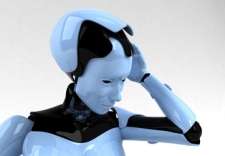
Robotic demonstrators developed by European researchers produce compelling evidence that thinking-by-doing is the machine cognition paradigm of the future. Robots act on objects and teach themselves in the process.
European researchers at the PACO-PLUS project have developed robotic demonstrators to illustrate a new approach to robotic cognition. The team uses a concept called object-action complexes (OACs), pronounced oaks.
These complexes represent a combination of perception of and action upon any given object. The OACs are recorded by the robot every time it performs an action. These recorded actions can be saved and exchanged with other robots, and over time the team hope it will lead to entire libraries of OACs that can be exchanged between researchers.
But that is just a major bonus of this particular system. The primary thrust was to show that robots could teach themselves simple actions, leading to more complex actions and, hopefully, leading to abstract thought in the future.
The PACO-PLUS team performed a large number of demonstrations with humanoid robots and the results so far are very promising.
Autonomous exploration
With autonomous exploration, a robot can patiently explore thousands of potential ways to interact with an object it has no prior knowledge of learning over time that grasping it in one way is better than another, that it balances better in one direction than another, etc.
The first thing a robot will do when it encounters an object for the first time is to lift it before its eyes and then rotate the object so the robot gets a look at it from all angles. After that, [the robot] will be able to identify the object from any angle, explains Tamim Asfour, leader of the Humanoids Research Group at the Institute for Anthropomatics at the Karlsruhe Institute of Technology (KIT) in Germany and co-coordinator of the PACO-PLUS project.
One can see how complex actions could arise over time, as a robot progressively teaches itself how to interact with a cup, jug, handles and doors. Similarly, as the robots experience with different objects expands, its options expand, too, and it could learn to use a key with a hole in a door to see if that action will lead to any result.
This is the core of the OAC concept, that interaction with the environment leads to ever-more sophisticated strategies over time, and ultimately gives rise to intelligence.
Of course, the autonomous exploration is extremely time consuming, unsurprising when one recalls that it took hundreds of millions of years to evolve intelligent life. So another method for teaching robots is learning from human observation and human coaching, and PACO-PLUS developed a large range of successful demonstrators with this method as well.
Human coaching
With coaching, robots can watch humans perform an action, for example wiping a table, and then they can imitate it. It is astonishing how easy it is for robots to mimic complex actions like this.
Similarly, a coach can guide the robots through a complex task, for example putting a cup in a dishwasher. At each stage the coach tells the robot open the dishwasher, take this object/cup, put it in the dishwasher. Over time, the robot learns these sorts of actions.
This is a phenomenally sophisticated demonstration of robotic learning, and it was achieved, using a new approach, in the space of just four years. As such it stands as a remarkable testament to the work ethic of the PACO-PLUS team and the power of its approach.
Of course, we did a lot of other work too, notes Asfour. For example, we looked at some situations with more traditional industrial robots, to see how our work could be applied there.
The work has been very well received in the wider robotic community, and some partners are looking at how they can integrate some of the results into other projects. In the meantime, PACO-PLUS is currently pursuing further research funding to perfect the work achieved.
But already PACO-PLUS has dramatically advanced the field of robotic cognition and helped to set the research and development agenda for the next decade.
This is the second of a two-part PACO-PLUS feature. Part 1.
Provided by
ICT Results
-
From lemons to lemonade: Reaction uses carbon dioxide to make carbon-based semiconductor,
28 comments
-
Every black hole contains a new universe: A physicist presents a solution to present-day cosmic mysteries,
215 comments
-
New silicon memory chip developed,
16 comments
-
Thioridazine kills cancer stem cells in human while avoiding toxic side-effects of conventional cancer treatments,
2 comments
-
SpaceX private rocket blasts off for space station (Update),
41 comments
-
electromagnet core dereference between hard and soft iron
1 hour ago
-
Measuring water pressure in an open tank
11 hours ago
-
Question from a non-engineer: Pulley Systems
19 hours ago
-
Formula to calculate psi required to deliver gpm through nozzel
May 23, 2012
-
Introduction and general help regarding poers..
May 23, 2012
-
Is there a known treshold between diffusion and Bernoulli's flow?
May 22, 2012
- More from Physics Forums - General Engineering
More news stories
Nvidia says Kai platform will turn price tide for tablets
(Phys.org) -- In March, Nvidia gave some signs that they were working to lower the cost of their Tegra 3 processors and they suggested consumers might see prices for Android tablets as low as $199. Connect ...
Several iOS developers welcome Apple's larger-screen iPhone
The sixth-generation iPhone is expected to have a larger screen, and several iOS developers say they would receive that change with a warm welcome.
Electronics / Consumer & Gadgets
18 hours ago |
1 / 5 (1) |
0
Robotics: Gesturing for control
New intelligent algorithms could help robots to quickly recognize and respond to human gestures. Researchers at A*STAR Institute for Infocomm Research in Singapore have created a computer program which recognises ...
19 hours ago |
not rated yet |
0
Wrinkle-traveling Clothbot makes its IEEE debut (w/ Video)
(Phys.org) -- As any gathering of scientists working with robots will suggest, attempts toward perfecting techniques and outcomes of grasping and maneuvering are key issues for researchers working on climbing robots. At ...
Raspberry Pi to add camera later this year
(Phys.org) -- The Raspberry Pi, a uniquely priced, no casing computer that plugs into your TV and a keyboard., will be given a camera accessory later this year. That may be oh-so-what news if this ...
Computers excel at identifying smiles of frustration (w/ Video)
(Phys.org) -- Researchers at the Massachusetts Institute of Technology (MIT) in the US have trained computers to recognize smiles, and they have turned out to be more adept at recognizing smiles of frustration ...
Is a classical electrodynamics law incompatible with special relativity?
(Phys.org) -- The laws of classical electromagnetism that were developed in the 19th century are the same laws that scientists use today. They include Maxwell’s four equations along with the Lorentz la ...
Dinosaur with tiny arms unearthed in Argentina
Argentine experts have discovered the near-complete remains of a new species of Jurassic-era dinosaur that stood on its rear legs and had tiny arms, according to a leading paleontologist.
Solar plane ends first leg of intercontinental bid
The Swiss sun-powered aircraft Solar Impulse landed safely in Madrid early Friday at the end of the first leg of its attempt at an intercontinental flight without using a drop of fuel.
HyperSolar shows dirty water no barrier to power world
(Phys.org) -- The Santa Barbara, California, company, HyperSolar, is set to transparently share the ups and downs of its research experiences toward the companys ultimate vision, successfully producing ...
Organic carbon from Mars, but not biological
(Phys.org) -- Molecules containing large chains of carbon and hydrogen--the building blocks of all life on Earth--have been the targets of missions to Mars from Viking to the present day. While these molecules ...
Oct 29, 2010
Rank: 5 / 5 (1)
Let's say I did a load of random movements before putting the cup in the dishwasher, like spinning around and making odd gestures with my hands.
Would the robot be able to make the logical inference that such movements are superfluous to putting a cup in a dishwasher, as a human would, or would it unintelligently copy the movements exactly and associate them with the processes needed to put a cup away.
Oct 29, 2010
Rank: 5 / 5 (1)
My sense is that such programing would have one of its basic algorithms being to figure-out the most efficient way to move object x from point a. to point b.; or calculating efficiency in whatever the task at hand is.
Oct 29, 2010
Rank: 5 / 5 (2)
Yes, but sometimes style plays a part in society. We have methods that are not efficient but are socially expected. A robot needs to sacrifice efficiency to fit in.
Oct 29, 2010
Rank: 5 / 5 (1)
I've read about this kind of thing in designing structural parts where it is put under simulated loads over and over in an "evolutionary" design process. It seems the same could be applied to this kind of thing. But I'm no computer scientist so perhaps not.
Oct 29, 2010
Rank: 5 / 5 (2)
You are never going to "program" a true AI in the traditional sense of the word. Any true AI is going to learn, not be programed. Intelligence is a bottom up proposition, not top down.
Oct 29, 2010
Rank: 5 / 5 (3)
That's assuming the robot understands the purpose of doing that action in the first place. If it's to store a cup in the dishwasher (or wash it) then, as long as it can understand THAT, it should be able to filter out actions that aren't necessary to put away the cup. But if it's just mimicking actions (which sounds like what's happening here) then the robot might think it's a good idea to do that at first (just like a kid does) until it "realizes" the general purpose of this sequence of actions and optimizes its routine.
Oct 29, 2010
Rank: not rated yet
This mechanism is used almost universally among higher animals that look after their young, so it has to be a good strategy. The challenge is in making the software general and flexible enough to be able to learn from these behaviours and build on them over time and for the hardware to have sufficient degrees of freedom to mimic coached actions. Nice work.
Nov 01, 2010
Rank: not rated yet
It's a little goofy, but there are some interesting philosophical problems brought up in the series.
Nov 01, 2010
Rank: not rated yet
This would only apply if ALL robots were 100% identical. They are not.