Saving platinum: Monolayer of platinum on tungsten carbide catalyzes electrolytic production of hydrogen
October 15, 2010

Saving platinum: Monolayer of platinum atoms on tungsten carbide catalyzes electrolytic production of hydrogen

(PhysOrg.com) -- Hydrogen is one of the most promising fuels of the future. Whether powered by wind or sun energy, electrolysis of water is the method of choice for producing hydrogen without emission of carbon dioxide. The character and properties of the hydrogen-producing catalyst, usually platinum, are of critical importance for the efficiency and cost of the electrocatalytic system.

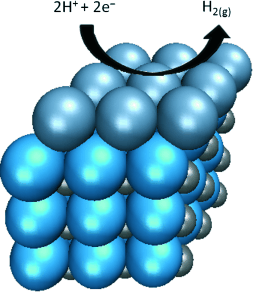
In the journal , Jingguang G. Chen and a team at the University of Delaware (USA) have now introduced a new method for saving on without losing efficiency: they deposit a single layer of platinum atoms onto an inexpensive tungsten carbide support.

Splitting water by electrolysis to produce hydrogen only works efficiently if the cathode, the cell’s negative electrode, is equipped with an efficient . Platinum is the material of choice because of its high activity -- unfortunately it is very expensive, currently costing around 52 dollars a gram. “Its high price and limited availability are the biggest stumbling blocks on the way to the mass production of through electrolysis,” explains Chen.

Current attempts to save on platinum by depositing platinum particles onto a support, have not been efficient enough. The platinum atoms often settle too far inside the porous support and are shielded from the reaction. Says Chen, “Our aim was to deposit a single layer of platinum atoms onto an inexpensive planar support so that all the platinum atoms can participate in the reaction.”

The problem with this method is that if such a monolayer of metal atoms is deposited onto a support, the atoms interact with the substrate. The electronic structure of the atoms can change because the distances between the individual atoms in the layer can be different from those in the pure metal. In addition, bonding between the platinum and atoms of the support can lead to undesired effects. This can greatly disrupt the catalytic properties.

Chen and his team selected tungsten carbide as a carrier. This inexpensive material has properties very similar to those of platinum. They deposited thin films of tungsten carbide onto a tungsten substrate and added platinum by vapor deposition. The chemical and electronic properties of these atomic platinum monolayers on tungsten carbide did not differ significantly from those of a block of pure platinum. The catalytic efficiency of the supported platinum monolayer is also correspondingly strong.

is the ideal substrate for platinum,” says Chen. “It is possible to use significantly smaller amounts of platinum, which reduces the cost—possibly not just for water electrolysis, but also in other platinum-catalyzed processes.”

More information: Jingguang G. Chen, Low-Cost Hydrogen-Evolution Catalysts Based on Monolayer Platinum on Tungsten Monocarbide Substrates, Angewandte Chemie International Edition, http://dx.doi.org/ … ie.201004718

Provided by Wiley search and more info website

4.6 /5 (14 votes)  

Filter


Move the slider to adjust rank threshold, so that you can hide some of the comments.


Display comments: newest first

Royale
Oct 15, 2010

Rank: 1 / 5 (2)
Why does the picture show Helium being split? They're taking about water electrolysis the whole time. I'd like to see a relevant picture with the article. And looking at the picture, what exactly happens to the 2e- when the 2H is turning into hydrogen? Is that some kind of release of energy and a measure of that, because i'm no chemistry buff, but i know you can just take He and go 2H + 2e, what the hell is e, unless they're talking about energy.
jjoensuu
Oct 15, 2010

Rank: not rated yet
so now we have platinums reactions with water in the news...

Water's interaction with platinum requires a closer look, researchers find: http://www.physor...ser.html
Skeptic_Heretic
Oct 15, 2010

Rank: 4 / 5 (4)
Why does the picture show Helium being split? They're taking about water electrolysis the whole time. I'd like to see a relevant picture with the article. And looking at the picture, what exactly happens to the 2e- when the 2H is turning into hydrogen? Is that some kind of release of energy and a measure of that, because i'm no chemistry buff, but i know you can just take He and go 2H + 2e, what the hell is e, unless they're talking about energy.
There's no helium there.

When you electrolyze water into hydrogen and oxygen what happens is 2H2O -> 2H2 O2. Now the actual mechanics are adding energy rips the hydrogen ion (otherwise known as a proton or H plus) from the Oxygen or hydroxide molecule. Then the hydrogen picks up a free electron. What the image is showing above is the picking up of free electrons (provided by the input of electricity). So you get 2H positive ion plus two free electrons (e negative) ->H2.

I really wish this site used the extended character map.
david_42
Oct 15, 2010

Rank: 5 / 5 (1)
What helium? 2H+ means two hydrogen ions. 2e- is just two electrons.

Helium's abbreviation is He
Sanescience
Oct 15, 2010

Rank: 5 / 5 (2)
electrolysis of water is the method of choice for producing hydrogen without emission of carbon dioxide


Really? Direct thermochemical production is not only far more efficient, it scales up well.

However, hydrogen as an energy carrier leaves much to be desired. It is toxic, corrosive, exceptionally flammable, high pressure chambers, requires mega investments in new infrastructure, and is low energy density unless in it's cryogenic state (think space shuttle with all the insulation issues).

Besides, the oil companies already built and own a massive infrastructure for hydrocarbons. Reusing that infrastructure for bio-diesel produced by a range of recycling, farming, and hydroponics, would make far more sense. Plus millions of people who know how to work on car engines can keep their jobs. A win-win-win ( industry, environment, public ) strategy.
apex01
Oct 15, 2010

Rank: not rated yet
I agree with Sanescience, plus it would be far more cost effective and swift.
dgc
Oct 15, 2010

Rank: not rated yet
Skeptic Heretic, et.al.:

Actually, the catalyst arrow's direction is in the wrong direction for a fuel cell's anodic reaction: H2 needs to be converted to 2H+ and 2e-; the cathodic reaction is O2 + 4H+ + 4e-, yielding 2 molecules of water. Both protons and electrons flow from anode to cathode, doing useful work in the process.

Sanescience, et.al.:

Hydrogen actually does have a very high energy relative energy density, but of course you are addressing its use in tranportation applications. While it remains to be seen whether hydrogen storage can be effected using existing or experimental engineering methods, you should not overlook autothermal reforming for portable or transportion applications of fuel cells. These approaches all have their limitations, but then again this is why the technology is still fundamentally in a R&D phase until new, cost-effective, and comparable materials can be applied to engineer improved units.
PinkElephant
Oct 16, 2010

Rank: not rated yet
@dgc,

This article is talking about electrolysis, not about fuel cells. The Platinum in this case is on the cathode, not the anode.

http://en.wikiped...quations

@Sanescience,

The point of searching for a highly efficient method of generating hydrogen (and oxygen) from electricity, is that intermittent power sources such as wind turbines, solar panels, or wave power generators could deposit their energy into a form that can be stored and possibly transported for later use. The resulting gases do not necessarily need to be used directly as transportation fuel. They can be fed into hydrogen-burning power plants to generate electricity at some later point in time, or continuously at a slow pace to smooth out the variability of the power source.

And before you say it's cheaper to make hydrogen from fossil fuels, don't forget that currently the externality costs of such production methods are not correctly factored into the price of the product.
Sanescience
Oct 17, 2010

Rank: not rated yet
PinkElephant: There is definitely utility in electrolysis of water from intermittent power. But it is not anything that can drive major industry. If hydrogen is going to displace any meaningful part of the fossil fuel juggernaut (which I do not recommend) then you have to do it with nuclear.
holoman
Oct 18, 2010

Rank: not rated yet
All of these electrolytic concepts always involve
some rare materials or exotic catalyse.

I read where a company uses no rare materials, electrodes, catalyse to product hydrogen from natural gas, fresh water, salt water, and coal.
Rank 4.6 /5 (14 votes)
Relevant PhysicsForums posts
  • Acid Base Theories
    created23 hours ago
  • Stability of phenyl cation
    createdMay 23, 2012
  • Carbon dioxide density & distribution in the atmosphere
    createdMay 23, 2012
  • Question regarding classification of halogen derivatives of alkanes
    createdMay 23, 2012
  • the concept of mole
    createdMay 23, 2012
  • What is water of crystallisation?
    createdMay 22, 2012
  • More from Physics Forums - Chemistry

More news stories

Discarded data may hold the key to a sharper view of molecules

(Phys.org) -- There's nothing like a new pair of eyeglasses to bring fine details into sharp relief. For scientists who study the large molecules of life from proteins to DNA, the equivalent of new lenses have come in the ...

Chemistry / Biochemistry

created 9 hours ago | popularity 4.7 / 5 (3) | comments 0 | with audio podcast

New CO2-removing catalyst can take the heat

(Phys.org) -- The current method of removing the greenhouse gas carbon dioxide (CO2) from the flues of coal-fired power plants uses so much energy that no one bothers to use it. So says Roger Aines, principal ...

Chemistry / Materials Science

created 17 hours ago | popularity 5 / 5 (7) | comments 6 | with audio podcast

Pivotal role for proteins -- from helping turn carbs into energy to causing devastating disease

Research into how carbohydrates are converted into energy has led to a surprising discovery with implications for the treatment of a perplexing and potentially fatal neuromuscular disorder and possibly even cancer and heart ...

Chemistry / Biochemistry

created 9 hours ago | popularity 5 / 5 (1) | comments 0 | with audio podcast

Nuisance seaweed found to produce compounds with biomedical potential

A seaweed considered a threat to the healthy growth of coral reefs in Hawaii may possess the ability to produce substances that could one day treat human diseases, a new study led by scientists at Scripps ...

Chemistry / Biochemistry

created 11 hours ago | popularity 5 / 5 (2) | comments 1 | with audio podcast

Study cracks a secret of methanol production

(Phys.org) -- What’s the best way to make methanol? The question is more pressing than it sounds. Not only is methanol an important industrial chemical – some 50 million tons are used each year to ...

Chemistry / Materials Science

created 17 hours ago | popularity 5 / 5 (1) | comments 0 | with audio podcast


Is a classical electrodynamics law incompatible with special relativity?

(Phys.org) -- The laws of classical electromagnetism that were developed in the 19th century are the same laws that scientists use today. They include Maxwell’s four equations along with the Lorentz la ...

HyperSolar shows dirty water no barrier to power world

(Phys.org) -- The Santa Barbara, California, company, HyperSolar, is set to transparently share the ups and downs of its research experiences toward the company’s ultimate vision, successfully producing ...

Organic carbon from Mars, but not biological

Molecules containing large chains of carbon and hydrogen--the building blocks of all life on Earth--have been the targets of missions to Mars from Viking to the present day. While these molecules have previously ...

In nanorod crystal growth, nanoparticles seen as artificial atoms

In the growth of crystals, do nanoparticles act as "artificial atoms" forming molecular-type building blocks that can assemble into complex structures? This is the contention of a major but controversial theory ...

First direct observation of oriented attachment in nanocrystal growth

Berkeley Lab researchers have reported the first direct observation of nanoparticles undergoing oriented attachment, the critical step in biomineralization and the growth of nanocrystals. A better understanding ...

Asteroid nudged by sunlight: Most precise measurement of Yarkovsky effect

Scientists on NASA's asteroid sample return mission, Origins, Spectral Interpretation, Resource Identification, Security, Regolith Explorer (OSIRIS-REx), have measured the orbit of their destination asteroid, ...