Research brings cure for Parkinson's disease a step closer
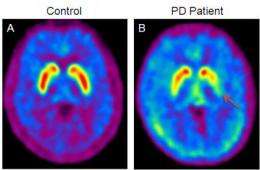
An international collaboration led by academics at the University of Sheffield, has shed new light into Parkinson's disease, which could help with the development of cures or treatments in the future.
The collaboration, which was led by Professor Peter Redgrave from the University's Department of Psychology, suggests that many of the problems suffered by patients with Parkinson's disease - difficulties in initiating actions, slow laboured movements and tremors – can be understood in terms of damage to control circuits in the brain responsible for habits.
The analysis, which is published online and will appear in the November issue of Nature Reviews Neuroscience, has involved combining the experience of an international team of clinical experts to explain why, paradoxically, removal of part of the brain can help sufferers of Parkinson's disease regain smooth initiation of movements.
An important processing unit in the brain (the basal ganglia) is part of two behavioural control circuits – habitual control, which directs our fast, stimulus-driven automatic, largely unconscious movements; and voluntary goal-directed control, which is driven by a conscious appreciation of the action's outcome. This means goal-directed movements are typically slower, require effort, and can only be done one at a time. Different regions of the basal ganglia are involved in goal-directed and habitual control. An important proposal in the Nature Reviews Neuroscience article is that Parkinson's disease is linked to a preferential loss of the neurotransmitter dopamine from the regions involved in habitual control.
Many of the symptoms of Parkinson's disease can therefore be understood in terms of a catastrophic loss of habits, which means patients have to rely on the goal-directed control system for everything they do. This idea can explain why their movements are slow, effortful and easily interrupted. For example, when approaching a narrow door or object, a patient with Parkinson's disease can suddenly freeze and find it difficult to start again. Under serial goal-directed control, (i.e. you can only think about doing one thing at a time), when the patient stops thinking about walking and starts to think about going through the door or avoiding the object, they stop walking.
The proposed analysis offers a further important insight into the symptoms of Parkinson's disease. At the level of the basal ganglia, the goal-directed and habitual control circuits are physically separated, but down-stream, they converge on shared motor systems (that is, we can do the same action either under goal-directed or habitual control). Numerous experiments show that the loss of dopamine from the basal ganglia increases inhibitory output from the habitual control circuits. Therefore, for a patient with Parkinson's disease to express goal-directed behaviour, they have to overcome the distorting inhibitory signals from the malfunctioning habitual control system. This provides a further reason for why patients find it so difficult to initiate and maintain actions and why their behaviour is so effortful and slow.
These ideas also offer a potential resolution of a continuing paradox in Parkinson's disease research – why destruction of the parts of the basal ganglia responsible for habits can have such a beneficial effect on Parkinson's disease. Professor Redgrave and his team propose that removal of the distorting inhibitory output from habitual control circuits could make it easier for goal-directed behaviour to be expressed.
It is hoped this new interpretation of Parkinson's disease will help in the discovery of new cures and treatment in the future for the 120,000 people in the UK suffering with the disease. Firstly, by directing attention to what makes the habitual basal ganglia particularly vulnerable, and secondly to parts of the brain where goal-directed behaviour is being disrupted by dysfunctional signals from the circuits responsible for habits.
Neuroscientist Professor Peter Redgrave from the University of Sheffield's Department of Psychology, said: "We hope our analysis provides a better understanding of the link between normal and abnormal functioning in the basal ganglia. This is important because the better your understanding of normal function, the better the questions you can ask about its failings, which hopefully, will direct you towards more effective treatments."
More information: To read the full paper entitled 'Goal-directed and habitual control in the basal ganglia: implications for Parkinson's disease' in Nature Reviews Neuroscience, visit: www.nature.com/nrn/journal/vao … rent/pdf/nrn2915.pdf


