Garden of Eden: Paradise lost -- and found
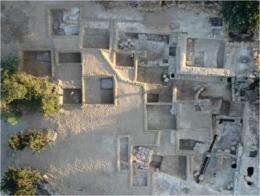
This is an aerial view of the Ramat Rachel archaeological dig. Credit: AFTAU
Ancient gardens are the stuff of legend, from the Garden of Eden to the Hanging Gardens of Babylon. Now researchers at Tel Aviv University, in collaboration with Heidelberg University in Germany, have uncovered an ancient royal garden at the site of Ramat Rachel near Jerusalem, and are leading the first full-scale excavation of this type of archaeological site anywhere in the pre-Hellenistic Levant.
According to Prof. Oded Lipschits and graduate student Boaz Gross of Tel Aviv University's Department of Archaeology, this dig is an unparalleled look into the structure and function of ancient gardens. "We have uncovered a very rare find," says Prof. Lipschits, who believes that this excavation will lead to invaluable archaeological knowledge about ancient royal gardens in the Middle East.
The discovery, which dates back to the 7th century B.C.E., was recently reported in Quadmoniot, the journal of the Israel Exploration Society, and another paper on the dig is forthcoming in Near Eastern Archaeology.
Flower power in the ancient world
According to Gross, such gardens were once the ultimate symbol of power. It makes an obvious statement of status, he explains, to have a massive and lush green space surrounding one's palace, especially when the surrounding area is bare, as it would have been in the dry climate of the Judean Hills only two miles from the Old City of Jerusalem. In fact, he says, the garden would have been the most prominent feature of Ramat Rachel, visible from the west, north and south.
One of the dig's most important aspects is water management. In ancient times, control over water indicated political strength, says Gross. A main feature of the Ramat Rachel gardens is its intricate irrigation system, the likes of which have never been seen before outside of Mesopotamia. Features include open channels and closed tunnels, stone carved gutters and the framework for elaborate waterfalls.
In similar Assyrian gardens, trees and plants would have been brought in from all over the empire, explains Prof. Lipschits, who says that this type of garden, also in the Babylonian or Persian kingdoms, would have also served a spiritual function as a place of peace, tranquillity and connection to nature.
A global village?
Preliminary results show that while Ramat Rachel was built by the Judeans, the people of the ancient kingdom of Judah, it was commissioned by foreign powers. These results may reveal information about a wide variety of empires that ruled in Israel at one time. This site, says Gross, was in use from the 7th to the 4th century B.C.E., a time period which saw many wars and exchanges of power with the garden evolving under each civilization.
Researchers are excited about what more this unique dig will be able to tell them. There has never been anything like it, explains Gross, who says that the TAU team will be pioneering a method for excavating gardens. "Proper excavation will provide an essential tool to future researchers," he says. "We are carefully deciphering what we have in front of us. There are no parallels to it."
The team hopes to delve deeper into the history of the garden with a close analysis of soil and other findings to determine what kind of plant life would have grown there, and which, if any, animals called the garden home.
Provided by
Tel Aviv University
-
From lemons to lemonade: Reaction uses carbon dioxide to make carbon-based semiconductor,
28 comments
-
Every black hole contains a new universe: A physicist presents a solution to present-day cosmic mysteries,
214 comments
-
New silicon memory chip developed,
16 comments
-
Computing experts unveil superefficient 'inexact' chip,
45 comments
-
SpaceX private rocket blasts off for space station (Update),
41 comments
-
What does exophillic and endophillic mean in terms of mosquito and their control?
12 hours ago
-
Semen stains glows under black lights (uv light)?
May 23, 2012
-
Question on Human Chromosome 2
May 23, 2012
-
How important is composition of TBST in diluting antibodies and Western Blotting?
May 22, 2012
-
Does the medulla monitor blood pH
May 20, 2012
-
What physically constitutes memory?
May 17, 2012
- More from Physics Forums - Biology
More news stories
Relatively speaking: Researchers identify principles that shape kinship categories across languages
Different languages refer to family relationships in different ways. For example, English speakers use two terms grandmother and grandfather to refer to grandparents, while Mandarin Chinese uses four terms. ...
Other Sciences / Social Sciences
9 hours ago |
4 / 5 (2) |
0
|
Social welfare cuts ultimately come with heavy price, researchers say
(Phys.org) -- Slashing government funding for Medicaid, food stamps and other programs that serve the poor while politically popular with some lawmakers and many conservatives may do more harm ...
Other Sciences / Social Sciences
16 hours ago |
4.4 / 5 (7) |
39
Psychologists examine how race affects juvenile sentencing
When it comes to holding children accountable for crimes they commit, race matters.
Other Sciences / Social Sciences
7 hours ago |
5 / 5 (1) |
0
CWRU class earns Science magazine prize for innovation
Science magazine has awarded a prize for Inquiry-Based Instruction to a Case Western Reserve University class that melds biology, computer modeling, mathematical analysis and writing.
Other Sciences / Social Sciences
9 hours ago |
not rated yet |
0
Oldest art even older
New dates from Geißenklösterle Cave in Southwest Germany document the early arrival of modern humans and early appearance of art and music.
Other Sciences / Archaeology & Fossils
4 hours ago |
5 / 5 (1) |
0
Is a classical electrodynamics law incompatible with special relativity?
(Phys.org) -- The laws of classical electromagnetism that were developed in the 19th century are the same laws that scientists use today. They include Maxwell’s four equations along with the Lorentz la ...
HyperSolar shows dirty water no barrier to power world
(Phys.org) -- The Santa Barbara, California, company, HyperSolar, is set to transparently share the ups and downs of its research experiences toward the companys ultimate vision, successfully producing ...
Organic carbon from Mars, but not biological
Molecules containing large chains of carbon and hydrogen--the building blocks of all life on Earth--have been the targets of missions to Mars from Viking to the present day. While these molecules have previously ...
In nanorod crystal growth, nanoparticles seen as artificial atoms
In the growth of crystals, do nanoparticles act as "artificial atoms" forming molecular-type building blocks that can assemble into complex structures? This is the contention of a major but controversial theory ...
First direct observation of oriented attachment in nanocrystal growth
Berkeley Lab researchers have reported the first direct observation of nanoparticles undergoing oriented attachment, the critical step in biomineralization and the growth of nanocrystals. A better understanding ...
Asteroid nudged by sunlight: Most precise measurement of Yarkovsky effect
Scientists on NASA's asteroid sample return mission, Origins, Spectral Interpretation, Resource Identification, Security, Regolith Explorer (OSIRIS-REx), have measured the orbit of their destination asteroid, ...