Neanderthals did not make jewelry after all
October 19, 2010

Neanderthals may have made jewelry after all

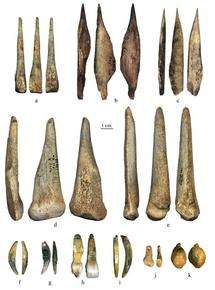
Tools previously thought to have been fashioned by later Neanderthals

(PhysOrg.com) -- The theory that later Neanderthals might have been sufficiently advanced to fashion jewellery and tools similar to those of incoming modern humans has suffered a setback. A new radiocarbon dating study, led by Oxford University, has found that an archaeological site that uniquely links Neanderthal remains to sophisticated tools and jewellery may be partially mixed.

The study, published in the early online version of the journal PNAS, suggests that the position of key finds in the archaeological layers of the Grotte du Renne at Arcy-sur-Cure in France may not be trustworthy. The research team, from the UK and France, dated material from the site and discovered their radiocarbon ages were extremely variable and did not correspond with the expected sequence indicated by the excavated archaeological layers. The Grotte du Renne has 15 archaeological layers, covering a depth of about four metres spanning periods from the Mousterian to the Gravettian periods.

For decades scholars have debated the extent of cognitive and behavioral development in Neanderthals before they disappeared from Europe about 30,000 years ago. Neanderthals are the most recent, extinct modern human relative. We have a from around 700,000-800,000 years ago and recent work in decoding the Neanderthal shows we share between one to four per cent of their DNA.

One pivotal period is around 35,000-40,000 years ago when the earliest dispersed into Western Europe. Finds made in the 1950s and 1960s at the Grotte du Renne site have provided persuasive evidence to suggest either that Neanderthals developed a more modern type of behaviour before modern human dispersal, developing their own complex ornaments and tools, or that they mimicked the behavior of the modern humans that they encountered after their arrival. Over the years the site has yielded 29 Neanderthal teeth and a piece of ear bone from a Neanderthal skull in the same archaeological levels as rings made of ivory, awls, bone points, pierced animal teeth, shell and ivory pendants. The finds were recovered from three archaeological levels (VII, IX, X) associated with the Châtelperronian industry, a tool culture thought to have evolved from the earlier Neanderthal, Mousterian industry.

For this study, researchers from the Oxford Radiocarbon Accelerator Unit analysed 59 remains of cut-marked bones, horse teeth smashed by humans, awls, ornaments fashioned from animal teeth and mammoth ivory tusks from six key archaeological levels of the site. They included the three Châtelperronian levels (VIII, IX and X) and the Aurignacian level with material derived from modern humans in level VII. Thirty-one new radiocarbon dates were obtained: the oldest material in the Aurignacian level was dated at around 35,000 years ago, but when the researchers dated materials from the lower Châtelperronian levels they discovered many of the ages were hugely variable, with some much younger and several at about the same age as dates from the Aurignacian level. The most serious chronological problems were in the oldest part of the Châtelperronian layer (X) where more than a third of the radiocarbon ages were outside the ranges expected.

Lead author Dr Thomas Higham, Deputy Director of the Oxford Radiocarbon Accelerator Unit, said: ‘Our results confirm that material has moved up and down and is out of sequence in the Châtelperronian levels. We think that there has probably been some physical disturbance which has disrupted the proper sequence of the layers. This means that any chronological interpretation from this site should be viewed with extreme caution.

‘Our study raises questions about the link between Neanderthals and the tools and jewellery found in the Châtelperronian levels. This site is one of only two in the French Palaeolithic that seems to show a link between ornaments and Neanderthal remains. This has previously been interpreted as indicating that were not intellectually inferior to modern people but possessed advanced cognition and behaviour. Our work says there is a big question mark over whether this link exists.’

Provided by Oxford University search and more info website

4.7 /5 (13 votes)  

Filter


Move the slider to adjust rank threshold, so that you can hide some of the comments.


Display comments: newest first

DavidMcC
Oct 19, 2010

Rank: 5 / 5 (4)
"... we share between one to four per cent of their DNA."
Eh? I thought we shared more than that with a banana!
Also, I thought our split with Neanderthals occurred at only about 450KY ago, but maybe that's been updated.
furlong64
Oct 19, 2010

Rank: 4 / 5 (4)
Yeah, that DNA figure means we're more closely related to asparagus than Neanderthals. Someone mistyped.
gopher65
Oct 19, 2010

Rank: 5 / 5 (6)
I think they meant that humans have about 1-4% of Neanderthal specific gene sequences encoded in our DNA, not that our DNA is 1-4% similar. That wouldn't make sense. because our DNA is nearly identical to Neanderthal DNA if you're comparing that percent measurement (which is silly, because it doesn't tell you very much).
jjoensuu
Oct 19, 2010

Rank: 2.3 / 5 (4)
if Neanderthals really share like one-to-four percent of their DNA with us, could that be just coincidental code similarities? I mean that maybe they are actually not related to us at all.

Perhaps Neanderthals share more code with some other species? Like pumpkins.
NameIsNotNick
Oct 19, 2010

Rank: 5 / 5 (7)
Our DNA contains 1-4% of sequences unique to Neanderthals indicating that they may have interbred with humans. Our DNA, however, is 99.7% identical to theirs.
http://news.natio...na-gene/
__o
Oct 20, 2010

Rank: 3.7 / 5 (3)
couldn't it be that they were too smart to wear jewelry? i mean really? is that a sign of advanced thinking or some sort of disorder? hanging bits of rock and bone from body parts maybe didn't occur to them..
xznofile
Oct 20, 2010

Rank: 4 / 5 (1)
jewelry & clothing is a cultural badge among H sapiens. Interesting that it's not among Neanderthals, just conjecture of course but consider they may have had had no tribal concept & were totally egalitarian. likewise, humans have unwittingly appended sexual hierarchy to group affiliation that makes us fight in groups.
Rank 4.7 /5 (13 votes)
Relevant PhysicsForums posts

More news stories

Relatively speaking: Researchers identify principles that shape kinship categories across languages

Different languages refer to family relationships in different ways. For example, English speakers use two terms — grandmother and grandfather — to refer to grandparents, while Mandarin Chinese uses four terms. ...

Other Sciences / Social Sciences

created 8 hours ago | popularity 4 / 5 (2) | comments 0 | with audio podcast

Social welfare cuts ultimately come with heavy price, researchers say

(Phys.org) -- Slashing government funding for Medicaid, food stamps and other programs that serve the poor – while politically popular with some lawmakers and many conservatives – may do more harm ...

Other Sciences / Social Sciences

created 16 hours ago | popularity 4.3 / 5 (6) | comments 36

Psychologists examine how race affects juvenile sentencing

When it comes to holding children accountable for crimes they commit, race matters.

Other Sciences / Social Sciences

created 6 hours ago | popularity 5 / 5 (1) | comments 0

CWRU class earns Science magazine prize for innovation

Science magazine has awarded a prize for Inquiry-Based Instruction to a Case Western Reserve University class that melds biology, computer modeling, mathematical analysis and writing.

Other Sciences / Social Sciences

created 8 hours ago | popularity not rated yet | comments 0

Oldest art even older

New dates from Geißenklösterle Cave in Southwest Germany document the early arrival of modern humans and early appearance of art and music.

Other Sciences / Archaeology & Fossils

created 3 hours ago | popularity 5 / 5 (1) | comments 0


Is a classical electrodynamics law incompatible with special relativity?

(Phys.org) -- The laws of classical electromagnetism that were developed in the 19th century are the same laws that scientists use today. They include Maxwell’s four equations along with the Lorentz la ...

HyperSolar shows dirty water no barrier to power world

(Phys.org) -- The Santa Barbara, California, company, HyperSolar, is set to transparently share the ups and downs of its research experiences toward the company’s ultimate vision, successfully producing ...

Organic carbon from Mars, but not biological

Molecules containing large chains of carbon and hydrogen--the building blocks of all life on Earth--have been the targets of missions to Mars from Viking to the present day. While these molecules have previously ...

In nanorod crystal growth, nanoparticles seen as artificial atoms

In the growth of crystals, do nanoparticles act as "artificial atoms" forming molecular-type building blocks that can assemble into complex structures? This is the contention of a major but controversial theory ...

Asteroid nudged by sunlight: Most precise measurement of Yarkovsky effect

Scientists on NASA's asteroid sample return mission, Origins, Spectral Interpretation, Resource Identification, Security, Regolith Explorer (OSIRIS-REx), have measured the orbit of their destination asteroid, ...

First direct observation of oriented attachment in nanocrystal growth

Berkeley Lab researchers have reported the first direct observation of nanoparticles undergoing oriented attachment, the critical step in biomineralization and the growth of nanocrystals. A better understanding ...