Mysterious pulsar with hidden powers discovered
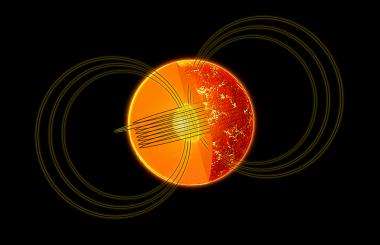
Illustration: NASA/CXC/M.Weiss
Dramatic flares and bursts of energy - activity previously thought reserved for only the strongest magnetized pulsars - has been observed emanating from a weakly magnetised, slowly rotating pulsar. The international team of astrophysicists who made the discovery believe that the source of the pulsar's power may be hidden deep within its surface.
Pulsars, or neutron stars, are the collapsed remains of massive stars. Although they are on average only about 30km in diameter, they have hugely powerful surface magnetic fields, billions of times that of our Sun.
The most extreme kind of pulsars have a surface magnetic field 50-1000 times stronger than normal and emit powerful flares of gamma rays and X-rays. Named magnetars (which stands for "magnetic stars") by astronomers, their huge magnetic fields are thought to be the ultimate source of power for the bursts of gamma rays.
Theoretical studies indicate that in magnetars the internal field is actually stronger than the surface field, a property which can deform the crust and propagate outwards. The decay of the magnetic field leads to the production of steady and bursting X-ray emission through the heating of the neutron star crust or the acceleration of particles.
Now, research published today in Science Express, suggests that the same power source can also work for weaker, non-magnetar, pulsars. The observations, which were made by NASA's Chandra and Swift X-ray observatories of the neutron star SGR 0418, may indicate the presence of a huge internal magnetic field in these seemingly less powerful pulsars, which is not matched by their surface magnetic field.
"We have now discovered bursts and flares, i.e. magnetar-like activity, from a new pulsar whose magnetic field is very low," said Dr Silvia Zane, from UCL's (University College London) Mullard Space Science Laboratory, and an author of the research.
Pulsars are highly magnetized, and as they rotate winds of high-energy particles carry energy away from the star, causing the rotation rate of the star to gradually decrease. What sets SGR 0418 apart from similar neutron stars is that, unlike those stars that are observed to be gradually rotating more slowly, careful monitoring of SGR 0418 over a span of 490 days has revealed no evidence that its rotation is decreasing.
"It is the very first time this has been observed and the discovery poses the question of where the powering mechanism is in this case. At this point, we are also interested in how many of the other normal, low field neutron stars that populate the galaxy can at some point wake up and manifest themselves as a flaring source," said Dr Zane.
A crucial question is how large an imbalance can be maintained between the surface and interior magnetic fields. SGR 0418 represents an important test case.
"If further observations by Chandra and other satellites push the surface magnetic field limit lower, then theorists may have to dig deeper for an explanation of this enigmatic object," said Dr Nanda Rea, Institut de Ciencies de l'Espai (ICE-CSIC, IEEC) in Barcelona, who led the discovery.
More information: 'A low-magnetic-field Soft Gamma Repeater' is published in the 14 October issue of Science Express.
Provided by
University College London
-
From lemons to lemonade: Reaction uses carbon dioxide to make carbon-based semiconductor,
28 comments
-
Every black hole contains a new universe: A physicist presents a solution to present-day cosmic mysteries,
214 comments
-
New silicon memory chip developed,
16 comments
-
Computing experts unveil superefficient 'inexact' chip,
45 comments
-
SpaceX private rocket blasts off for space station (Update),
41 comments
-
Math behind Theoretical Physics
22 hours ago
-
Do we know whats at the center of galaxies yet?
23 hours ago
-
Structure of the Milky Way?
May 20, 2012
-
What would it take to terraform Pluto and Charon?
May 19, 2012
-
Whats is volume of mass at the centre of the sun
May 19, 2012
-
Galaxies moving faster than the speed of light?
May 18, 2012
- More from Physics Forums - General Astronomy
More news stories
Organic carbon from Mars, but not biological
Molecules containing large chains of carbon and hydrogen--the building blocks of all life on Earth--have been the targets of missions to Mars from Viking to the present day. While these molecules have previously ...
Space & Earth / Space Exploration
8 hours ago |
3.5 / 5 (2) |
0
|
Asteroid nudged by sunlight: Most precise measurement of Yarkovsky effect
Scientists on NASA's asteroid sample return mission, Origins, Spectral Interpretation, Resource Identification, Security, Regolith Explorer (OSIRIS-REx), have measured the orbit of their destination asteroid, ...
Space & Earth / Space Exploration
4 hours ago |
4.8 / 5 (5) |
0
|
New mapping of Mars shows western Medusae Fossae formation older than once thought
(Phys.org) -- Recent geologic mapping of the Medusae Fossae Formation on Marsan intensely eroded deposit near the northern edge of the cratered highlandshas revealed a wider distribution of its ...
Space & Earth / Space Exploration
5 hours ago |
not rated yet |
0
|
Autopsy of a eruption: Linking crystal growth to volcano seismicity
A forensic approach that links changes deep below a volcano to signals at the surface is described by scientists from the University of Bristol in a paper published today in Science. The research could ultima ...
Space & Earth / Earth Sciences
8 hours ago |
4 / 5 (1) |
0
|
Tiny planet-finding mirrors borrow from Webb Telescope playbook
NASA's next flagship mission the James Webb Space Telescope will carry the largest primary mirror ever deployed. This segmented behemoth will unfold to 21.3 feet in diameter once the observatory ...
Space & Earth / Space Exploration
4 hours ago |
3 / 5 (1) |
0
Is a classical electrodynamics law incompatible with special relativity?
(Phys.org) -- The laws of classical electromagnetism that were developed in the 19th century are the same laws that scientists use today. They include Maxwell’s four equations along with the Lorentz la ...
HyperSolar shows dirty water no barrier to power world
(Phys.org) -- The Santa Barbara, California, company, HyperSolar, is set to transparently share the ups and downs of its research experiences toward the companys ultimate vision, successfully producing ...
In nanorod crystal growth, nanoparticles seen as artificial atoms
In the growth of crystals, do nanoparticles act as "artificial atoms" forming molecular-type building blocks that can assemble into complex structures? This is the contention of a major but controversial theory ...
First direct observation of oriented attachment in nanocrystal growth
Berkeley Lab researchers have reported the first direct observation of nanoparticles undergoing oriented attachment, the critical step in biomineralization and the growth of nanocrystals. A better understanding ...
Global warming winner: Once rare butterfly thrives
(AP) -- Global warming is rescuing the once-rare brown Argus butterfly, scientists say.
Gene discovery points towards non-hormonal male contraceptive
A new type of male contraceptive could be created thanks to the discovery of a key gene essential for sperm development.
Oct 14, 2010
Rank: 4.8 / 5 (6)
Oct 15, 2010
Rank: 3 / 5 (2)
"Maybe it has something to do with neutron decay... etc". But then again, I don't know the official publications by heart.
My apologies if I offended anyone.
Oct 17, 2010
Rank: 1.4 / 5 (5)
Until astrophysicists read the papers already published on neutron repulsion [1-5] or study nuclear rest mass data and rediscover this empirical fact themselves.
1. "Attraction and repulsion of nucleons: Sources of stellar energy", Journal of Fusion Energy 19, 93-98 (2001).
2. "Nuclear systematics: III. The source of solar luminosity", Journal of Radioanalytical & Nuclear Chemistry 252, 3-7 (2002).
3. "Super-fluidity in the solar interior: Implications for solar eruptions and climate", Journal of Fusion Energy 21, 193-198 (2002).
4. "Neutron repulsion confirmed as energy source", Journal of Fusion Energy 20, 197-201 (2003).
5. "Composition of the solar interior: Information from isotope ratios", Proceedings SOHO/GONG Conference on Helioseismology (ESA SP-517, editor: Huguette Lacoste, 2003) 345-348.
Oliver K. Manuel
Former NASA Principal
Investigator for Apollo