Lastest graphene research could lead to improvements in bluetooth headsets and other devices
October 18, 2010

Lastest graphene research could lead to improvements in bluetooth headsets and other devices

Enlarge

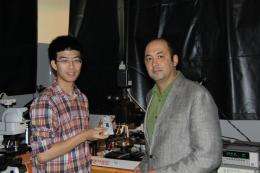
Alexander Balandin, right, and Guanxiong Liu, one of Balandin’s graduate students

Researchers at the UC Riverside Bourns College of Engineering have built and successfully tested an amplifier made from graphene that could lead to more efficient circuits in electronic chips, such as those used in Bluetooth headsets and toll collection devices in cars.

Graphene, a single-atom thick carbon crystal, was first isolated in 2004 by Andre Geim and Konstantin Novoselov, who won the Nobel Prize in physics this month for that work. has many extraordinary properties, including superior electrical and heat conductivity, mechanical strength and unique optical absorption.

The demonstration at UCR of the graphene with signal processing functions is a major step forward in graphene technology because it is a transition from individual graphene devices to graphene circuits and chips, said Alexander Balandin, a professor of electrical engineering, who performed the work along with a graduate student and researchers at Rice University.

The triple-mode amplifier based on graphene has advantages over amplifiers built from conventional semiconductors, such as silicon, said Balandin, who is also chair of the UC Riverside Materials Science and Engineering program. The graphene amplifier reveals greater functionality and a faster speed because of graphene's electrical ambipolarity (current conduction by negative and positive charges).

It can be switched between different modes of operation by a simple change of applied voltage. These characteristics are expected to result in simpler and smaller chips, a faster system response and less .

The of the graphene amplifier functionality was reported last week in the journal ACS Nano.

The fabrication and experimental testing were performed in Balandin's Nano-Device Laboratory. The co-authors of the paper are Guanxiong Liu, one of Balandin's graduate students, Kartik Mohanram, an assistant professor at Rice University, and Xuebei Yan, one of Mohanram's graduate students.

The researchers from Rice University designed the amplifier and testing protocol. Liu built the device in the UCR clean room. Liu and Yan then tested the amplifier in Balandin's lab.

The triple-mode amplifier can be charged at anytime during operation in the three modes: positive, negative or both. By combining these three modes, the researchers demonstrated the amplifier can achieve the modulation necessary for phase shift keying and frequency shift keying, which are widely used in wireless and audio applications.

These applications include: Bluetooth headsets for cell phones; radio frequency identification (RFID), which is used in wireless products, including toll collection devices in cars, cards used to pay for public transportation and identification tags on animals; and ZigBee, a communication protocol used in devices such as such as wireless light switches with lamps and electrical meters with in-home-display.

More information: http://pubs.acs.or … 21/nn1021583

Provided by University of California -- Riverside

Filter


Move the slider to adjust rank threshold, so that you can hide some of the comments.


Display comments: newest first

trekgeek1
Oct 18, 2010

Rank: 4 / 5 (1)
I actually have a graduate colloquium at 2pm and he's the presenter. Hopefully he'll talk about this a little.
chemscientist
Oct 23, 2010

Rank: not rated yet
I agree with the fact that graphene conducts well, but in case if overloading occours then the whole connection(circuit) will get burnt or destroyed unlike copper circuits.
Rank 5 /5 (7 votes)
Relevant PhysicsForums posts
  • Density question
    created11 hours ago
  • Mass transport originating from a point source at a solid gas interface
    createdMay 22, 2012
  • Ammonia dispersion in Air
    createdMay 22, 2012
  • Multi Choice Help
    createdMay 21, 2012
  • index of refraction and thickness of materials
    createdMay 18, 2012
  • Solar battery maintainer for car
    createdMay 17, 2012
  • More from Physics Forums - Materials & Chemical Engineering

More news stories

A nanoclutch for nanobots

Chinese researchers have designed and tested simulations of a "nanoclutch," a speed regulation tool for nanomotors.

Nanotechnology / Nanophysics

created 1 hour ago | popularity not rated yet | comments 0

In nanorod crystal growth, nanoparticles seen as artificial atoms

In the growth of crystals, do nanoparticles act as "artificial atoms" forming molecular-type building blocks that can assemble into complex structures? This is the contention of a major but controversial theory ...

Nanotechnology / Nanophysics

created 5 hours ago | popularity 5 / 5 (2) | comments 0 | with audio podcast

First direct observation of oriented attachment in nanocrystal growth

Berkeley Lab researchers have reported the first direct observation of nanoparticles undergoing oriented attachment, the critical step in biomineralization and the growth of nanocrystals. A better understanding ...

Nanotechnology / Nanophysics

created 5 hours ago | popularity 5 / 5 (1) | comments 0 | with audio podcast

'Metamaterials,' quantum dots show promise for new technologies

(Phys.org) -- Researchers are edging toward the creation of new optical technologies using "nanostructured metamaterials" capable of ultra-efficient transmission of light, with potential applications including ...

Nanotechnology / Nanophysics

created 3 hours ago | popularity 5 / 5 (1) | comments 0 | with audio podcast

Scientists evaluate different antimicrobial metals for use in water filters

Porous ceramic water filters are often coated with colloidal silver, which prevents the growth of microbes trapped in the micro- and nano-scale pores of the filter. Other metals such as copper and zinc have also been shown ...

Nanotechnology / Bio & Medicine

created 1 hour ago | popularity not rated yet | comments 0


Thousands of invisibility cloaks trap a rainbow

Many people anticipating the creation of an invisibility cloak might be surprised to learn that a group of American researchers has created 25 000 individual cloaks.

Study provides compelling evidence for an effective new treatment for tinnitus

According to new research, a multidisciplinary approach to treating tinnitus that combines cognitive behaviour therapy with sound-based tinnitus retraining therapy is significantly more effective than currently available ...

Slip-and-slide power generators

Researchers from Vestfold University College in Norway have created a simple, efficient energy harvesting device that uses the motion of a single droplet to generate electrical power.

Brentuximab vedotin effective in large-cell lymphoma

(HealthDay) -- More than half of patients with relapsed or refractory systemic anaplastic large-cell lymphoma (ALCL) treated with the CD30-directed antibody-drug conjugate brentuximab vedotin achieve a complete ...

Autism often not diagnosed until age 5 or older: U.S. report

(HealthDay) -- Even though autism symptoms typically emerge before age 3, most children with autism are diagnosed when they're 5 or older, a new snapshot of autism in America shows.

Apple VP: New project is 'most important,' 'best work we've done'

Jonathan Ive, Apple's senior vice president of industrial design, said that despite the iMac, iPhone, iPod or iPad, Apple's current project is its best.