Who killed the graphite anode? Researchers move silicon anode li-ion battery technology forward
Oct 11, 2010
Who killed the graphite anode? Researchers move silicon anode li-ion battery technology forward
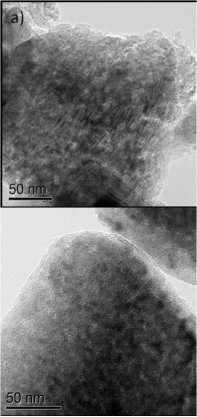
High-resolution transmission electron microscopic (TEM) images of silicon anode morphologies: a) original porous silicon and b) porous silicon coated with nano layer of carbon.

(PhysOrg.com) -- Scientists at Pacific Northwest National Laboratory developed a lithium-ion (Li-ion) battery technology with reversible capacity of more than 1,600 milliamp hours per gram (mAh/g) after 40 charging/discharging cycles. This silicon-based anode technology doubles the capacity of conventional graphite anode technology used in Li-ion batteries, and may lead to Li-ion batteries with much higher energy density and capacity.

A future with millions of fossil-fuel powered cars displaced from American roadways by plug-in presents significant economic and environmental benefits. It also poses a challenge to develop a next-generation that offers far greater energy density. Silicon anodes for Li-ion batteries present a promising solution.

Today's electric vehicles rely on nickel-metal hydride batteries. They are heavy, bulky and have a specific energy that is too low, about 80 watt hours per kilogram (Wh/kg), for long-distance travel. Li-ion batteries, commonly used in handheld electronics, offer greater capacity. Composed of three main components—a graphite , a cathode and electrolyte (lithium salt dissolved in organic solvent)—the graphite anode has specific capacity of about 350 mAh/g. Li-ion batteries using graphite anodes exhibit a specific energy of more than 160 Wh/kg, double that of nickel-metal hydride batteries.

"If we want to increase driving distance of electric vehicles, we need to have much better capacity -- at least double the capacity of graphite anodes and cathodes used in the Li-ion battery," said Dr. Jason Zhang, a PNNL scientist.

One of the limiting factors of the Li-ion battery is its anode—the graphite. Lithium is added to graphite when charging and removed as the battery is used. Graphite anodes are used in nearly all Li-ion batteries, but recent research has sought to capitalize on a better anode solution—silicon. With a theoretical capacity of more than 10 times that of graphite, silicon anodes can at least double the capacity of graphite-anode batteries. However, it is this very ability to absorb lithium and expand during charging that is the problem: The silicon breaks down quickly.

The challenge for PNNL researchers: Take advantage of silicon's high capacity while finding a way to keep it from deteriorating through repeated charging/discharging cycles.

Zhang and the PNNL research team addressed the challenge by designing a silicon particle architecture that would maintain structural integrity. Nanostructured porous silicon was used to maintain stability through repeated expansion and contraction. Next, chemical vapor deposition (CVD) of carbon coatings and highly elastic Ketjen Black (KB) carbon were used to improve the electrical conductivity throughout all cycling stages. The team placed these anodes between graphene -- planar sheets of bonded carbon atoms—to maintain strong electrical contact between silicon particles.

They tested these anodes in the laboratory and found they had a reversible capacity of more than 1,600 mAh/g after 40 charging/discharging cycles. This technology more than doubles the capacity of conventional graphite anodes used in Li-ion batteries.

The PNNL research team continues to improve the performance and long-term stability of the silicon anodes from 40 to 50 charging/discharging cycles today to a goal of about 500 cycles in the future. One solution may be the development of a better binder that can maintain improved mechanical and electrical contact. This method has potential for much greater cyclability while maintaining high .

Explore further: New method for producing clean hydrogen

More information: Xiao J, W Xu, D Wang, D Choi, W Wang, X Li, GL Graff, J Liu, and J Zhang. 2010. "Stabilization of Silicon Anode for Li-Ion Batteries." Journal of The Electrochemical Society, August 2, 2010, doi:10.1149/1.3464767

Related Stories

Increasing Electric Car Battery Performance

Sep 23, 2009

(PhysOrg.com) -- Researchers have found that by replacing conventional graphite electrodes with silicon nanotube electrodes, lithium-ion batteries can store 10 times more charge.

Recommended for you

New method for producing clean hydrogen

10 hours ago

Duke University engineers have developed a novel method for producing clean hydrogen, which could prove essential to weaning society off of fossil fuels and their environmental implications.

Non-wetting fabric drains sweat

May 20, 2013

(Phys.org) —Waterproof fabrics that whisk away sweat could be the latest application of microfluidic technology developed by bioengineers at the University of California, Davis.

Beautiful 'flowers' self-assemble in a beaker

May 16, 2013

By simply manipulating chemical gradients in a beaker of fluid, materials scientists at Harvard have found that they can control the growth behavior of crystals to create precisely tailored structures—such ...

User comments : 6

Adjust slider to filter visible comments by rank

Display comments: newest first

Parsec
not rated yet Oct 11, 2010
So... if I discharge and recharge my car every work day, thats about 260 days/year. 500 cycles gives me about 2 years of life if I take vacations and use my regular car. I think that a more realistic lifetime would be on the order of 2500 cycles or so. Otherwise I don't think this would work commercially. Having said that, I have no doubt that the very competent researchers here will achieve it eventually. I would just suggest a more realistic target.

Of course 500 cycles might be fine if we are talking about an application (like notebooks) that only require about a cycles per week or so.
Sanescience
not rated yet Oct 11, 2010
At this rate batteries are going to have the energy content of a hand-grenade. "No, no! Don't shoot the compute... KABOOOOSH!"
Roj
not rated yet Oct 12, 2010
Leasing options for vehicle batteries already exist for regular replacement. I'm sure the lease can be upgraded for Hot-Rod accessories like a silicon-anode power plant.
plasticpower
not rated yet Oct 12, 2010
I hope they can figure this out. Seems promising!
BuddyEbsen
not rated yet Oct 13, 2010
So... if I discharge and recharge my car every work day, thats about 260 days/year. 500 cycles gives me about 2 years of life if I take vacations and use my regular car.


Why would you need to charge/discharge fully every day? Tesla roadster has a 200 mile plus range. I would only need to charge it once per week, so 10-year life span. If you live 100 miles from work, then battery electric is probably not for you.
VOR
not rated yet Oct 14, 2010
I guess they mean mAh 's per cell? (about 3 volts or so?) they should stick to watts.

More news stories

New method for producing clean hydrogen

Duke University engineers have developed a novel method for producing clean hydrogen, which could prove essential to weaning society off of fossil fuels and their environmental implications.

Protein study suggests drug side effects are inevitable

A new study of both computer-created and natural proteins suggests that the number of unique pockets – sites where small molecule pharmaceutical compounds can bind to proteins – is surprisingly small, meaning drug side ...

Beautiful 'flowers' self-assemble in a beaker

By simply manipulating chemical gradients in a beaker of fluid, materials scientists at Harvard have found that they can control the growth behavior of crystals to create precisely tailored structures—such ...

Attacking MRSA with metals from antibacterial clays

In the race to protect society from infectious microbes, the bugs are outrunning us. The need for new therapeutic agents is acute, given the emergence of novel pathogens as well as old foes bearing heightened antibiotic resistance.

Encouraging signs for bee biodiversity

Declines in the biodiversity of pollinating insects and wild plants have slowed in recent years, according to a new study. Researchers led by the University of Leeds and the Naturalis Biodiversity Centre in the Netherlands ...

If you can remember it, you can remember it wrong

(Medical Xpress)—Native peoples in regions where cameras are uncommon sometimes react with caution when their picture is taken. The fear that something must have been stolen from them to create the photo ...

B vitamins could delay dementia

(Medical Xpress)—Despite spending billions of dollars on research and development, drug companies have been unable to come up with effective treatments for dementia and Alzheimer's Disease (AD). Now, A. ...