Discovery of red palm weevil in California
October 26, 2010 By Iqbal Pittalwala
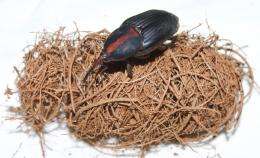
The red palm weevil.
Scientists and growers met on campus Friday, Oct. 22, to address a potentially devastating new threat to California?s iconic palm trees: the red palm weevil.
Confirmation was received this week that the red palm weevil, considered the worlds most damaging insect pest of palm trees, has been found in Laguna Beach, Orange County, Calif.
The weevil was discovered infesting a Canary Islands palm in a residential area by a landscape specialist in September 2010. The insect was subsequently positively identified as Rhynchophorus ferrugineus, the red palm weevil, by experts at the USDA-ARS Systematic Entomology Laboratory, Md. Weevil larvae bore tunnels through palm trunks as they feed, eventually killing the trees.
Thomas O. Baldwin, dean of UC Riversides College of Natural and Agricultural Sciences, and Albert Keck, chairman of the California Date Commission and a major palm grower in the Coachella Valley, convened the meeting to plan on strategies for containing and eradicating the weevil, which has caused enormous damage elsewhere in the world. The Orange County sighting is the first appearance of the weevil in the United States.
Keck, president of Hadley, Inc., which supplies dates to the food industry and palm trees to the landscape industry, said, This problem is central to our livelihood. Noting that palm trees are an integral part of the Southern California landscape, he said that the potential impact of the weevil on the state and beyond would be catastrophic on both economic and emotional fronts.
The university is preparing a proposal to collaborate with the California Department of Food and Agriculture to manage the weevil and the threat it poses to the public and industry. They also plan an informational campaign to alert and educate homeowners. A follow-up meeting is planned for 2 p.m., Friday, Oct. 29 at UCR.
Entomologist Mark Hoddle, the director of the Center for Invasive Species Research at UCR, noted, The international trade in live palms is the most likely source for this pest. It was probably moved as eggs, larvae, or pupae hidden inside palms. These can travel great distances because they live with their food supply. Once larvae emerge as new adults, they abandon their original host plant and fly to new palms, traveling as many as 7 km (~4.3 miles) in 3-5 days.
Adult red palm weevils are large beetles with body lengths of 35 to 40 mm (1.4-1.6 inches). The weevils have a long, slender snout which the female uses to penetrate palm tissue and create access wounds in which eggs are deposited. Adult weevils are predominately reddish-brown in the most typical form. The weevil collected in Laguna Beach has a single, contrasting red stripe running the length of the snout. The larvae are legless grubs, pale yellow with a brown head, some larger than 50 mm (2 inches).
A strong message needs to go out as soon as possible to arborists and others in industry to keep an eye out for this deadly pest, Baldwin said. Unlike many previous agricultural pests, the red palm weevil is also an urban problem. We at the university have two ways to proceed: we assume the pest has already spread or we wait to see signs of it having spread. We are not willing to wait.
More information: Homeowners and others who are concerned about their palms should visit the Center for Invasive Species Research website for more information: http://cisr.ucr.ed … _weevil.html .
Provided by University of California, Riverside
-
From lemons to lemonade: Reaction uses carbon dioxide to make carbon-based semiconductor,
27 comments
-
Every black hole contains a new universe: A physicist presents a solution to present-day cosmic mysteries,
209 comments
-
New silicon memory chip developed,
16 comments
-
Computing experts unveil superefficient 'inexact' chip,
45 comments
-
SpaceX private rocket blasts off for space station (Update),
41 comments
-
Semen stains glows under black lights (uv light)?
16 hours ago
-
Question on Human Chromosome 2
20 hours ago
-
How important is composition of TBST in diluting antibodies and Western Blotting?
May 22, 2012
-
Does the medulla monitor blood pH
May 20, 2012
-
What physically constitutes memory?
May 17, 2012
-
How come some pathogenic micoorganisms are commensals in our body?
May 17, 2012
- More from Physics Forums - Biology
More news stories
Researchers find a way to delay aging of stem cells
Stem cells are essential building blocks for all organisms, from plants to humans. They can divide and renew themselves throughout life, differentiating into the specialized tissues needed during development, ...
36 minutes ago |
5 / 5 (1) |
0
|
Plants could use light even more effectively for food production
(Phys.org) -- Scientists from Wageningen University have concluded that it is possible to develop plants that produce even more food by reducing the level of pigments which make no contribution to photosynthesis. The conclusion ...
43 minutes ago |
not rated yet |
0
Social media used to collect information on marine wilderness
(Phys.org) -- Researchers from Murdoch University's Cetacean Research Unit are working with colleagues from Duke University in the US and Marine Ventures Foundation on an innovative project that will use social ...
1 hour ago |
not rated yet |
0
Fungi shifted plant balance of power
Cooperating with fungi didn't just help the earliest plants spread across a barren, rocky landscape; it also played a decisive role in the rise of more complex plants with roots and leaves that make up most ...
1 hour ago |
not rated yet |
0
|
Marine scientist discusses cod colonization
New evidence suggests that Atlantic cod may have the ability to affect entire food webs in both benthic and pelagic marine ecosystems, according to a University of Maine marine scientist, writing in the Proceedings of ...
1 hour ago |
not rated yet |
0
Is a classical electrodynamics law incompatible with special relativity?
(Phys.org) -- The laws of classical electromagnetism that were developed in the 19th century are the same laws that scientists use today. They include Maxwell’s four equations along with the Lorentz la ...
Robot monitors toxic red tides
A robotic device suspended under the ocean surface from a buoy off the New Hampshire coast is monitoring seawater for evidence of the red tide, clusters of microscopic plants that release toxins into fish ...
Pair call for public discourse on treating wastewater contaminated with birth control pill chemicals
(Phys.org) -- As people go about their daily lives, its easy to overlook the impact their lifestyle has on the environment. Resources are used and as a result of their use, certain elements are placed ...
Private supply ship flies by space station in test (Update)
The world's first private supply ship flew tantalizingly close to the International Space Station on Thursday but did not stop, completing a critical test in advance of the actual docking.
Designing a dye you can count on
Natural substances such as chlorophyll and the heme pigment of red blood cells contain colorful molecules known as porphyrins. They owe their exceptional visual characteristics to a macrocyclic ...
Lifting barriers to nutrition
(Medical Xpress) -- A University of Alberta study has revealed challenges that schools are working through, to adopt healthier food choices for their students in an effort to meet government guidelines for ...