'Deepwater Horizon' disaster hit bluefish tuna hard
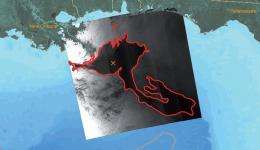
This Envisat Advanced Synthetic Aperture Radar (ASAR) image, acquired on 18 May 2010, shows the extent of the oil spill (outlined in red) in the Gulf of Mexico, following the explosion of the Deepwater Horizon oil rig off the coasts of Louisiana and Mississippi, USA, on 22 April. Credits: GeoVille, ESA
The Gulf of Mexico oil spill couldnt have occurred at a worse time for bluefin tuna: they had come to the area a major spawning ground to produce offspring. Satellites are helping assess the damage from the disaster on the fishs spawning habitat.
The majestic Atlantic bluefin tuna, among the largest fish able to grow the size of a Volkswagen Beetle, come to the Gulf yearly from January to June. Their peak spawning time in the Gulf is April and May just when some 10 million litres of oil a day was pouring into the water following the explosion of the Deepwater Horizon rig on 20 April.
The commercially valuable fish spawn in surface waters, with females releasing eggs and males following behind to fertilise them. The presence of surface oil could harm eggs, larvae and even adults. With the western Atlantic tuna population's spawning stock declining by 82% over the last 30 years, it is imperative they spawn without disturbance.
Within the Gulf, there are two spawning hotspots: one in the northwest and one in the northeast, which overlapped the spill area.
In an effort to safeguard their spawning grounds, the Ocean Foundation a non-profit organisation involved in protecting ocean environments and species needed to know which habitats throughout the northeastern part of the Gulf had been the most affected.
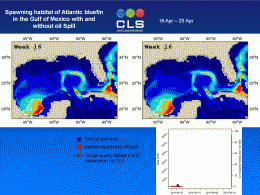
This animation shows the impact of the DeepWater Horizon oil spill in the Gulf of Mexico on the spawning habitat of Atlantic bluefin tuna. To simulate bluefin spawning habitats and larvae development, scientists used electronically tagged tuna and an ocean model based on in-situ ocean temperature profiles, sea-surface height data (from radar altimeters on Envisat and NASA’s Jason) and ocean colour data (from MERIS on Envisat and MODIS on NASA’s Terra), which signify the presence of plankton (food). By overlaying the oil spill extent maps from Envisat’s Advanced Synthetic Aperture Radar and the ‘spawning habitat index’, it was possible to see where and how often the oil spill and spawning habitats had overlapped between 20 April and 29 August 2010. Credits: CLS
This required knowing the extent of the oil spill and the locations that provided favourable conditions for tuna spawning.Radar data from ESAs Envisat and other European and international satellites were used transformed into weekly maps showing the location, shape and size of the spill.
To simulate bluefin spawning habitats and larvae development, scientists used electronically tagged tuna and an ocean model based on measured ocean temperatures, sea-surface heights from radar altimeters on Envisat and NASAs Jason satellite and ocean colour information from MERIS on Envisat and MODIS on NASAs Aqua satellite. Water colour can signify the presence of plankton for the tuna to feed on.
By overlaying the oil spill extent maps and the spawning habitat index, it was possible to see where and how often the oil spill and spawning habitats had overlapped between 20 April and 29 August.
Quickly after hatching, larvae begin searching for food close to the surface. That means the presence of oil there is likely fatal for such tiny organisms.
Since the spill area and the most favoured spawning habitat coincided at the end of the breeding season, researchers accounted for the lethal effect of surface oil and found that the spill had reduced the number of juvenile bluefin by more than 20%.
Fortunately, the spawning hotspot in the west was apparently unaffected by the pollution, as observed from satellite images.
"This analysis will help us and our colleagues elevate our understanding of these impacts to another level and guide the development of strong policy recommendations," said Dr. David Guggenheim of the Ocean Foundation.
"In addition, this analysis and its approach represents a next-generation tool that can help equip researchers and decision-makers should we face another similar environmental disaster in the future."
By the time the Deepwater Horizon well was finally plugged on 15 July, some 750 million litres of crude oil had spewed into the Gulf.
Earth observation satellites have played a vital role in helping to understand the disaster. Within days of the explosion, satellites began monitoring the situation and providing data in near-real time to US authorities involved in cleanup efforts.
Now satellites are helping scientists to answer the most pressing questions about the consequences of the spill. Maps based on ESA data also document the oil spill effects on natural coastline habitats and sea turtle nesting sites.
Natural habitat protection is coming under the spotlight this week at the UN Convention on Biological Diversity's 10th Conference of the Parties (COP 10), being held in Nagoya, Japan. ESA is attending the COP10 with an exhibition booth and a side event.
Provided by
European Space Agency
-
From lemons to lemonade: Reaction uses carbon dioxide to make carbon-based semiconductor,
27 comments
-
Every black hole contains a new universe: A physicist presents a solution to present-day cosmic mysteries,
209 comments
-
New silicon memory chip developed,
16 comments
-
Computing experts unveil superefficient 'inexact' chip,
45 comments
-
SpaceX private rocket blasts off for space station (Update),
41 comments
-
Conversion from aircraft bearing to normal degrees
14 hours ago
-
Interpretation/Analysis of the Lab results(HEPA filter)
May 22, 2012
-
Has anyone here attended the The Urbino Summer School in Paleoclimatology?
May 22, 2012
-
Earthquakes: Mag 6 N. Italy and Mag 5.6 W. Bulgaria
May 21, 2012
-
determining time frame for most recent geological layers
May 17, 2012
-
solar radiation - conversion to calculate radiation impacting vertical surface
May 16, 2012
- More from Physics Forums - Earth
More news stories
Robot monitors toxic red tides
A robotic device suspended under the ocean surface from a buoy off the New Hampshire coast is monitoring seawater for evidence of the red tide, clusters of microscopic plants that release toxins into fish ...
25 minutes ago |
not rated yet |
0
|
Pair call for public discourse on treating wastewater contaminated with birth control pill chemicals
(Phys.org) -- As people go about their daily lives, its easy to overlook the impact their lifestyle has on the environment. Resources are used and as a result of their use, certain elements are placed ...
Private supply ship flies by space station in test (Update)
The world's first private supply ship flew tantalizingly close to the International Space Station on Thursday but did not stop, completing a critical test in advance of the actual docking.
Space & Earth / Space Exploration
36 minutes ago |
5 / 5 (1) |
0
Warming could exceed 3.5 C, say climate scientists
Climate researchers said Thursday the planet could warm by more than 3.5 degrees Celsius (6.3 degrees Fahrenheit), boosting the risk of drought, flood and rising seas.
4 minutes ago |
not rated yet |
0
Did ancient Mars have a runaway greenhouse?
Cosmic impacts that once bombed Mars might have sent temperatures skyrocketing upward on the Red Planet in ancient times, enough to set warming of the surface on a runaway course, researchers say.
Space & Earth / Space Exploration
1 hour ago |
3.7 / 5 (3) |
0
|
Is a classical electrodynamics law incompatible with special relativity?
(Phys.org) -- The laws of classical electromagnetism that were developed in the 19th century are the same laws that scientists use today. They include Maxwell’s four equations along with the Lorentz la ...
Researchers find a way to delay aging of stem cells
Stem cells are essential building blocks for all organisms, from plants to humans. They can divide and renew themselves throughout life, differentiating into the specialized tissues needed during development, ...
Designing a dye you can count on
Natural substances such as chlorophyll and the heme pigment of red blood cells contain colorful molecules known as porphyrins. They owe their exceptional visual characteristics to a macrocyclic ...
Lifting barriers to nutrition
(Medical Xpress) -- A University of Alberta study has revealed challenges that schools are working through, to adopt healthier food choices for their students in an effort to meet government guidelines for ...
Engineered materials: Custom-made magnets
A novel approach to designing artificial materials could enable magnetic devices with a wider range of properties than those now available. An international team of researchers have now extended the properties ...
Photonics: Beam me up
'Tractor beams' of light that pull objects towards them are no longer science fiction. Haifeng Wang at the A*STAR Data Storage Institute and co-workers have now demonstrated how a tractor beam can in fact be realized on a ...

Oct 18, 2010
Rank: not rated yet