Eight days left in comet flyby countdown
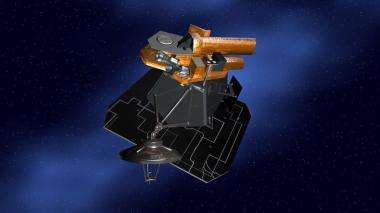
(PhysOrg.com) -- NASA's EPOXI mission continues to close in on its target, comet Hartley 2, at a rate of 12.5 kilometers (7.8 miles) per second. On Nov. 4 at about 10:01 a.m. EDT (7:01 a.m. PDT) the spacecraft will make its closest approach to the comet at a distance of about 700 kilometers (434 miles). It will be the fifth time that a comet has been imaged close-up and the first time in history that two comets have been imaged with the same instruments and same spatial resolution.
"Hartley 2 has already put on a great show with more than a few surprises for the mission's science team," said EPOXI principal investigator Mike A'Hearn from the University of Maryland, College Park. "We expect more of the unexpected during encounter."
Science observations of comet Hartley 2 began on Sept. 5. The imaging campaign is more than a tantalizing tease of things to come. It is providing EPOXI's science team the best extended view of a comet in history during its pass through the inner solar system. The observations will continue through the encounter phase of the mission.
The hours surrounding comet encounter will be especially challenging for the mission team as they are commanding a recycled spacecraft that was not designed for this comet flyby. The spacecraft was designed and employed successfully for NASA's Deep Impact encounter of comet Tempel 1 back on July 4, 2005. By recycling Deep Impact's already built, tested and in-flight spacecraft, the EPOXI mission provided savings on the order of 90% that of a hypothetical mission with similar goals, starting from the ground up.
"If we were starting from scratch we'd probably move some of the spacecraft's components to different locations," said Tim Larson, project manager for the EPOXI mission from NASA's Jet Propulsion Laboratory in Pasadena, Calif. "But we've developed a creative way to work with what we have. This spacecraft, and mission team, have logged 3.2 billion miles over the past five years, and we are confident that we have a successful plan in place to give Hartley 2 a thorough look-see."
The mission's encounter phase begins the evening of Nov. 3, when the spacecraft is about 18 hours from the time of closest approach to the comet's nucleus. At that time the spacecraft will stop transmitting through its large high-gain antenna and reorient itself so its two visible-light and one infrared imager maintain lock on the comet for the next 24 hours-plus.
"When the encounter phase begins all images the spacecraft takes will be stored aboard its two computers," said Larson. "Soon after we fly past the comet at about 7 a.m. local time, we will be able to re-orient the spacecraft so that we maintain imaging lock on the comet nucleus while pointing our big high gain antenna at Earth."
At that point, the spacecraft will begin beaming down its cache of cometary close-ups while continuing to take new images. It is expected to take several hours for all the images held aboard spacecraft memory to be downliked.
"We will be waiting," said A'Hearn. "The images at closest approach won't get to Earth until many hours after the actual encounter due to the way we use memory on the spacecraft. We will get some early hints at how this nucleus differs from that of comet Tempel 1 based on five images that will get to Earth only about one hour after closest approach."
EPOXI is an extended mission that utilizes the already "in-flight" Deep Impact spacecraft to explore distinct celestial targets of opportunity. The name EPOXI itself is a combination of the names for the two extended mission components: the extrasolar planet observations, called Extrasolar Planet Observations and Characterization (EPOCh), and the flyby of comet Hartley 2, called the Deep Impact Extended Investigation (DIXI). The spacecraft will continue to be referred to as "Deep Impact."
More information: For more information about EPOXI visit www.nasa.gov/epoxi or epoxi.umd.edu/
Provided by JPL/NASA


