New center looks at how human systems function or fail
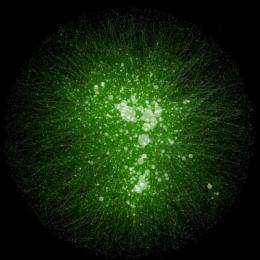
This image, created by Trey Ideker using Cytoscape, depicts thousands of known molecular and genetic interactions occurring inside the human body. Because of its seemingly fuzzy complexity, Ideker has dubbed the result a "data hairball." Nonetheless, researchers can tease them apart to examine specific interactions, such as the differences between species or between healthy and diseases cells. Credit: UC San Diego
A new center called the National Resource for Network Biology (NRNB), based at the University of California, San Diego School of Medicine, will help clinicians analyze an ever-growing wealth of complex biological data and apply that knowledge to real problems and diseases.
In recent years, the study of biological networks has exploded, with scientists shifting much of their focus from single cells to complex systems, producing novel maps of interactive networks of genes and proteins that help define and describe a functioning human being. But the exponential growth in data has created a new challenge: How do you effectively use it?
The NRNB is part of the answer, said Trey Ideker, PhD, associate professor of bioengineering in UC San Diego's Jacobs School of Engineering, chief of the Division of Genetics at the School of Medicine and principal investigator of the new center., which is funded by a five-year, $6.5 million grant from the National Institute of Health's National Center for Research Resources (NCRR), and the only center of its type to be funded this year.
"Ten years ago, the Human Genome Project was a huge achievement. It listed for the first time all of the 25,000 or so genes in a human being," said Ideker. "But it didn't and doesn't -- really tell us how those genes work together. For that you need another 'omics data set: the interactome."
An "interactome" describes all of the molecular interactions within cells. For the past decade, a grassroots effort called Cytoscape, developed by Ideker and colleagues, has provided biologists with the beginnings of one: an online, open-source, evolving platform that describes and visualizes complex molecular interactions and biological pathways.
But this gathering of basic data has generally outpaced efforts to practically apply it, said Alexander Pico, PhD, Bioinformatic Group Leader at The Gladstone Institutes at UC San Francisco and executive director of the NRNB.
"The field of network biology is at a very interesting stage," Pico said. "We are sitting on loads of measurement data, with new technologies continuously expanding, and we are just beginning to put these 'parts lists' into comprehensive biological systems."
With support from the NIH, the new center will provide qualified researchers with access to more and better tools for conducting advanced studies of biological systems that result in sophisticated models of how human systems function or fail. All of this will ultimately lead to new and improved treatments and therapies, such as identifying disease biomarkers and molecular targets for potential drugs, defining genetic risk factors and deciphering how individual or group lifestyles (social networks) affect the development and transmission of disease.
"We are unique in having a balanced mix of software developers and bench biologists who know how to communicate with each other and with the greater community," said Pico. "We have been building and using the core toolset of NRNB for many years and we've made a regular practice of training others establishing collaborations that drive development along the most fruitful and effective routes."
Like its subject, the NRNB is the product of extensive interaction, with multiple collaborators. They include James Fowler, a UCSD professor in the School of Medicine and Division of Social Sciences who specializes in social networks; Bruce Conklin of The Gladstone Institute of Cardiovascular Disease; Chris Sander of the Memorial Sloan Kettering Cancer Center in New York; Gary Bader of the University of Toronto and Benno Schwikowski of Institut Pasteur in France. Olga Brazhnik of the NCRR is program officer.
The NRNB joins three other NCRR biomedical technology centers based at UC San Diego: the National Center for Microscopy and Imaging Research (Mark H. Ellisman, Director); the National Biomedical Computation Resource (Peter W. Arzberger, Director); and the Center for Computational Mass Spectrometry (Pavel A. Pevzner, Director).
Provided by University of California -- San Diego
-
From lemons to lemonade: Reaction uses carbon dioxide to make carbon-based semiconductor,
27 comments
-
Every black hole contains a new universe: A physicist presents a solution to present-day cosmic mysteries,
209 comments
-
New silicon memory chip developed,
16 comments
-
Computing experts unveil superefficient 'inexact' chip,
45 comments
-
SpaceX private rocket blasts off for space station (Update),
41 comments
-
Semen stains glows under black lights (uv light)?
16 hours ago
-
Question on Human Chromosome 2
19 hours ago
-
How important is composition of TBST in diluting antibodies and Western Blotting?
May 22, 2012
-
Does the medulla monitor blood pH
May 20, 2012
-
What physically constitutes memory?
May 17, 2012
-
How come some pathogenic micoorganisms are commensals in our body?
May 17, 2012
- More from Physics Forums - Biology
More news stories
Fungi shifted plant balance of power
Cooperating with fungi didn't just help the earliest plants spread across a barren, rocky landscape; it also played a decisive role in the rise of more complex plants with roots and leaves that make up most ...
24 minutes ago |
not rated yet |
0
|
Marine scientist discusses cod colonization
New evidence suggests that Atlantic cod may have the ability to affect entire food webs in both benthic and pelagic marine ecosystems, according to a University of Maine marine scientist, writing in the Proceedings of ...
31 minutes ago |
not rated yet |
0
USDA links gene flow between weedy and domesticated rice to rising carbon dioxide levels
(Phys.org) -- New research at the U.S. Department of Agriculture (USDA) confirms that rising levels of atmospheric carbon dioxide facilitate the flow of genes from wild or weedy rice plants to domesticated ...
47 minutes ago |
1 / 5 (1) |
0
Social media used to collect information on marine wilderness
(Phys.org) -- Researchers from Murdoch University's Cetacean Research Unit are working with colleagues from Duke University in the US and Marine Ventures Foundation on an innovative project that will use social ...
6 minutes ago |
not rated yet |
0
Crowding causes cells to produce an orderly matrix of molecules
When researchers conduct experiments on the way cells grow and respond to outside cues, they tend to use solutions that are much more dilute than the crowded environments found inside living cells. Now, new ...
2 hours ago |
not rated yet |
0
|
Rapid coral death by a deadly chain reaction
(Phys.org) -- Most people are fascinated by the colorful and exotic coral reefs, which form habitats with probably the largest biodiversity. But human civilisation is the top danger to these fragile ecosystems ...
Young alum creates iPad user experience improvement (w/ Video)
(Phys.org) -- When Daniel Hooper became frustrated with editing text on his iPad, he wrote an application that could revolutionize the way users select and arrange their words on tablets.
Did ancient Mars have a runaway greenhouse?
Cosmic impacts that once bombed Mars might have sent temperatures skyrocketing upward on the Red Planet in ancient times, enough to set warming of the surface on a runaway course, researchers say.
The search for the earliest signs of Alzheimer's
(Medical Xpress) -- For the past five years, volunteers from the City of Berkeley and surrounding areas have come to Lawrence Berkeley National Laboratory to participate in an ongoing study thats changing ...
Long-term meditation leads to different brain organization
(Medical Xpress) -- People who practice mindfulness meditation learn to accept their feelings, emotions, and states of mind without judging or resisting them. They simply live in the moment.
Malware intelligence system enables organizations to share threat information
As malware threats expand into new domains and increasingly focus on industrial espionage, Georgia Tech researchers are launching a new weapon to help battle the threats: a malware intelligence system that ...