Researchers show how cells open 'doors' to release neurotransmitters
October 14, 2010 By Anne Ju

Lindau unveils details of exocytotic biomechanism

Enlarge

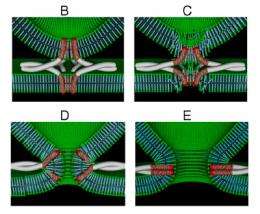
A schematic model of a fusion pore opening.

Like opening a door to exit a room, cells in the body open up their outer membranes to release such chemicals as neurotransmitters and other hormones.

Cornell researchers have shed new light on this lightning-quick, impossibly small-scale process, called exocytosis, by casting sharp focus on what happens right at the moment the "doors" on the cell wall open.

Publishing online Oct. 11 in , researchers led by Cornell's Manfred Lindau used a combination of , electrophysiology, microfabricated electrochemical sensors and advanced microscopy to elucidate exocytosis of noradrenaline. This is a neurotransmitter released from the adrenal gland by a type of neuroendocrine cell called a chromaffin cell.

Lindau, professor of applied and engineering physics, studies the properties of exocytosis by looking at how packets of chemicals called vesicles adhere to the cell wall and open the door between the vesicle interior and cell's exterior. This "door" is called the fusion pore.

"Biochemists have been working on experiments to identify what proteins and molecules are the main players in this mechanism of release," Lindau said.

It turns out that neurotransmitter release is largely regulated by a set of proteins called SNARE proteins, and one called synaptobrevin is located on the cell's vesicle membrane. The synaptobrevins bind with other proteins called syntaxin and SNAP-25, which are located in the that encloses the cell. When the cell is excited and the neurotransmitter release is triggered, these proteins together are believed to open the fusion pore.

Lindau's team of researchers used genetically altered mouse embryos that lacked synaptobrevin and introduced viruses with modified versions of the into their experiments. They then imaged and studied the release function of the for the different versions of the synaptobrevins.

They discovered that one end of the synaptobrevin -- the part that anchors it in the vesicle membrane -- is pulled deeper into the vesicle membrane when the cell is stimulated. This movement is what temporarily changes the structure of the membrane and allows the opening of the fusion pore and neurotransmitter release. It had previously been thought that the fusion pore originates by an indirect effect of the SNARE protein in the membrane lipids. Lindau's experiments have shown that the vesicle membrane component of synaptobrevin is the active part of the molecular nanomachine that forms the fusion pore.

To continue visualizing the molecular details of this complex process, Lindau is working on sabbatical at the University of Oxford with professor Mark Sansom on molecular dynamics and computer simulations of the SNARE proteins and neurotransmitter exocytosis.

More information: The research published in PNAS was funded primarily by the National Institutes of Health and the Cornell Nanobiotechnology Center, which is supported by the National Science Foundation. The paper's authors include former Cornell graduate students Annita Ngatchou, et al.

Provided by Cornell University search and more info website


Rank 5 /5 (4 votes)
Relevant PhysicsForums posts

More news stories

Fungi shifted plant balance of power

Cooperating with fungi didn't just help the earliest plants spread across a barren, rocky landscape; it also played a decisive role in the rise of more complex plants with roots and leaves that make up most ...

Biology / Plants & Animals

created 24 minutes ago | popularity not rated yet | comments 0 | with audio podcast

Marine scientist discusses cod colonization

New evidence suggests that Atlantic cod may have the ability to affect entire food webs in both benthic and pelagic marine ecosystems, according to a University of Maine marine scientist, writing in the Proceedings of ...

Biology / Ecology

created 31 minutes ago | popularity not rated yet | comments 0

USDA links gene flow between weedy and domesticated rice to rising carbon dioxide levels

(Phys.org) -- New research at the U.S. Department of Agriculture (USDA) confirms that rising levels of atmospheric carbon dioxide facilitate the flow of genes from wild or weedy rice plants to domesticated ...

Biology / Biotechnology

created 47 minutes ago | popularity 1 / 5 (1) | comments 0

Social media used to collect information on marine wilderness

(Phys.org) -- Researchers from Murdoch University's Cetacean Research Unit are working with colleagues from Duke University in the US and Marine Ventures Foundation on an innovative project that will use social ...

Biology / Ecology

created 6 minutes ago | popularity not rated yet | comments 0

Crowding causes cells to produce an orderly matrix of molecules

When researchers conduct experiments on the way cells grow and respond to outside cues, they tend to use solutions that are much more dilute than the crowded environments found inside living cells. Now, new ...

Biology / Cell & Microbiology

created 2 hours ago | popularity not rated yet | comments 0 | with audio podcast


Rapid coral death by a deadly chain reaction

(Phys.org) -- Most people are fascinated by the colorful and exotic coral reefs, which form habitats with probably the largest biodiversity. But human civilisation is the top danger to these fragile ecosystems ...

Young alum creates iPad user experience improvement (w/ Video)

(Phys.org) -- When Daniel Hooper became frustrated with editing text on his iPad, he wrote an application that could revolutionize the way users select and arrange their words on tablets. 

Did ancient Mars have a runaway greenhouse?

Cosmic impacts that once bombed Mars might have sent temperatures skyrocketing upward on the Red Planet in ancient times, enough to set warming of the surface on a runaway course, researchers say.

The search for the earliest signs of Alzheimer's

(Medical Xpress) -- For the past five years, volunteers from the City of Berkeley and surrounding areas have come to Lawrence Berkeley National Laboratory to participate in an ongoing study that’s changing ...

Long-term meditation leads to different brain organization

(Medical Xpress) -- People who practice mindfulness meditation learn to accept their feelings, emotions, and states of mind without judging or resisting them. They simply live in the moment.

Malware intelligence system enables organizations to share threat information

As malware threats expand into new domains and increasingly focus on industrial espionage, Georgia Tech researchers are launching a new weapon to help battle the threats: a malware intelligence system that ...