Catastrophe in Hungary was avoidable: researcher
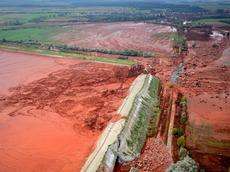
In Hungary, as in many parts of the world, toxic bauxite sludges created during aluminium production are stored in the open air. Prolonged rainfall probably pushed the collection pond to its limits. The dam failure has now caused the biggest environmental catastrophe in Hungary's history.
A collection pond for bauxite sludge, a waste product of aluminium production, burst last Monday in the Hungarian town of Ajka, north of Lake Balaton. Around one million cubic metres of caustic sludge contaminated with toxic heavy metals spread out like a tidal wave over an area of 40 square kilometres. Ten people are thought to have been killed, and 120 injured. The long-term consequences are still unforeseeable. ETH Zurich Professor Gerhard Furrer from the Institute of Biogeochemistry and Pollutant Dynamics gives an initial assessment.
What consequences does the sludge have for the affected areas?
The main reason why the sludge avalanche is so toxic is that it contains caustic soda solution, which is used in aluminium manufacture. It can only be neutralised by diluting it one hundred thousand to one million times with unpolluted water. If we extrapolate that to the estimated million cubic metres of sludge that has leaked out, it is immediately clear that neutralising it is an impossible task. A major part of the sludge will be diluted only slightly in the headwaters of the catastrophe zone – even with large amounts of rain. As a result the caustic sludge is acutely life-threatening for all creatures that come into unprotected contact with it.
What else makes the sludge hazardous?
In the short term, the caustic soda liquor is the most dangerous component. In the long term – after gradual dilution of the caustic liquor – the heavy metals such as chromium, arsenic and vanadium contained in the sludge may become more important. These are initially present as negatively charged soluble compounds. If they are deposited in the affected waterways and flooded regions, their toxic effect can cause a large number of organisms to die.
These metals will ultimately combine with microscopic mineral particles in the course of time. If the sludge dries out, fine dust with caustic properties can still be formed. When blown up in clouds by the wind, it can enter people’s lungs and make them ill.
Does the dust remain hazardous for ever?
The caustic soda solution in the red sludge can combine with carbon dioxide from the air, thus causing the material to carbonate. As a result the majority of the caustic liquor will be neutralised. However, this process can take many months or even years. For this reason, a drying-out process in summer 2011 would have devastating consequences.
Is there any possible way of bringing the catastrophe under control?
The events of the past few days already show that the expression “bring under control” is presumptuous.
What will be the most important measures?
To allow an estimate of the potential hazard of the metals, we must first of all know the actual composition of the sludge. Since there may be large regional variations in composition, samples from various areas of the pond must be analysed. At the same time, the sludge should be collected and treated wherever possible. Firstly, this is very laborious and costly, and, secondly, it is possible only in an ideal terrain. Obstacles such as buildings, rocks or trees as well as small-scale irregularities can make the work more difficult or impossible. However, it is helpful that the colour of the red sludge stands out against the uncontaminated ground.
How must the red sludge be treated and disposed of?
Red sludge from bauxite mining is actually a valuable material. In its untreated state, it can be used to neutralise acidic industrial waste. If it is correctly treated and the caustic soda is removed, the material can be used to produce building materials, for example.
What would be necessary to prevent such environmental catastrophes?
There is an urgent need for a complete global inventory of such tailing ponds, whose toxic contents represent chemical time-bombs that can go off suddenly as a result of dam failures. Following Aznalcóllar near Seville in Spain (1998) and Baia Mare, Romania (2000), this is already the third such catastrophe in Europe alone in the last twelve years. All of them would have been avoidable. It cannot be the task of research alone to protect the world from such catastrophes. Government regulations and supervision are needed here. The company in Hungary is apparently a private firm that was unknown or had no international roots.
During the accident in Spain in 1998, 4 to 5 million cubic metres of toxic sludge entered the environment. The consequences for the ecosystem that was affected were so serious that Spanish scientists adopted this region as a study object to investigate how long the mass extinction at the end of the Cretaceous period (which put an end to the dinosaurs) might have lasted before life recovered again. The mass extinction was probably triggered by the impact of a gigantic meteorite, leaving behind it inhospitable living conditions on earth similar to those of the toxic sludge. The “good” news from the study is that biological activity was already observable again in the Spanish earth within the first ten years. Since there are no mandatory codes of practice for the safety and security of such so-called settling plants as yet, after the catastrophes in Spain and Romania the United Nations Economic Commission for Europe (UNECE) adopted the “Safety guidelines and good practices for tailing management facilities” on 12 August 2008 with the aim of improving the situation. However, even these seem at first sight not to be particularly mandatory.
Provided by ETH Zurich


