Allergies and wheezing illnesses in childhood may be determined in the womb
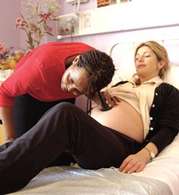
A child's chances of developing allergies or wheezing is related to how he or she grew at vital stages in the womb, according to scientists from the University of Southampton.
The new research, funded by the Medical Research Council (MRC) and the British Lung Foundation, and undertaken at Southampton General Hospital, reveals that fetuses which develop quickly in early pregnancy but falter later in pregnancy are likely to go on to develop allergies and asthma as children. Scientists believe this is due to changes in the development of their immune system and lungs.
A fetus that grows too slowly in the womb is also more likely to become an infant who wheezes with common colds, possibly as a result of narrower airways in its lungs.
Childhood allergies and asthma have become an epidemic in developed countries over the last 50 years. This research shows that in order to combat this, we need to understand more about how babies develop in the womb, comments Keith Godfrey, Professor of Epidemiology and Human Development at the University of Southampton and a consultant in dermatology at Southampton General Hospital.
We already know that a babys growth in the womb has an important influence on susceptibility to obesity and heart disease in later life, but this research provides some of the most direct evidence yet that changes in how the babys immune system and lungs develops before birth can predispose them to some of the commonest childhood illnesses.
For the research, published in the Journal Thorax, University of Southampton scientists at the MRC Epidemiology Unit based at Southampton General Hospital studied more than 1,500 three year-old children who were taking part in the Southampton Womens Survey, the UKs largest study of women and their offspring. The Survey has studied how a womans diet and lifestyle before and during pregnancy affects their babys growth in the womb, and is monitoring how these early life influences determine health and development during childhood.
The team discovered evidence of sensitivity to common allergens (atopy) in 27 per cent of children who had developed quickly in early pregnancy but faltered later in pregnancy, as compared with 4 per cent in those with a slow early growth trajectory and quicker growth in late pregnancy.
Professor Stephen Holgate, from the Medical Research Council, says: Unravelling the complex interplay between immunity and disease, over the course of a persons life, including before they are even born, is a core part of the MRCs research strategy. Furthering our understanding of the bodys natural resilience is critical to developing new advances in the treatment of infectious diseases, autoimmune diseases and allergies.
Ian Jarrold, Research Manager at the British Lung Foundation, says: Childrens lung health can be complex so this research, funded by the British Lung Foundation, is a considerable step forward in understanding why some children are more likely to develop allergies and asthma.
The most commonly reported long-term illnesses in children and babies are conditions of the respiratory system. Increasing our understanding of childhood lung conditions is vital for developing new ways of diagnosing and treating lung diseases earlier in life.
More information: Paper: Patterns of fetal and infant growth are related to atrophy and wheezing disorders at age 3. Katharine Pike, et al. Published in Thorax: DOI: 10.1136/thx.2010.134742
Provided by University of Southampton
-
From lemons to lemonade: Reaction uses carbon dioxide to make carbon-based semiconductor,
27 comments
-
Every black hole contains a new universe: A physicist presents a solution to present-day cosmic mysteries,
208 comments
-
New silicon memory chip developed,
16 comments
-
Computing experts unveil superefficient 'inexact' chip,
45 comments
-
SpaceX private rocket blasts off for space station (Update),
39 comments
-
Classical and Quantum Mechanics via Lie algebras
Apr 15, 2011
- More from Physics Forums - Independent Research
More news stories
New estimates up dementia rates in mid-income countries
(HealthDay) -- Use of 10/66 dementia diagnosis criteria (10/66) results in an increase in the estimated incidence of dementia in middle-income countries, according to a study published online May 23 in The La ...
Medicine & Health / Alzheimer's disease & dementia
18 minutes ago |
not rated yet |
0
Childhood obesity increases likelihood of a cranial disorder that may cause blindness
Children who are overweight or obese -- particularly older, non-Hispanic white girls -- are more likely to have a neurological disorder known as idiopathic intracranial hypertension, a rare condition that can result in blindness, ...
Medicine & Health / Pediatrics
4 hours ago |
not rated yet |
0
The Goldilocks effect: Babies learn from experiences that are 'just right'
Long before babies understand the story of Goldilocks, they have more than mastered the fairy tale heroine's method of decision-making. Infants ignore information that is too simple or too complex, focusing instead on situations ...
Medicine & Health / Psychology & Psychiatry
11 hours ago |
5 / 5 (4) |
1
|
Color-changing contact lenses to help diabetics (w/ Video)
For the millions of Americans with diabetes, the inconvenient and often painful method of testing blood sugar levels is a way of life. But research and innovative product design by scientists at The University of Akron may ...
17 hours ago |
4.2 / 5 (5) |
3
|
Stem-cell-growing surface enables bone repair
University of Michigan researchers have proven that a special surface, free of biological contaminants, allows adult-derived stem cells to thrive and transform into multiple cell types. Their success brings stem cell therapies ...
Medicine & Health / Medical research
13 hours ago |
5 / 5 (7) |
1
|
Yahoo seeks to shake up search, Web browsing
(AP) -- Joining the battle to redefine Internet search, Yahoo is taking aim with a new browser enhancement it calls "Axis."
Forensic sleuth probes fate of royal lovers and lion hearts
The French media like to call him the "Indiana Jones of the graveyards", but perhaps a better tag would be the Sherlock Holmes of forensic science.
Deep sea animals stowaway on submarines and reach new territory
Marine scientists studying life around deep-sea vents have discovered that some hardy species can survive the extreme change in pressure that occurs when a research submersible rises to the surface. The team's ...
Good vibes: Coupling electron spin states and carbon nanotube vibrations
(Phys.org) -- An electron’s spin is separate from its motion, and is suitable for use in both highly-precise magnetic sensing as well as a qubit in quantum computing. Recently, scientists at the University ...
New inexpensive, environmentally friendly solar cell shines with potential
The limitations of conventional and current solar cells include high production cost, low operating efficiency and durability, and many cells rely on toxic and scarce materials. Northwestern University researchers have developed ...