Introducing the A-Train
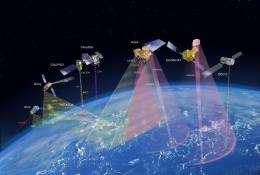
Mention the "A-Train" and most people probably think of the jazz legend Billy Strayhorn or perhaps New York City subway trains — not climate change. However, it turns out that a convoy of "A-Train" satellites has emerged as one of the most powerful tools scientists have for understanding our planet’s changing climate.
The formation of satellites — which currently includes Aqua, CloudSat, Cloud-Aerosol Lidar and Infrared Pathfinder Satellite Observations (CALIPSO) and Aura satellites — barrels across the equator each day at around 1:30 p.m. local time each afternoon, giving the constellation its name; the "A" stands for "afternoon."
Together, these four satellites contain 15 separate scientific instruments that observe the same path of Earth's atmosphere and surface at a broad swath of wavelengths. At the front of the train, Aqua carries instruments that produce measurements of temperature, water vapor, and rainfall. Next in line, CloudSat, a cooperative effort between NASA and the Canadian Space Agency (CSA), and CALIPSO, a joint effort of the French space agency Centre National d’Etudes Spatiales (CNES) and NASA, have high-tech laser and radar instruments that offer three-dimensional views of clouds and airborne particles called aerosols. And the caboose, Aura, has a suite of instruments that produce high-resolution vertical maps of greenhouse gases, among many other atmospheric constituents.
In coming months, the A-Train will expand with the launch of NASA's aerosol-sensing Glory satellite and the carbon-tracking Orbiting Carbon Observatory 2 (OCO-2) satellite. In 2010, the Japan Aerospace Exploration Agency (JAXA) plans to launch the Global Change Observation Mission-Water (GCOM-W1), which will monitor ocean circulation. Meanwhile, a fifth satellite, France’s Polarization and Anistropy of Reflectances for Atmospheric Science coupled with Observations from a Lidar (PARASOL), which studies aerosols, is easing out of an A-Train orbit as its fuel supplies dwindles.
Accidental Origins
This multi-sensor view allows scientists to simultaneously observe changes in key environmental phenomenon – such as clouds or ice sheets – from numerous perspectives. And it helps skirt around engineering obstacles that would have made it impossible to cluster all 15 instruments on one large spacecraft.
But it wasn’t necessarily planned that way. Formation flying is a fairly novel concept, and it came to the fore partly by accident. The concept of an A-Train first emerged when scientists and engineers were hashing out the orbit of Aura, which launched in 2004. At the time, rather than calculating a whole new orbital plan for Aura, flight engineers realized they could simply model its orbit after Aqua, a sister satellite NASA had launched in 2002.
They went forward with that plan, but limitations in data transmissions rates, meant that the two satellites ended up flying much closer to each other than originally planned. In the end, they decided that Aura would fly about 6,300 kilometers – a mere 15 minutes of flight – behind Aqua.
Meanwhile, two additional satellites that study minute airborne particles called aerosols and clouds – the CALIPSO and CloudSat – without realizing it had requested nearly identical orbits near Aura because the scientists involved with these missions wanted to compare their results with the humidity and cloud measurements coming from Aura. In 2006, CloudSat and CALIPSO eased into the train behind Aura just 93 kilometers – about 12.5 seconds – from one another. As a result, CALIPSO’s lidar beam and CloudSat’s radar have coincided at Earth’s surface about ninety percent of the time they have been in orbit.
Reaping the Rewards
The longer the A-Train has existed, the more scientists have begun to appreciate its potential. Indeed, scientists representing all the A-Train satellites are meeting this week in New Orleans to compare notes and to sketch out plans for future cross-satellite collaboration. Leading earth scientists from three national space agencies, including the director of NASA’s Earth Science Division Michael Freilich, Didier Renaut from CNES and Haruhisa Shimoda of JAXA, are giving talks about A-Train science. And scientists from dozens of institutions are presenting research on topics ranging from air quality, to the carbon cycle, to cloud dynamics.
There is a great deal to discuss. Multi-sensor measurements from the A-Train, for example, have proven critical in working out why the summer of 2007 experienced the greatest loss of Arctic sea ice in history. A-Train sensors captured environmental conditions during the loss – which was far greater than climate models had predicted – allowing scientists to go back after the fact to pinpoint its causes. By now, they have proven that some unexpected factors, such as anomalously high winds and an sharp decrease in cloudiness, fueled the rapid loss, in addition to more predictable culprits such as high air temperatures and low humidity.
Likewise, synergistic A-Train measurements have yielded great insight into aerosols – small airborne particles such as dust, sea salt, and soot. Depending on their composition, aerosols can scatter and or absorb the sun’s heat, and can thus both warm and cool the planet. Some types of aerosols also seed clouds, A-Train sensors have helped reveal, and can change cloud behavior. A-Train instruments aboard Aura and Aqua, for example, produced groundbreaking insight about aerosols and ice clouds, making it possible for scientists to prove that polluted ice clouds have smaller particles and are therefore much less likely to produce rain.
Still, pressing questions about our climate remain. What is the overall affect of aerosols and clouds on climate? How much carbon is absorbed by forests? How will the monsoon cycle react to a warming world? To what extent will a changing climate change the size and strength of hurricanes? And what feedback cycles will encourage or discourage climate change? These and many more questions still need answers, and now that the power of formation flying is clear, it is a good bet that A-Train satellites will play a key role in answering them.
More information: To learn more about the A-Train symposium, please visit: a-train-neworleans2010.larc.nasa.gov/
Provided by NASA’s Earth Science News Team


